
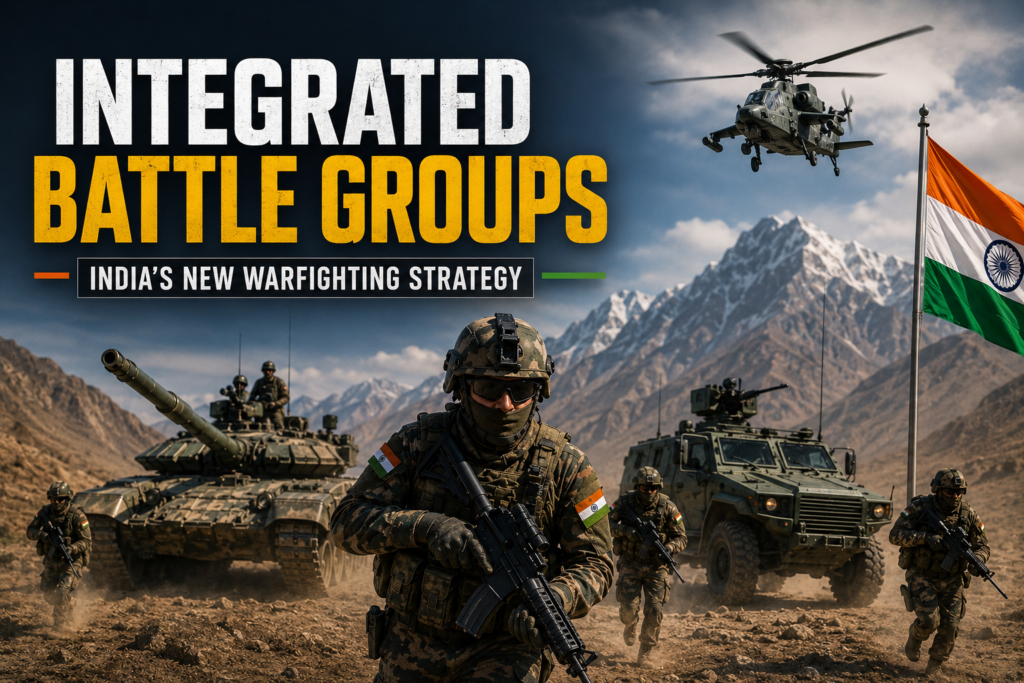
Modern warfare demands speed, flexibility and coordinated operations. Traditional military formations, while effective, often require considerable time to mobilise during emergencies. To address evolving security challenges, the Indian Army is introducing Integrated Battle Groups (IBGs)—self-contained, agile combat formations designed for rapid deployment and decisive action.
The IBG concept represents one of the most significant operational reforms undertaken by the Indian Army in recent decades. It aims to improve combat readiness, enhance joint operations and ensure a faster military response along India’s borders.
What Are Integrated Battle Groups?
Integrated Battle Groups are brigade-sized combat formations that combine multiple arms and services under a single commander.
Unlike traditional formations that depend on support from higher headquarters, an IBG is designed to operate independently with all essential combat and support elements integrated into one unit.
An IBG typically includes:
- Infantry
- Armoured units
- Artillery
- Air defence systems
- Engineers
- Signals units
- Logistics support
- Intelligence, Surveillance and Reconnaissance (ISR) assets
- Drone capabilities
This structure allows commanders to respond rapidly without waiting for additional reinforcements.
Why India Is Introducing IBGs
India faces diverse security challenges along its northern and western borders.
Rapid mobilisation has become increasingly important in modern military operations.
The IBG concept seeks to:
- Reduce mobilisation time
- Improve battlefield coordination
- Enhance operational flexibility
- Increase combat effectiveness
- Strengthen deterrence
These reforms align with the Indian Army’s objective of becoming a technology-driven, future-ready force.
The Indian Army’s transformation complements recent reforms highlighted in ₹52,000 Crore Defence Boost: What It Means for India, aimed at strengthening combat readiness across all three services.
The Ministry of Defence provides official updates on India’s defence reforms, military modernisation and policy initiatives.
Key Advantages of IBGs
Faster Deployment
IBGs can mobilise much more quickly than conventional divisions, enabling faster responses to emerging threats.
Integrated Combat Power
By combining infantry, armour, artillery and support units under one command, IBGs improve operational efficiency.
Greater Flexibility
Different IBGs can be tailored for specific terrains and missions, including deserts, mountains and plains.
Improved Joint Operations
IBGs can work closely with the Indian Air Force and other services during integrated military operations.
Better Border Preparedness
Rapid deployment enhances India’s ability to respond to crises along sensitive border regions.
Role of Technology
Technology forms the backbone of modern Integrated Battle Groups.
Future IBGs are expected to employ:
- Drones
- Artificial Intelligence
- Secure communication networks
- Electronic warfare systems
- Satellite-based surveillance
- Advanced battlefield management systems
These technologies improve situational awareness and decision-making during combat.
Challenges
Despite their advantages, implementing IBGs presents several challenges.
These include:
- Large-scale training requirements
- Command restructuring
- Logistics integration
- Technology adaptation
- Infrastructure development
Successfully overcoming these challenges will require sustained investment and organisational reforms.
The success of Integrated Battle Groups depends on advanced technologies discussed in Electronic Warfare: India’s Invisible Battlefield and Cyber Warfare: India’s Digital Battlefield, which enable secure communications and real-time battlefield awareness.
Strategic Importance
Integrated Battle Groups significantly strengthen India’s military posture.
They improve readiness along the Line of Actual Control (LAC) with China and the Line of Control (LoC) with Pakistan while supporting rapid offensive and defensive operations.
Their flexibility also makes them valuable for humanitarian assistance, disaster relief and counter-terrorism operations when required.
Modern IBGs also rely on intelligence from Military Satellites: How Space Strengthens India’s National Security to monitor troop movements and improve operational planning.
Looking Ahead
The Indian Army continues to refine the IBG concept through field exercises and operational evaluations.
As new technologies become available, future IBGs are expected to become even more network-centric, agile and capable of operating across multiple domains.
Conclusion
Integrated Battle Groups represent a major transformation in India’s military doctrine.
By combining speed, flexibility, advanced technology and integrated combat capabilities, IBGs will enable the Indian Army to respond more effectively to future security challenges.
As warfare evolves, these formations are expected to become a cornerstone of India’s defence preparedness and national security strategy.
Rapid mobilisation of Integrated Battle Groups also depends on strategic infrastructure such as Advanced Landing Grounds: India’s Border Air Power, Mountain Warfare: Geography Still Decides Wars, and the Border Roads Organisation (BRO): India’s Strategic Backbone.