
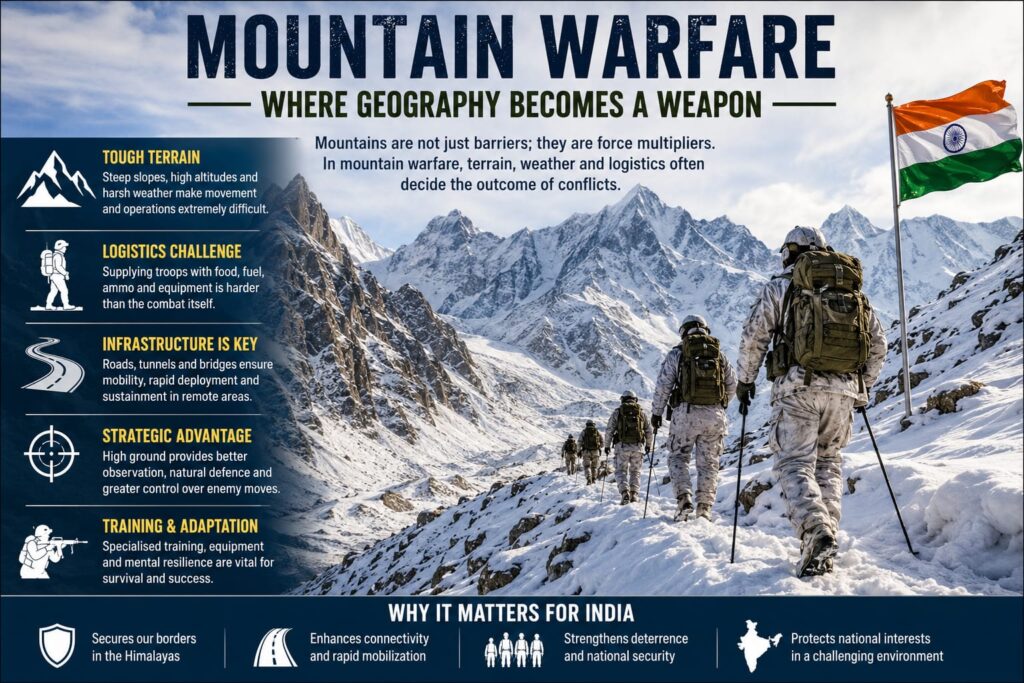
In an age of advanced drones, precision-guided missiles and artificial intelligence, geography continues to play a decisive role in warfare. Nowhere is this more evident than in mountain warfare, where terrain, weather and logistics often determine the outcome of military operations.
Mountain warfare remains one of the most demanding forms of combat. High altitudes, extreme temperatures, difficult terrain and limited infrastructure create unique challenges for military forces. For countries such as India, which shares long mountainous borders with China and Pakistan, mastering mountain warfare is essential for national security.
What Is Mountain Warfare?
Mountain warfare refers to military operations conducted in mountainous terrain.
Unlike conventional battlefields, mountain regions present numerous obstacles:
- Steep slopes
- High altitudes
- Harsh weather conditions
- Limited mobility
- Difficult logistics
Military forces operating in such environments must adapt their tactics, equipment and training to overcome these challenges.
Why Geography Matters
Throughout history, mountains have acted as natural defensive barriers.
Mountain terrain provides several advantages to defenders:
- Observation of enemy movements
- Limited avenues of approach
- Natural obstacles
- Defensive strongpoints
At the same time, attackers face difficulties in moving troops, equipment and supplies through narrow valleys and steep passes.
As a result, geography often becomes a force multiplier.
The Importance of Logistics
Military strategists often argue that logistics win wars.
This principle becomes even more important in mountainous regions.
Armies require:
- Food supplies
- Ammunition
- Fuel
- Medical support
- Winter equipment
Maintaining supply lines in remote mountain areas can be more challenging than combat itself.
Infrastructure such as roads, tunnels, bridges and airfields therefore becomes critical to military success.
India’s Mountain Warfare Experience
India possesses extensive experience in mountain warfare.
The country maintains military deployments across:
- Ladakh
- Siachen Glacier
- Jammu and Kashmir
- Arunachal Pradesh
Indian forces regularly operate at some of the highest altitudes in the world.
This experience has shaped India’s doctrine, training methods and force structure.
Siachen: The World’s Highest Battlefield
The Siachen Glacier represents one of the most extreme examples of mountain warfare.
Located in the eastern Karakoram range, the glacier sits at altitudes exceeding 20,000 feet.
Soldiers stationed there face:
- Extreme cold
- Low oxygen levels
- Avalanches
- Harsh weather
The challenges of survival often exceed the dangers posed by enemy action.
The India-China Border Challenge
The Line of Actual Control (LAC) with China stretches across difficult Himalayan terrain.
Recent tensions have highlighted the importance of:
- Rapid troop mobilisation
- Strategic infrastructure
- Border connectivity
- High-altitude readiness
Both India and China have invested heavily in roads, tunnels and logistics networks to strengthen their positions.
Infrastructure has become a key component of strategic competition.
Infrastructure development has become central to the India-China Border Infrastructure Race.
Technology and Modern Mountain Warfare
Modern technology is transforming operations in mountainous regions.
Important innovations include:
- Surveillance drones
- Satellite imagery
- Precision-guided weapons
- Advanced communications systems
- All-weather logistics platforms
However, technology cannot eliminate the fundamental challenges imposed by geography.
Terrain continues to influence military decision-making.
Infrastructure as a Strategic Asset
Projects such as:
- Atal Tunnel
- Sela Tunnel
- Zojila Tunnel
- Strategic border roads
have significantly improved India’s military mobility.
Infrastructure allows forces to move quickly, sustain operations and respond effectively during crises.
As a result, roads and tunnels have become critical components of national security.
India’s border readiness has improved significantly due to projects undertaken by the Border Roads Organisation (BRO).
Lessons from Global Conflicts
Recent conflicts have demonstrated that geography remains relevant despite technological advances.
Mountainous terrain continues to:
- Slow offensives
- Protect defenders
- Complicate logistics
- Increase operational costs
Military planners must therefore balance technological capabilities with geographic realities.
The Future of Mountain Warfare
Mountain warfare is likely to remain a central component of security planning for countries with difficult terrain.
Future developments may include:
- Greater use of autonomous systems
- Improved logistics technologies
- Enhanced surveillance capabilities
- Better high-altitude equipment
Nevertheless, the importance of geography is unlikely to disappear.
Mountains will continue to shape military operations for decades to come.
Conclusion
Mountain warfare remains one of the most demanding and strategically significant forms of combat. Despite rapid technological advances, geography continues to influence military operations, logistics and strategic planning.
For India, which faces security challenges across some of the world’s highest mountain ranges, maintaining expertise in mountain warfare is essential. Infrastructure development, logistics preparedness and specialised training will remain critical to protecting national interests in the Himalayas.
In modern warfare, technology matters. But geography still decides where and how battles are fought.
More information about high-altitude operations can be found on the official Indian Army website.