
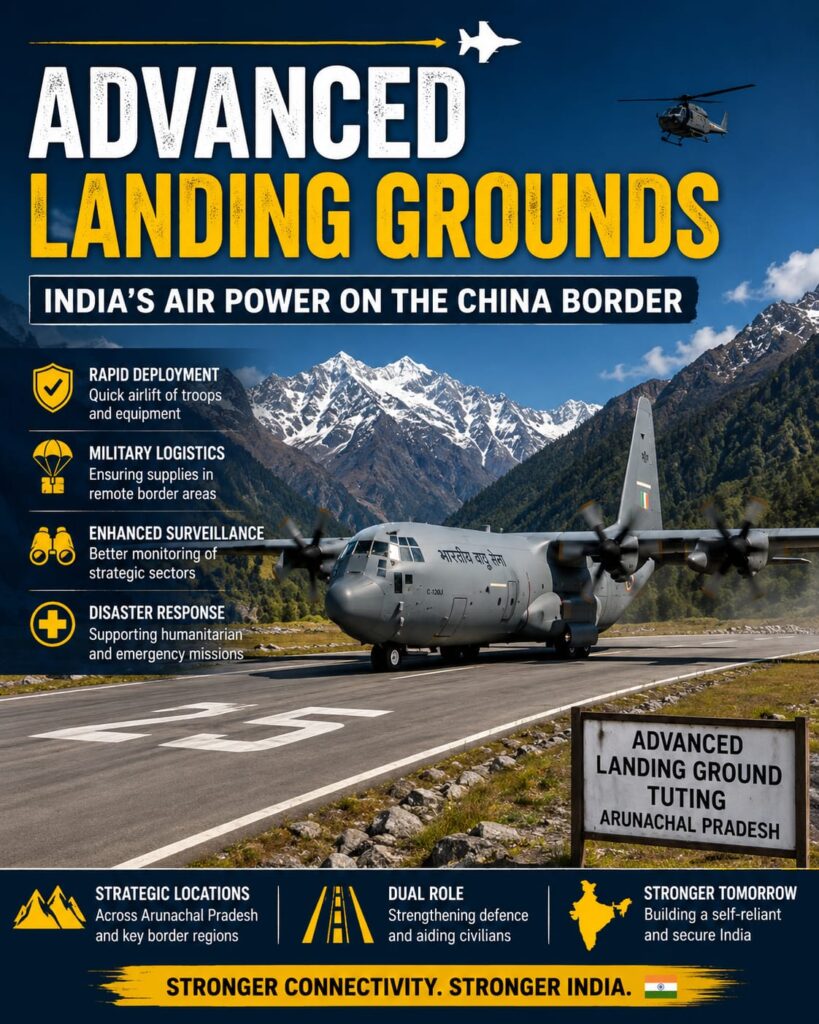
In modern warfare, speed can determine victory. The ability to rapidly deploy troops, equipment and humanitarian assistance to remote border regions has become a critical element of national security.
For India, this challenge is particularly significant along the Himalayan frontier with China. To strengthen its operational readiness, the Indian Air Force has modernised and expanded a network of Advanced Landing Grounds (ALGs) across the Northeast and other strategically important regions.
These airstrips have become vital assets for military logistics, surveillance and rapid response operations.
What Are Advanced Landing Grounds?
Advanced Landing Grounds are military airstrips designed to support aircraft operations in remote and strategically sensitive locations.
Unlike large air bases, ALGs are smaller facilities capable of handling transport aircraft, helicopters and emergency military operations.
They allow armed forces to:
- Deploy troops rapidly
- Deliver military equipment
- Transport supplies
- Conduct medical evacuations
- Support disaster relief missions
Why India Needs ALGs
India shares a 3,400-kilometre Line of Actual Control (LAC) with China.
Much of this frontier passes through rugged mountains where road connectivity remains difficult despite major infrastructure improvements.
ALGs reduce India’s dependence on ground transportation by allowing rapid airlift capability directly into border regions.
Key Advanced Landing Grounds
Mechuka ALG
Located in Arunachal Pradesh, Mechuka ALG plays an important role in supporting military operations near the China border.
Tuting ALG
Tuting provides rapid access to one of the most strategically sensitive sectors along the eastern Himalayas.
Walong ALG
Walong has historical significance dating back to the 1962 Sino-Indian War and remains strategically important today.
Vijaynagar ALG
One of India’s most remote airstrips, Vijaynagar strengthens connectivity to isolated border communities while supporting military logistics.
Pasighat ALG
Pasighat is among the oldest operational airfields in Arunachal Pradesh and serves both civilian and defence requirements.
Strategic Importance
Advanced Landing Grounds significantly improve India’s operational flexibility.
They enable:
- Faster troop mobilisation
- Better surveillance
- Improved logistics
- Rapid reinforcement during crises
- Enhanced disaster response
Consequently, ALGs act as force multipliers for the Indian Armed Forces.
Complementing Border Infrastructure
ALGs work alongside other strategic infrastructure such as:
- Border Roads Organisation (BRO) projects
- Strategic tunnels
- Border highways
- Military bridges
Together, they create an integrated logistics network capable of supporting operations in high-altitude regions.
India’s border infrastructure has expanded rapidly through projects such as the Sela Tunnel and the Border Roads Organisation’s strategic road network.
Humanitarian and Civilian Role
Although primarily designed for defence, ALGs also provide major civilian benefits.
They support:
- Disaster relief
- Medical evacuations
- Emergency supplies
- Connectivity for remote communities
This dual-use capability makes them valuable national assets.
India’s Infrastructure Push
Following recent border tensions, India has accelerated investment in frontier infrastructure.
The expansion of ALGs forms part of a broader strategy that includes:
- New roads
- Bridges
- Tunnels
- Communication networks
- Military logistics hubs
The objective is to ensure rapid deployment capability across the Himalayan frontier.
Future Challenges
Despite significant progress, India still faces challenges.
These include:
- Difficult terrain
- Extreme weather
- High construction costs
- Maintenance in remote regions
- Environmental constraints
Continued investment and technological innovation will be essential to sustain these critical assets.
Conclusion
Advanced Landing Grounds have become a cornerstone of India’s border security strategy.
By enabling rapid air mobility, strengthening logistics and improving operational readiness, they enhance India’s ability to protect its territorial integrity along the China border.
As geopolitical competition in the Himalayas continues, ALGs will remain indispensable for military preparedness, disaster response and national security.
More information about the Indian Air Force’s operational capabilities is available on the official Indian Air Force website.