
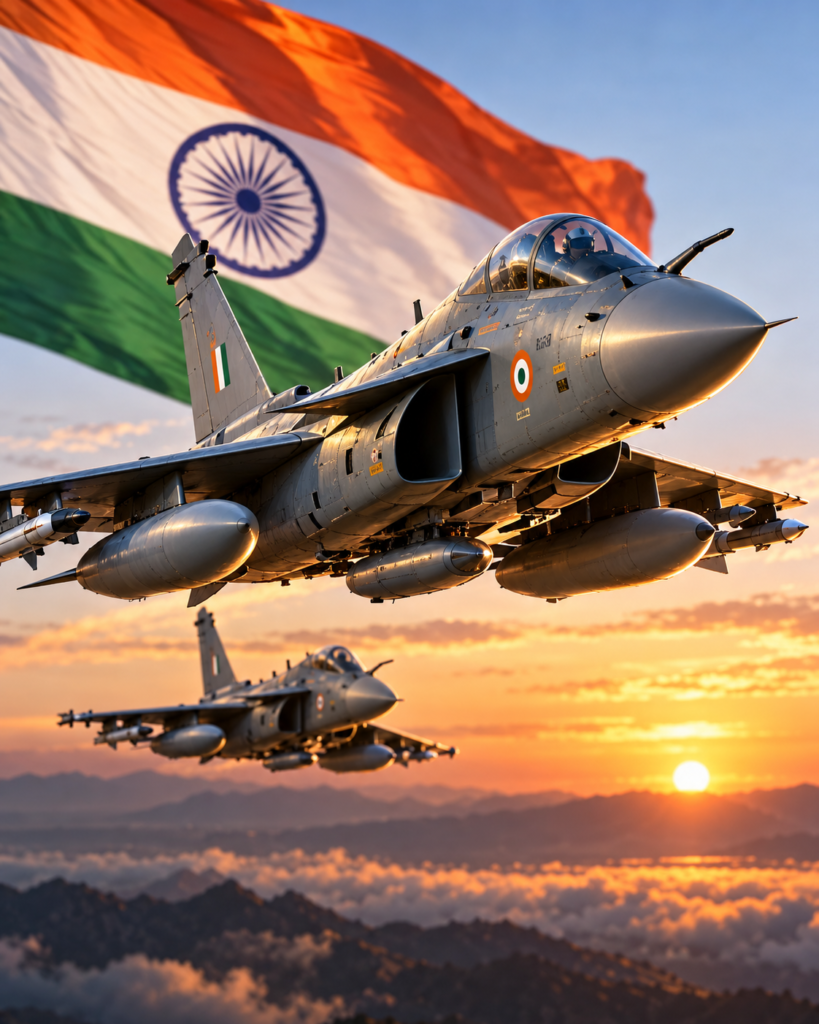
Tejas Mk-1A Is Becoming the Backbone of India’s Indigenous Fighter Push
India’s Tejas Mk-1A is more than another fighter aircraft entering the Indian Air Force.
It represents India’s attempt to build a complete domestic combat-aircraft ecosystem—from design and aerostructures to avionics, electronic warfare, manufacturing and eventually fighter engines.
The programme has faced delays, but the broader industrial effort around Tejas has continued to expand.
The IAF currently wants to induct roughly 36–40 fighters annually in the coming years to rebuild its squadron strength. At the same time, India is preparing for the next stages of its fighter programme through Tejas Mk-2 and the Advanced Medium Combat Aircraft (AMCA).
That makes Tejas Mk-1A an important bridge between India’s current fleet and its future air-power ambitions.
180 Tejas Mk-1A Aircraft Are on Order
The scale of India’s commitment to Tejas is substantial.
The first major Mk-1A contract, signed in 2021, covered 83 aircraft.
In September 2025, the Ministry of Defence signed another contract for 97 additional Mk-1A aircraft, taking the total number of Mk-1A aircraft ordered for the IAF to 180.
This is effectively the foundation of India’s next large indigenous fighter fleet.
The significance extends beyond the number of aircraft.
A 180-aircraft order gives Indian companies an opportunity to develop long-term production experience, supplier relationships and specialised manufacturing capabilities.
That ecosystem will be important for future programmes as well.
India Is Expanding Tejas Production Capacity
India has been investing in the infrastructure needed to manufacture Tejas at a larger scale.
In October 2025, Defence Minister Rajnath Singh inaugurated the third LCA Mk-1A production line at HAL’s Nashik facility and flagged off the first Tejas Mk-1A produced there.
The new line was established with more than 30 major assembly jigs covering components including:
- Centre fuselage
- Front fuselage
- Rear fuselage
- Wings
- Air intake
The expansion is intended to increase production capacity and support faster aircraft deliveries.
HAL has also described the Nashik facility as part of its broader effort to expand advanced aircraft manufacturing.
This matters because India’s future fighter requirements will demand sustained production, not one-off manufacturing
This expansion also fits into India’s wider effort to create Defence Industrial Corridors and build geographically concentrated defence-manufacturing ecosystems.
The Tejas Ecosystem Goes Beyond HAL
One of the most important aspects of the programme is the industrial network behind the aircraft.
Tejas involves HAL, the Aeronautical Development Agency, DRDO, the IAF and a large network of Indian suppliers.
The government’s second Mk-1A contract is designed to involve a substantial domestic industrial base, while the expansion of HAL’s production infrastructure has also created opportunities for private-sector suppliers.
At Nashik alone, the government said the new production activity had already helped develop more than 40 industry partners and created around 1,000 jobs around the facility.
This is strategically important.
A successful fighter programme creates expertise that can later be transferred to:
Tejas Mk-2 → AMCA → future unmanned combat aircraft → exports
The Final Mile: Completing Mk-1A Induction
The Mk-1A programme has nevertheless experienced delays.
The IAF’s first deliveries were originally expected earlier, but engine availability and subsequent integration and testing issues pushed the timeline back.
However, the current situation is moving toward induction.
In September 2026, the IAF said engines had been installed on Mk-1A aircraft and that thorough testing was underway before formal induction. The IAF Vice Chief said only a small number of technical points remained at that stage.
By early October, officials said most integration work had been completed, with two or three radar-related issues still being worked on.
The EL/M-2052 AESA radar must work seamlessly with the aircraft’s weapon-firing controls and Angad electronic-warfare suite before final certification.
This is therefore better understood as a final integration and certification phase, rather than a collapse of the programme.
Engine Supply Has Been a Major Lesson
The Tejas programme has also highlighted the importance of propulsion supply chains.
The Mk-1A uses the GE F404-IN20 engine.
Earlier delays in engine deliveries affected aircraft production schedules. By September, HAL had received 10 engines from GE, while additional deliveries were expected.
The lesson extends beyond Tejas.
A fighter programme requires reliable access to every critical component.
Even if the airframe is ready, production can slow if an engine, radar, electronic-warfare system or other major subsystem is unavailable.
This is one reason India increasingly wants greater control over critical defence technologies.
Why Indigenous Fighter Production Matters
India operates a large and diverse fighter fleet, but several legacy platforms are gradually reaching the later stages of their service lives.
The IAF has consequently emphasised the need for new aircraft.
Air Chief Marshal A.P. Singh recently said the IAF needs around 36–40 fighters annually in the coming years to stop the decline in squadron numbers and eventually move toward the authorised strength.
That requirement makes domestic production capacity strategically important.
India cannot depend indefinitely on importing every fighter it needs.
A stronger indigenous manufacturing base offers greater control over:
- Production
- Upgrades
- Maintenance
- Spare parts
- Technology
- Operational availability
- Future modifications
It can also reduce the vulnerability created by external supply disruptions.
Tejas Is Building Experience for Tejas Mk-2
The Mk-1A is not intended to be the end of India’s fighter journey.
The next major step is Tejas Mk-2, a larger and more capable medium-weight fighter designed to provide the IAF with greater range, payload and performance.
The experience accumulated through Mk-1A will be valuable for Mk-2.
That includes experience in:
- Digital flight-control systems
- Composite structures
- AESA radar integration
- Electronic warfare
- Mission computers
- Weapon integration
- Aircraft testing
- Production engineering
- Supply-chain management
In other words, every successful Tejas production cycle helps India build the knowledge required for the next aircraft.
AMCA Is the Long-Term Goal
Beyond Tejas Mk-2 lies India’s most ambitious combat-aircraft programme: AMCA.
The Advanced Medium Combat Aircraft is intended to provide India with an indigenous fifth-generation fighter capability.
But AMCA is not simply another aircraft programme.
It represents India’s attempt to master technologies associated with advanced combat aviation, including:
- Low observability
- Advanced sensors
- Sensor fusion
- Electronic warfare
- Networked warfare
- High-performance propulsion
- Internal weapons carriage
- Advanced mission systems
The development of Tejas therefore has significance beyond the Mk-1A itself.
It is helping create the industrial and technological foundation needed for more advanced aircraft.
India Still Needs a Domestic Fighter Engine
One of the biggest remaining challenges is propulsion.
India has made significant progress in designing and manufacturing fighter airframes, but a fully indigenous high-performance fighter engine remains a major strategic objective.
The IAF chief has emphasised the need for India to develop a fighter engine domestically.
An indigenous engine would give India greater freedom in future aircraft development.
It could also reduce dependence on foreign suppliers for one of the most critical components of a fighter.
This makes propulsion one of the most important long-term areas for India’s aerospace industry.
India’s broader indigenous defence-engine push is therefore becoming an important part of its long-term effort to reduce dependence on foreign propulsion technology.
MRFA Can Complement the Indigenous Fighter Programme
India’s indigenous fighter push does not mean the IAF will stop acquiring foreign aircraft.
The IAF is also pursuing the 114-aircraft Multi-Role Fighter Aircraft (MRFA) programme.
The IAF chief recently said the government is looking at finalising the programme within the current financial year if negotiations proceed as planned.
This could provide additional fighter capacity while Tejas Mk-2 and AMCA mature.
The two approaches can therefore complement each other.
Imported fighters can address near- and medium-term requirements.
Indigenous fighters can provide long-term technological and industrial sovereignty.
Rafale Could Add Another Indian Fighter Production Line
The development of India’s fighter ecosystem is also increasingly connected to foreign partnerships.
The Defence Secretary said in September that the planned Rafale procurement could help establish a second fighter production line in India, while the indigenous Tejas Mk-1A programme would continue.
If implemented, this could have an important industrial effect.
India would not simply receive additional aircraft.
It could gain more experience in:
- Advanced aircraft manufacturing
- Supply-chain development
- Quality control
- Production engineering
- Maintenance and overhaul
- Technology absorption
That could strengthen India’s broader aerospace manufacturing base.
From Tejas to a Larger Fighter Ecosystem
India’s objective should ultimately be bigger than producing one successful fighter.
The country needs an ecosystem capable of continuously producing advanced combat aircraft.
That ecosystem would include:
Design agencies
↓
HAL and private manufacturers
↓
Engine and avionics suppliers
↓
Radar and electronic-warfare companies
↓
Weapons manufacturers
↓
Testing and certification infrastructure
↓
Maintenance and upgrade facilities
↓
Exports
This is how a fighter programme can evolve into an aerospace industry.
Future Indian fighters will also increasingly depend on artificial intelligence in modern warfare, particularly for sensor fusion, decision support and autonomous mission functions.
The Export Opportunity
A mature indigenous fighter programme could eventually create opportunities in overseas markets.
India already has growing defence-export ambitions, and an operational fighter with an established production and support ecosystem could become an important future export product.
Tejas has already generated international interest over the years, but sustained exports would require competitive pricing, reliable production, financing, training, maintenance and long-term support.
That means improving production consistency is important not only for the IAF but also for India’s future defence-export ambitions.
Why the Mk-1A Matters Beyond 180 Aircraft
The 180-aircraft order is important, but its greatest value may be what comes after it.
A successful Mk-1A production programme can establish:
- Higher manufacturing efficiency
- More domestic suppliers
- Better quality-control processes
- Faster aircraft assembly
- Larger skilled workforce
- Greater private-sector participation
- More mature aerospace tooling
- Better maintenance infrastructure
Those capabilities can then be transferred to future aircraft.
That is how India can gradually move from building an aircraft to building a fighter industry.
The Bigger Picture: India’s Air Power Transformation
Tejas Mk-1A is arriving at an important moment for Indian air power.
The IAF needs more fighters.
India is expanding production infrastructure.
Tejas Mk-2 is progressing toward the next generation.
AMCA represents the fifth-generation ambition.
MRFA can provide additional capacity.
And India is seeking greater control over critical aerospace technologies.
The immediate Mk-1A induction timeline remains important, but the larger story is the construction of an Indian combat-aircraft ecosystem.
Conclusion
The Tejas Mk-1A programme represents one of India’s most important defence-industrial efforts.
The aircraft itself is significant, but the ecosystem being created around it is even more important.
India is expanding production lines, developing domestic suppliers, strengthening aerospace manufacturing and preparing for increasingly advanced fighters.
The current Mk-1A programme has experienced delays, particularly around engines and final systems integration. But the aircraft programme continues to move toward induction, while production infrastructure is expanding.
The next challenge is scale.
India needs to turn Tejas into a sustainable production system, use that experience to accelerate Tejas Mk-2, and build the technological foundation for AMCA.
If that happens, Tejas Mk-1A will ultimately be remembered for more than the number of aircraft it delivered.
It could become the foundation on which India built a modern indigenous fighter industry.