
India’s Maritime Surveillance Is Entering a New Phase
India is moving to strengthen its maritime surveillance architecture as the security environment across the Indian Ocean and wider maritime domain becomes more complex.
The issue received fresh attention during the Indian Navy’s Naval Commanders’ Conference 2026, held in New Delhi from September 29 to October 1.
At the conference, Defence Minister Rajnath Singh called for a significant upgrade of India’s maritime surveillance architecture, pointing to the growing volume and complexity of maritime traffic and the need for stronger analytical capabilities.
The conference also focused on technology absorption, artificial intelligence, autonomous and uncrewed systems, data sharing and greater integration between the armed services.
This points toward an important shift: maritime security is increasingly becoming a data and information problem as much as a naval-power problem.
Why Maritime Surveillance Matters to India
India sits at the centre of the Indian Ocean’s major shipping routes.
Energy imports, commercial shipping, military movements and critical supply chains all depend on secure maritime routes.
According to the Ministry of Defence, approximately 85–90% of India’s crude oil and around 50% of its natural gas imports arrive through maritime routes. That makes the security of sea lanes directly relevant to India’s economy, energy supplies and defence preparedness.
The importance of maritime surveillance therefore extends well beyond detecting warships.
A modern surveillance network needs to help identify:
- Merchant vessels
- Naval ships
- Submarines
- Unmanned systems
- Suspicious vessels
- Illegal maritime activity
- Potential threats around critical sea lanes
- Changes in maritime traffic patterns
The challenge is not simply collecting information.
It is turning enormous quantities of information into usable intelligence quickly.
The Navy Wants More Than Traditional Surveillance
Traditional maritime surveillance relied heavily on individual platforms such as ships, aircraft and coastal radar stations.
Modern maritime security is becoming much more distributed.
The Indian Navy’s Commanders’ Conference specifically highlighted the need for seamless data sharing, technology transformation, resilience and greater jointness.
That suggests a future architecture in which information from multiple sources can be brought together.
These could include:
- Coastal radar networks
- Maritime patrol aircraft
- Naval helicopters
- Satellites
- Unmanned aerial systems
- Shipborne sensors
- Automatic Identification System data
- Electronic intelligence
- Underwater sensors
- Commercial maritime information
The value comes from combining the data, rather than relying on one sensor.
AI Could Change Maritime Domain Awareness
The sheer scale of maritime traffic creates a major analytical challenge.
Thousands of commercial vessels operate across the Indian Ocean and adjoining seas. A surveillance system therefore needs to distinguish routine activity from behaviour that deserves further examination.
AI and big-data analytics can potentially help operators:
- Detect unusual vessel movements
- Correlate information from multiple sensors
- Identify patterns over time
- Prioritise potential threats
- Reduce the workload on human operators
- Improve the speed of maritime decision-making
The Navy’s 2026 Commanders’ Conference specifically included AI and Big Data Analysis among the technologies being considered for induction.
Importantly, AI does not replace human decision-making.
Its major value is potentially allowing personnel to process far more information than would be practical through manual analysis alone.
This connects directly with the wider role of artificial intelligence in modern warfare, where AI is increasingly being applied to surveillance, intelligence analysis and military decision support.
Autonomous and Uncrewed Systems Are Becoming Part of the Network
Another major development is the growing role of autonomous and uncrewed platforms.
The Ministry of Defence identified autonomous and uncrewed systems as an important area of technology absorption during the Naval Commanders’ Conference.
Uncrewed platforms could provide additional surveillance coverage without putting personnel directly into every observation mission.
Depending on the platform, they can potentially perform:
- Persistent observation
- Coastal monitoring
- Reconnaissance
- Communications relay
- Surface surveillance
- Intelligence collection
- Search and rescue support
The larger strategic importance lies in networking these systems with conventional naval platforms.
A drone operating independently provides information.
A drone connected to a wider maritime surveillance architecture can become another sensor in a much larger system.
The Ministry of Defence announced in August 2026 that it signed a ₹1,943 crore, 30-month lease for two MQ-9B Sea Guardian HALE RPAS for the Indian Navy, specifically citing enhanced Maritime Domain Awareness and persistent ISR coverage.
India’s Maritime Surveillance and Energy Security
The importance of surveillance becomes especially visible during a maritime crisis.
The Indian Navy has been involved in Operation Urja Suraksha, including efforts to facilitate the safe movement of Indian-flagged merchant vessels, particularly LPG tankers, through the Strait of Hormuz during the West Asia crisis.
Such missions demonstrate that maritime security is not limited to conventional naval warfare.
A disruption to shipping can affect:
- Energy supplies
- Insurance costs
- Freight movement
- Industrial production
- Food and commodity supply chains
- National economic activity
Consequently, maritime surveillance has an economic-security dimension alongside its military role.
The Indian Ocean Is Becoming More Data-Driven
India’s maritime responsibilities increasingly extend beyond its immediate coastline.
The Ministry of Defence said Indian warships are operating in areas including the South China Sea, Mediterranean and Atlantic, reflecting the Navy’s wider operational reach.
As the geographical area of operations expands, maintaining National Maritime Domain Awareness becomes more demanding.
India’s broader Indo-Pacific maritime partnerships are also becoming increasingly important to this effort, including cooperation with Indonesia on maritime domain awareness and sea-lane security.
A ship deployed hundreds or thousands of kilometres from India cannot depend solely on its own sensors.
It needs access to information from a broader network.
That makes information sharing and interoperability increasingly important.
The recent Naval Commanders’ Conference placed particular emphasis on jointness, data sharing and integration among the armed services.
Maritime Surveillance Is Also About Grey-Zone Activity
Modern maritime competition does not always involve conventional military confrontation.
The Defence Ministry highlighted congestion, deception and grey-zone activities as factors making the maritime environment more complicated.
This creates a requirement for surveillance systems that can identify activity that may not immediately appear to be conventional military operations.
Examples could include:
- Unusual shipping patterns
- AIS anomalies
- Unidentified vessels
- Maritime infrastructure activity
- Persistent surveillance by unmanned platforms
- Coordinated movements involving multiple vessels
The objective is not necessarily to treat every unusual activity as hostile.
Rather, better surveillance gives authorities more information with which to assess what is happening.
Indigenous Technology Will Be Critical
Surveillance architecture is not only about buying sensors.
The same principle applies to the wider defence ecosystem, where India is expanding domestic manufacturing capabilities through Defence Industrial Corridors.
India will also need domestic capabilities in:
- Radar
- Communications
- Satellites
- Artificial intelligence
- Data fusion
- Cybersecurity
- Electronic warfare
- Unmanned systems
- Command-and-control software
- Secure networks
The Navy’s Commanders’ Conference placed considerable emphasis on technology absorption and indigenisation.
This fits into India’s broader defence-industrial strategy, where domestic development is increasingly being connected with operational requirements.
The Navy has also reported that recently commissioned warships contain more than 75% indigenous content, according to the Defence Ministry.
India’s Naval Expansion Adds More Sensors and Platforms
The surveillance push is occurring alongside naval fleet expansion.
The Defence Ministry stated that 18 warships are planned for induction or commissioning during 2026, describing this as the largest single-year force accretion in the Navy’s history.
More ships mean more potential surveillance platforms.
But the strategic value of those platforms increasingly depends on how effectively their sensors and communications systems connect with the wider network.
A modern fleet is therefore not simply a collection of ships.
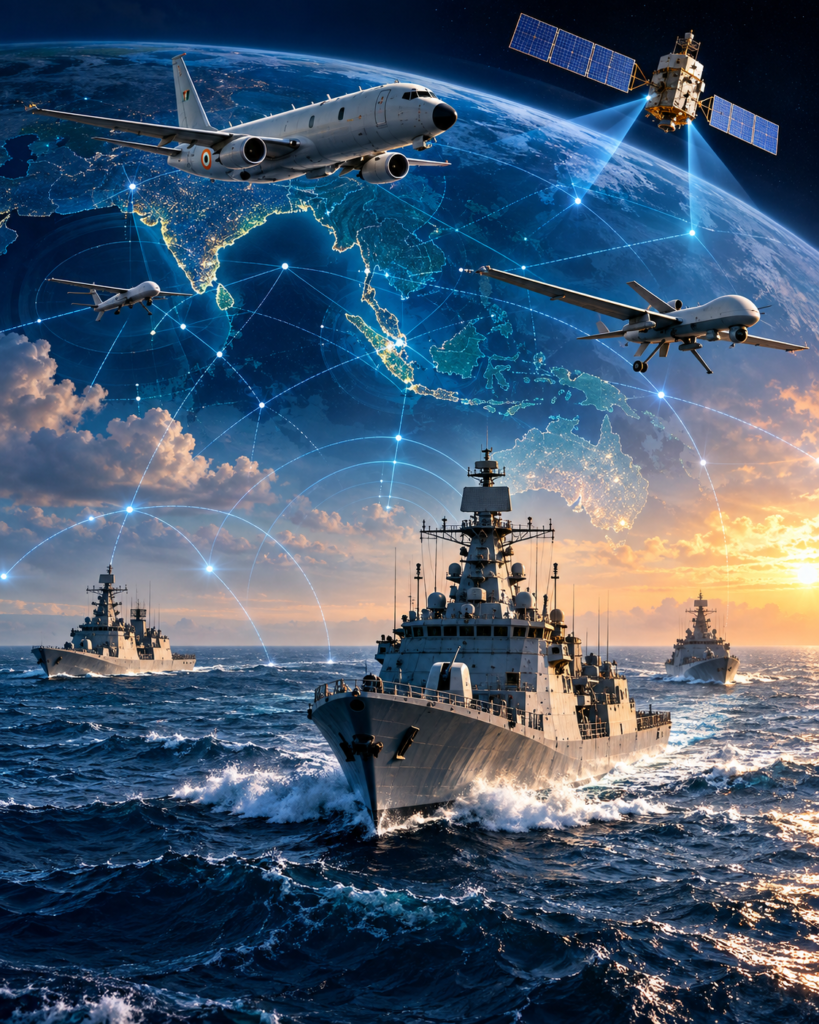
It is increasingly a network of interconnected sensors, weapons, aircraft, unmanned systems and command centres.
The Next Step: From Maritime Awareness to Maritime Intelligence
There is an important distinction between maritime domain awareness and maritime intelligence.
Awareness means knowing what is happening.
Intelligence involves combining information, understanding patterns and producing assessments that support decisions.
This is where India’s planned upgrade in analytical capabilities becomes particularly important.
The Defence Minister’s call for stronger maritime surveillance was accompanied by an emphasis on the growing complexity of maritime traffic.
The future system will therefore likely depend not simply on collecting more data, but on filtering, correlating and interpreting it more effectively.
India’s Indian Ocean Strategy Is Becoming More Networked
India’s position in the Indian Ocean gives it a strong geographic interest in maritime security.
But geography alone does not provide persistent awareness.
The combination of:
Satellites + ships + aircraft + coastal sensors + unmanned systems + AI + secure communications
can provide a much broader picture of activity at sea.
These capabilities increasingly depend on technologies such as electronic warfare, which can support the detection, protection and analysis of electromagnetic activity across the maritime battlespace.
The Naval Commanders’ Conference shows that these technologies are increasingly being considered together rather than as isolated programmes. The conference’s final review highlighted AI, autonomous and uncrewed systems, technology absorption, resilience and greater integration.
What Comes Next?
India’s maritime surveillance architecture is likely to evolve toward greater integration.
The major areas to watch are:
- AI-assisted maritime analytics
- Uncrewed aerial and surface surveillance
- Greater sensor fusion
- Satellite-enabled maritime awareness
- Secure data-sharing networks
- Underwater surveillance
- Electronic intelligence
- Integration between Navy, Coast Guard and other agencies
- Indigenous maritime technology
- Faster conversion of surveillance data into operational decisions
The challenge will be integrating these different technologies into a reliable system rather than developing them as disconnected capabilities.
Conclusion
India’s maritime surveillance push reflects a broader change in how naval power is being built.
The Indian Navy is operating in an environment where the number of vessels, the geographical area of operations and the complexity of maritime threats are all increasing.
The government’s latest focus on upgrading maritime surveillance, improving analytical capabilities and accelerating the adoption of AI, autonomous systems and data-driven technologies indicates that information superiority is becoming an increasingly important component of India’s maritime security architecture.
For India, the objective is not simply to see farther.
It is to understand the maritime environment faster, connect information across platforms and respond more effectively when the situation demands it.
That could become one of the defining elements of India’s evolving Indian Ocean security architecture.