
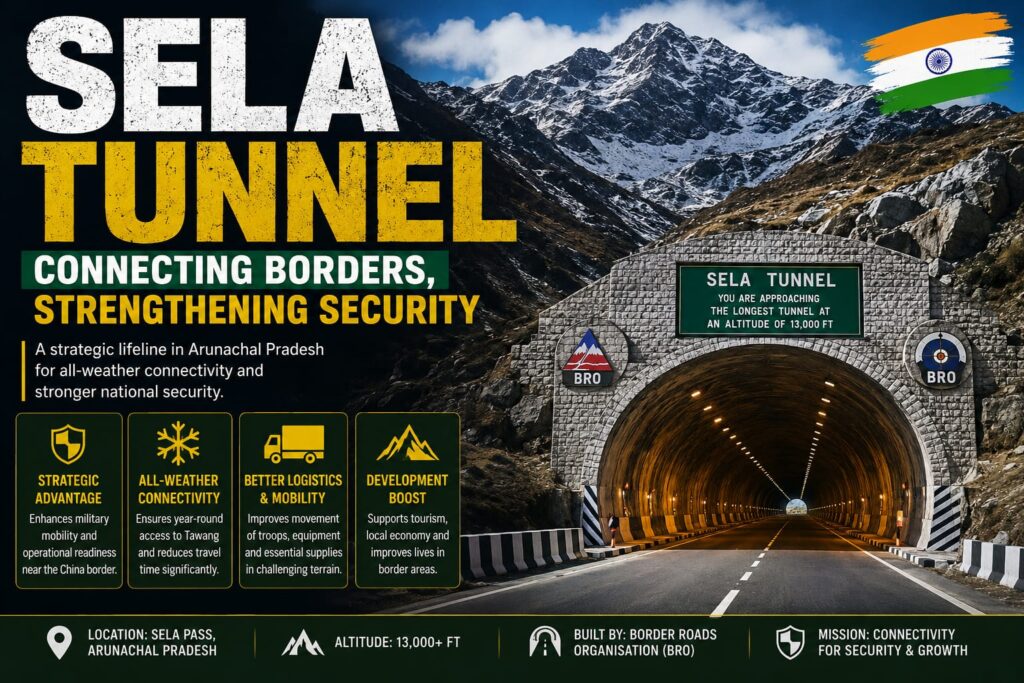
Infrastructure has become a critical component of national security in the 21st century. Roads, bridges and tunnels are no longer just development projects; they are strategic assets that improve mobility, logistics and military preparedness.
Among India’s most important infrastructure projects is the Sela Tunnel in Arunachal Pradesh. Built in one of the country’s most challenging terrains, the tunnel has significantly improved connectivity to India’s northeastern frontier and strengthened the nation’s ability to respond to security challenges along the border with China.
What Is the Sela Tunnel?
The Sela Tunnel is a strategically important road tunnel located in Arunachal Pradesh.
Constructed by the Border Roads Organisation (BRO), the tunnel passes beneath the Sela Pass, a high-altitude mountain pass situated at over 13,000 feet above sea level.
The project consists of:
- A main tunnel
- An escape tunnel
- Approach roads and supporting infrastructure
The tunnel provides all-weather connectivity to the Tawang region.
Why Is the Sela Tunnel Important?
The Sela Pass often experiences heavy snowfall during winter, disrupting transportation and military movement.
The tunnel solves this problem by:
- Providing year-round connectivity
- Reducing travel time
- Improving logistics
- Enhancing military mobility
As a result, the region remains accessible even during harsh weather conditions.
Strategic Importance for National Security
Arunachal Pradesh shares a long border with China.
Following the 1962 Sino-Indian War and recent border tensions, India has accelerated infrastructure development in frontier regions.
The Sela Tunnel improves India’s ability to:
- Deploy troops rapidly
- Transport equipment efficiently
- Maintain supply lines
- Respond quickly during emergencies
Therefore, the tunnel is a major force multiplier for India’s defence preparedness.
Strengthening Connectivity to Tawang
Tawang is one of the most strategically important regions in Arunachal Pradesh.
The area holds military, cultural and geopolitical significance.
Improved connectivity through the Sela Tunnel benefits:
- Local communities
- Tourism
- Trade
- Security forces
Moreover, better infrastructure contributes to economic development in remote border areas.
The importance of strategic connectivity is also discussed in our article on Border Roads Organisation (BRO): India’s Strategic Backbone.
The Role of the Border Roads Organisation
The Border Roads Organisation has played a vital role in improving India’s frontier infrastructure.
Over the years, BRO has built:
- Strategic roads
- Bridges
- Airfields
- Tunnels
Projects such as the Atal Tunnel and Sela Tunnel demonstrate India’s growing focus on infrastructure-led security.
Infrastructure and Modern Warfare
Modern military operations depend heavily on mobility and logistics.
Even the most advanced military equipment becomes less effective without reliable transportation networks.
Consequently, tunnels, roads and bridges have become essential components of national defence planning.
The Sela Tunnel is a clear example of how infrastructure contributes directly to military readiness.
Infrastructure development remains central to the India-China Border Infrastructure Race.
Economic and Regional Benefits
Beyond national security, the tunnel provides important civilian benefits.
These include:
- Faster transportation
- Reduced travel disruptions
- Increased tourism
- Better access to healthcare and education
Thus, the project supports both development and security objectives.
The tunnel also supports India’s preparedness discussed in Mountain Warfare: Geography Still Decides Wars.
Looking Ahead
India continues to invest heavily in border infrastructure.
Future projects are expected to further strengthen connectivity across the Himalayas.
Furthermore, improved infrastructure will play a critical role in supporting economic growth and strategic stability in border regions.
Conclusion
The Sela Tunnel represents far more than an engineering achievement. It is a strategic asset that strengthens India’s connectivity, enhances military preparedness and supports regional development.
As India modernises its border infrastructure, projects such as the Sela Tunnel will continue to play a crucial role in safeguarding national interests and improving the lives of people living in frontier regions.
In the modern era, infrastructure and security are closely linked, and the Sela Tunnel stands as a powerful example of this reality.