
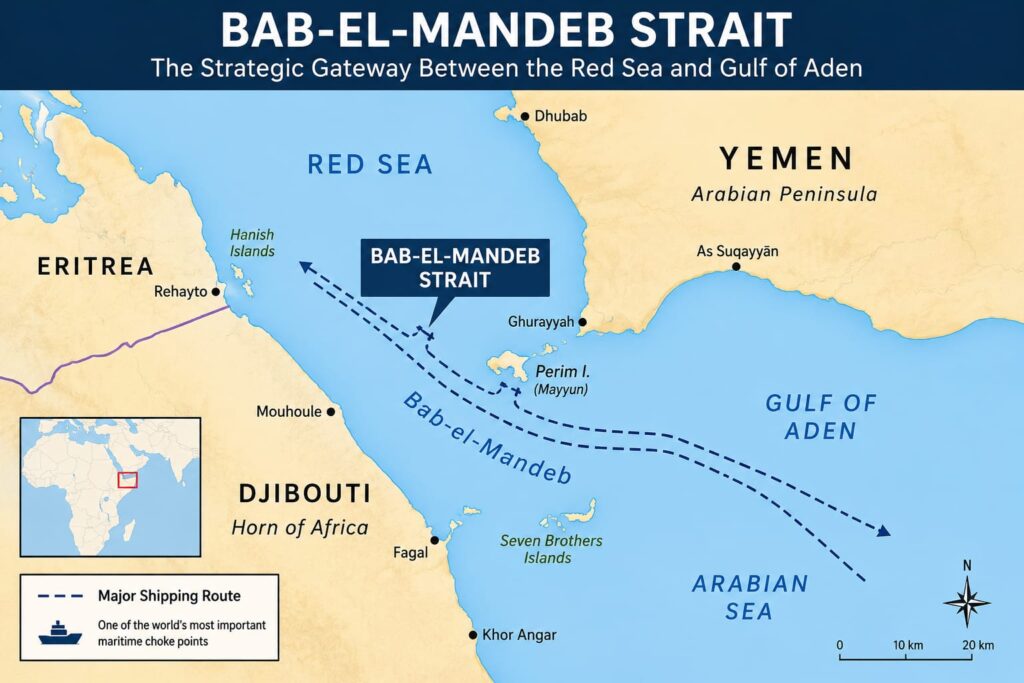
The Bab-el-Mandeb Strait is one of the most strategically important maritime chokepoints in the world. Located between Yemen on the Arabian Peninsula and Djibouti and Eritrea in Africa, it connects the Red Sea to the Gulf of Aden and the Arabian Sea.
Although geographically distant from India, the strait plays a critical role in India’s trade, energy security and maritime strategy. Any disruption in this narrow passage can affect global shipping routes and have significant economic consequences.
What Is the Bab-el-Mandeb Strait?
The Bab-el-Mandeb Strait is a narrow waterway that serves as the southern gateway to the Red Sea.
It connects:
- The Red Sea
- The Gulf of Aden
- The Arabian Sea
- The Indian Ocean
Because of this location, it is a vital link between Europe, Asia and the Middle East.
Why the Bab-el-Mandeb Strait Matters
A large volume of global maritime trade passes through this route every year.
The strait is particularly important because it provides access to:
- The Suez Canal
- European markets
- Middle Eastern energy routes
- Asian manufacturing hubs
Without this passage, ships would be forced to take significantly longer routes around Africa.
Why It Matters for India
- Trade Connectivity
India’s trade with Europe depends heavily on maritime routes passing through the Red Sea and Bab-el-Mandeb Strait.
Many Indian exports and imports travel through this corridor before reaching European markets.
- Energy Security
A portion of global energy shipments passes through the strait.
Any disruption can influence:
- Oil prices
- Shipping costs
- Supply chains
This directly affects India’s economy.
- Maritime Strategy
India has increasingly focused on securing sea lanes of communication across the Indian Ocean region.
The Bab-el-Mandeb Strait forms an important part of this wider maritime network.
Security Challenges
The region faces several security concerns:
- Piracy
- Regional conflicts
- Terrorist threats
- Geopolitical instability
These challenges make the strait one of the most closely monitored maritime passages in the world.
Connection to the Red Sea Crisis
Recent tensions in and around the Red Sea have highlighted the importance of the Bab-el-Mandeb Strait.
Disruptions in shipping have demonstrated how events in a narrow waterway can affect global trade and supply chains.
For India, such developments reinforce the importance of maritime security and diversified trade routes.
India’s Strategic Response
India has adopted several measures to protect its interests:
- Strengthening naval capabilities
- Expanding maritime surveillance
- Enhancing cooperation with friendly nations
- Protecting sea lines of communication
These efforts aim to ensure uninterrupted access to critical trade routes.
Relationship with Other Global Chokepoints
The Bab-el-Mandeb Strait is part of a larger network of strategic chokepoints that shape global commerce.
Other important chokepoints include:
- Strait of Malacca
- Strait of Hormuz
- Suez Canal
Together, these routes form the backbone of global maritime trade.
Strategic Conclusion
The Bab-el-Mandeb Strait may appear to be a distant waterway, but its impact on India is significant. From trade and energy security to maritime strategy, this narrow passage influences major aspects of India’s national interests.
As global competition and geopolitical tensions increase, understanding critical chokepoints such as Bab-el-Mandeb becomes increasingly important for policymakers, businesses and citizens alike.