
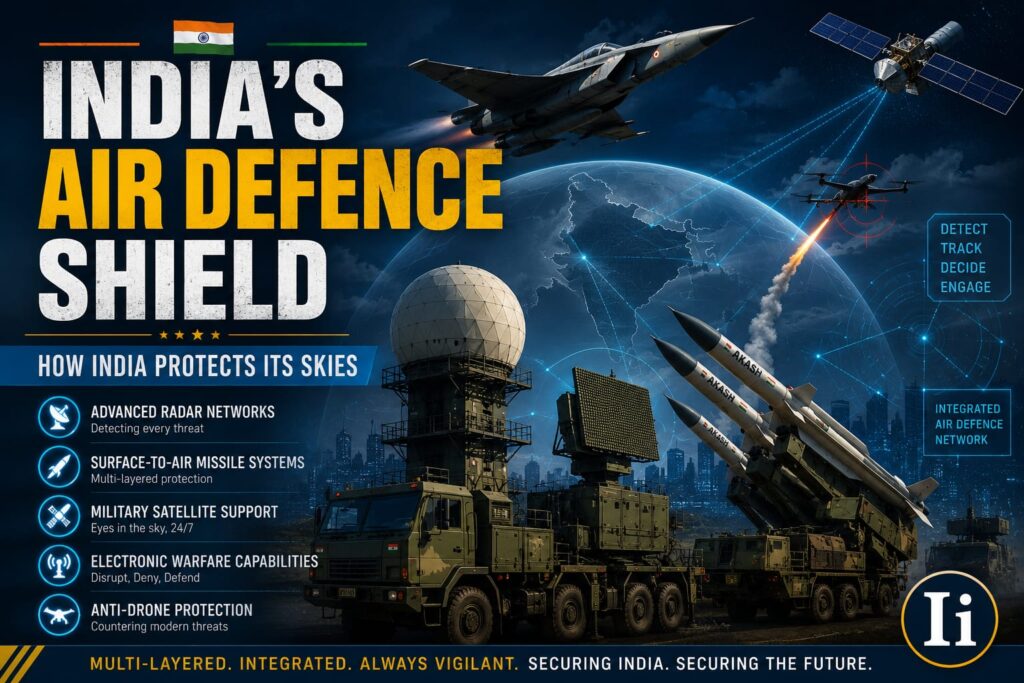
Modern warfare is increasingly dominated by threats from the air. Fighter aircraft, drones, cruise missiles and ballistic missiles can strike targets with little warning. To defend against these threats, nations invest heavily in sophisticated air defence systems.
For India, air defence is a critical pillar of national security. Surrounded by a complex strategic environment and facing rapidly evolving threats, India has developed a layered air defence network designed to protect its airspace, military assets and population centres.
What Is Air Defence?
Air defence refers to the systems and capabilities used to detect, track and neutralize aerial threats before they can reach their targets.
A modern air defence network includes:
- Early warning radars
- Surveillance systems
- Command and control centres
- Surface-to-air missile systems
- Fighter aircraft
- Electronic warfare assets
Together, these components create a protective shield against hostile aircraft and missiles.
Why Air Defence Matters for India
India must secure:
- Major cities
- Strategic military bases
- Critical infrastructure
- Nuclear facilities
- Industrial and economic centres
A strong air defence system acts as both a defensive shield and a deterrent against potential adversaries.
The Layered Defence Concept
Modern air defence works through multiple layers designed to engage threats at different ranges.
Long-Range Air Defence
Long-range systems are designed to detect and intercept threats far from their targets.
Their role includes:
- Early engagement of hostile aircraft
- Defence against missile threats
- Protection of large geographical areas
Medium-Range Air Defence
Medium-range systems provide an additional protective layer by defending military installations, logistics hubs and strategic assets.
Short-Range Air Defence
Short-range systems are designed to counter:
- Drones
- Helicopters
- Low-flying aircraft
- Precision-guided weapons
They form the final line of defence.
The Importance of Radar Networks
Radar systems are the eyes of an air defence network.
They perform critical functions such as:
- Detecting incoming threats
- Tracking aircraft and missiles
- Providing targeting data
- Coordinating defensive responses
Without radar coverage, even advanced missile systems become significantly less effective.
The rise of drones has transformed the battlefield.
Modern drones can:
- Conduct surveillance
- Carry explosive payloads
- Attack military installations
As a result, anti-drone technologies have become a vital component of modern air defence.
Role of Electronic Warfare
Electronic warfare strengthens air defence by:
- Jamming enemy communications
- Disrupting navigation systems
- Protecting friendly networks
It enables forces to degrade enemy capabilities without necessarily using kinetic weapons.
Military Satellites and Air Defence
Military satellites provide:
- Early warning information
- Secure communications
- Intelligence gathering
- Navigation support
These space-based assets improve situational awareness and strengthen the effectiveness of air defence networks.
Future Challenges
Air defence systems must adapt to emerging threats such as:
- Hypersonic weapons
- Drone swarms
- Advanced cruise missiles
- Cyber attacks
Continuous modernization is essential to maintain effectiveness.
Strategic Conclusion
India’s air defence shield is far more than a collection of missile systems. It is an integrated network of radars, command centres, electronic warfare assets, satellites and defensive weapons working together to protect the country’s airspace.
As technology evolves and threats become more sophisticated, a strong and modern air defence network will remain essential for India’s security and strategic stability.
According to the Indian Air Force, India’s integrated air defence system combines sensors, radars, and missile networks to protect national airspace.