
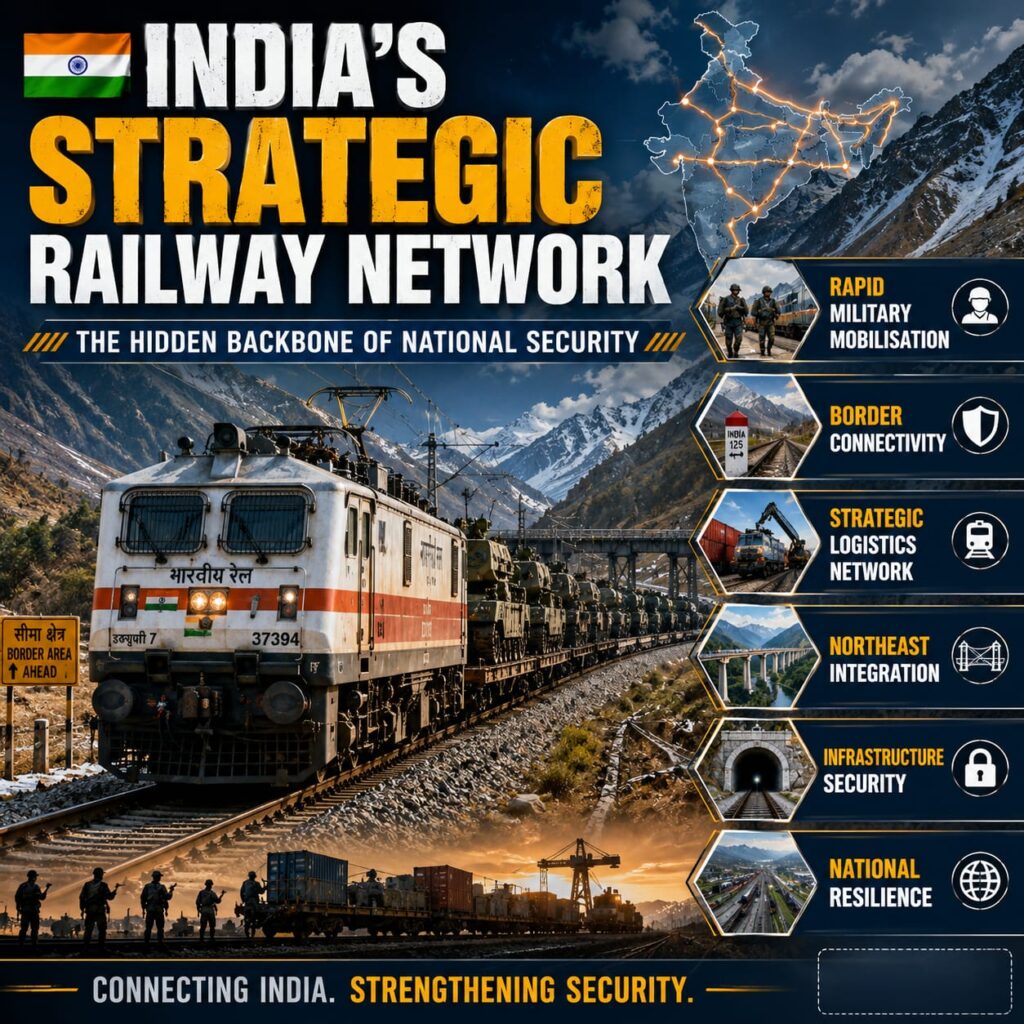
National security is often associated with fighter jets, warships, missiles and soldiers. However, military strength alone cannot secure a nation if troops, equipment and supplies cannot be moved quickly when needed. Infrastructure plays a critical role in modern warfare, and among all forms of infrastructure, railways remain one of the most important.
For India, a country with vast geography, challenging terrain and long borders with multiple countries, railways are more than just a transportation network. They are a strategic asset that supports economic growth, military readiness and national integration.
India’s strategic railway network serves as a hidden backbone of national security by enabling rapid mobilisation, strengthening border regions and improving logistical resilience during crises.
Why Railways Matter in Modern Warfare
History has repeatedly demonstrated the importance of railways during conflicts. Rail transport can move large quantities of troops, vehicles, ammunition and supplies over long distances efficiently and at relatively low cost.
Unlike road transport, railways can sustain continuous movement of heavy equipment such as tanks, artillery systems and military vehicles. During emergencies, a well-developed railway network allows armed forces to reinforce threatened sectors rapidly.
Even in the era of advanced aircraft and missiles, railways remain indispensable for large-scale logistics.
India’s Unique Strategic Challenges
India faces a complex security environment.
The country shares borders with China, Pakistan, Nepal, Bhutan, Bangladesh and Myanmar. Several border regions are mountainous and difficult to access.
Rapid deployment of forces is essential in areas such as:
- Ladakh
- Arunachal Pradesh
- Sikkim
- Jammu and Kashmir
- Northeast India
Maintaining military readiness in these regions requires reliable transportation networks capable of supporting both civilian and military needs.
This is where strategic railway infrastructure becomes critically important.
Military Mobility and Rapid Deployment
One of the primary advantages of railways is their ability to support large-scale military mobilisation.
Indian Railways has historically played a key role in transporting:
- Troops
- Armoured vehicles
- Artillery
- Ammunition
- Fuel supplies
During military exercises and emergencies, railways allow rapid reinforcement of sensitive sectors.
In a potential conflict scenario, the ability to move forces quickly between theatres can significantly enhance India’s operational flexibility and deterrence capability.
Strengthening Border Infrastructure
India has increasingly focused on improving connectivity near border areas.
While roads built by the Border Roads Organisation receive significant attention, railway expansion is equally important.
Strategic railway projects help:
- Reduce travel time to border regions
- Improve logistics support
- Facilitate civilian development
- Strengthen national integration
Enhanced connectivity ensures that remote regions remain connected to the national economy while simultaneously supporting defence requirements.
The Importance of Northeast Connectivity
Northeast India remains one of the most strategically important regions of the country.
The region is connected to mainland India through the narrow Siliguri Corridor, often called the “Chicken’s Neck.”
Railways play a vital role in maintaining connectivity between the Northeast and the rest of India.
Improved railway infrastructure helps:
- Support economic development
- Enhance military logistics
- Improve disaster response capabilities
- Strengthen national unity
Expanding railway networks in the Northeast remains a long-term strategic priority.
Strategic Railway Projects
According to ministry of railway, India is investing heavily in modern railway infrastructure.
Several projects aim to improve connectivity in challenging terrain and strategically important regions.
These investments include:
- Railway expansion in the Northeast
- Connectivity improvements in Jammu and Kashmir
- Freight corridor development
- Modernisation of logistics infrastructure
Such projects enhance both economic efficiency and national security.
Lessons from Recent Global Conflicts
Recent conflicts around the world have highlighted the continued importance of logistics.
Military success depends not only on combat capabilities but also on the ability to sustain operations over time.
Countries with strong transportation networks enjoy significant advantages in:
- Mobilisation
- Supply chain resilience
- Operational endurance
- Strategic flexibility
For India, strengthening railway infrastructure is an investment in long-term national resilience.
Railways as an Instrument of Deterrence
Deterrence is not only about possessing powerful weapons.
Potential adversaries must also recognise a nation’s ability to deploy and sustain forces effectively.
A robust railway network improves India’s deterrence posture by demonstrating:
- Rapid mobilisation capability
- Logistical strength
- Infrastructure resilience
- Operational preparedness
Strong transportation infrastructure can significantly enhance overall military effectiveness.
The Future of India’s Strategic Railway Network
India’s infrastructure transformation is expected to continue over the coming decades.
Future priorities include:
- Greater border connectivity
- Faster freight movement
- Improved logistics corridors
- Enhanced integration of remote regions
- Better support for defence requirements
As geopolitical competition intensifies across Asia, transportation infrastructure will become increasingly important for national security.
Railways will remain a critical pillar supporting India’s economic growth, territorial integrity and strategic preparedness.
Conclusion
India’s strategic railway network is far more than a transportation system. It is a vital component of national power.
By enabling military mobility, strengthening border regions, supporting economic development and improving logistical resilience, railways contribute directly to India’s national security.
While missiles, aircraft and warships often dominate headlines, the railway network quietly provides the foundation that allows these capabilities to function effectively.
In the 21st century, India’s railways will continue to serve as one of the hidden backbones of the nation’s security and strategic strength.
Also Read : India’s National Security Doctrine in the 21st Century