
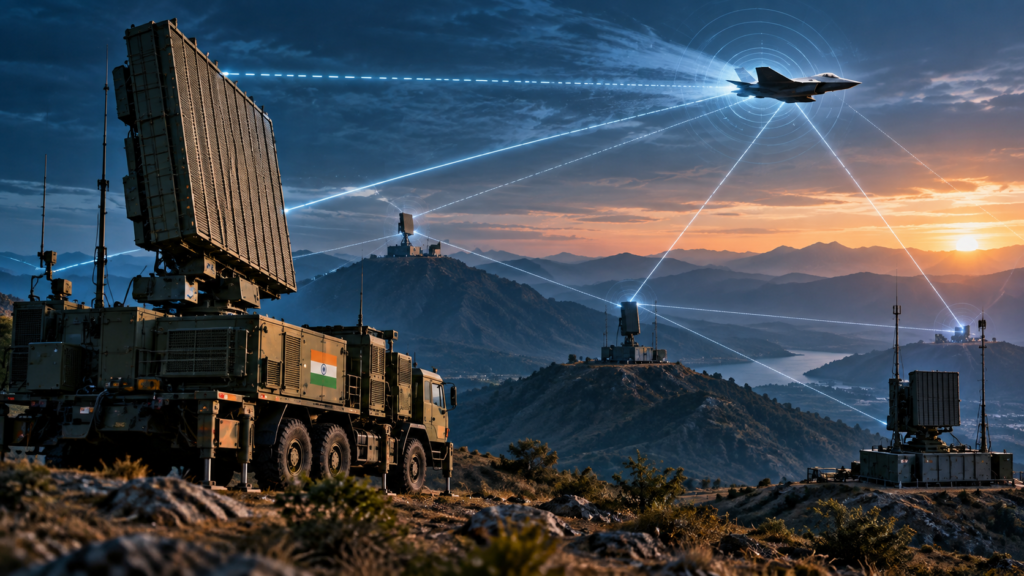
India’s Radar Technology Is Moving Beyond Conventional Detection
Modern aerial warfare is increasingly shaped by one question: how can a military detect an aircraft, missile or drone designed to be difficult to detect?
Stealth technology reduces an object’s radar signature, making traditional detection more difficult. At the same time, drones, cruise missiles and other low-observable threats are becoming more important on the modern battlefield.
India is therefore developing a broader range of radar and surveillance technologies.
One of the latest developments is the Multistatic Surveillance System (MSS) developed by DRDO laboratories LRDE and DLRL.
The system was added to DRDO’s official Technology Transfer list on 21 September 2026, with three licences available to Indian industry.
The development is significant because multistatic radar represents a different approach to surveillance: instead of relying on a single radar location and transmitter-receiver arrangement, multiple geographically separated sensing elements can contribute to the detection and tracking picture.
What Is Multistatic Radar?
A conventional radar generally uses a transmitter to send electromagnetic energy toward a target and a receiver to detect the returning signal.
A multistatic radar system distributes transmitting and receiving functions across multiple locations.
This can create several observation paths between the radar system and a target.
In simplified terms:
Conventional radar
Radar → Target → Same radar
Multistatic radar
Transmitter → Target → Receiver 1
Transmitter → Target → Receiver 2
Transmitter 2 → Target → Receiver 3
The additional geometry can provide information that may not be available from a single radar position.
It can also make the overall surveillance architecture more flexible.
Why Multistatic Radar Matters Against Stealth
Stealth aircraft are designed to reduce their detectability by controlling and reducing their radar cross-section from particular directions and frequencies.
That does not make an aircraft literally invisible to every radar.
Instead, stealth attempts to make detection, tracking and engagement more difficult.
This is where multistatic sensing can become useful.
A target that is difficult to observe from one geometry may produce detectable information from another observation angle.
DRDO’s own radar technology roadmap specifically lists multistatic radar, stealth detection, stealth target detection and low-frequency radars among its technology-development areas.
This demonstrates that India is pursuing several complementary approaches to the low-observable target problem rather than relying on a single radar technology.
DRDO’s Multistatic Surveillance System
The newly listed Multistatic Surveillance System (MSS) is associated with two DRDO laboratories:
- Electronics and Radar Development Establishment (LRDE)
- Defence Electronics Research Laboratory (DLRL)
DRDO has listed three licences for the technology, creating an opportunity for eligible Indian industry to pursue technology transfer.
This is important because the system is moving beyond laboratory development toward potential industrial adoption.
Technology transfer does not mean that every company can immediately manufacture the system.
DRDO’s Category A technology-transfer process involves industry expressing interest, technical assessment, licensing arrangements and compliance with applicable requirements.
The system was added to DRDO’s official Technology Transfer list on 21 September 2026, with three licences available to Indian industry.
Multistatic Radar Is Part of a Larger Radar Strategy
The MSS should not be viewed in isolation.
DRDO’s radar technology roadmap contains a much broader portfolio.
It includes:
- Airborne multistatic and dynamic radars
- Distributed netted-array radar
- Cognitive radar
- Low-frequency radar for stealth detection
- Passive coherent location radar
- Over-the-horizon radar
- Photonic radar
- Hypersonic-target detection radar
- AI/ML for radar applications
- Adaptive signal processing
- Miniaturised radar sensors
This suggests that India’s radar research is increasingly moving toward distributed, networked and specialised sensing architectures.
From One Radar to a Network of Sensors
The future of air surveillance is unlikely to depend on a single radar sitting at a single location.
Modern defence networks can combine information from multiple sensors.
These may include:
Ground-based radars
Airborne surveillance systems
Passive sensors
Electro-optical systems
Electronic-support systems
Satellites
Unmanned platforms
When information from these systems is combined, the military can potentially build a more complete picture of the airspace.
Multistatic radar fits naturally into this concept.
Rather than asking only whether one radar can see a target, the larger question becomes whether a network of sensors can detect, track and identify it.
The Role of Passive Detection
Multistatic systems can also be connected to passive sensing concepts.
A passive radar does not necessarily need to transmit its own powerful radar signal in the conventional way.
Instead, it can exploit existing electromagnetic sources and analyse changes or reflections associated with targets.
DRDO’s radar roadmap specifically lists Passive Coherent Location Radar alongside multistatic radar and stealth-detection technologies.
Such approaches can potentially complicate an adversary’s understanding of India’s surveillance architecture.
However, passive and multistatic systems also have technical challenges involving synchronization, signal processing, geometry, clutter and target identification.
Why Distributed Radar Networks Matter
A distributed radar architecture can offer an important advantage: resilience.
A conventional radar installation can become a high-value target.
If a surveillance network depends heavily on one location, damaging that location could create a gap in coverage.
A distributed system can potentially spread sensing functions across multiple locations.
This does not make a network invulnerable.
But it can provide additional pathways for maintaining situational awareness.
For a country with a large and geographically diverse airspace, such architectures could become increasingly relevant.
The Connection With Electronic Warfare
Radar does not operate in isolation from electronic warfare.
Modern battlespaces are saturated with electromagnetic signals.
Aircraft, missiles, drones and ground systems all generate or interact with electromagnetic energy.
DRDO’s Electronics and Communication Systems cluster works across radars, electronic warfare, electro-optical systems, lasers and communication systems, with technologies supporting missile programmes, unmanned aircraft, airborne early-warning systems and other platforms.
That creates a close technological relationship between radar and electronic warfare.
A modern surveillance system needs not only to detect a target but also to operate in an environment where an adversary may attempt to:
- Jam radar signals
- Deceive sensors
- Generate false targets
- Interfere with communications
- Manipulate the electromagnetic environment
Advanced signal processing and distributed sensing can therefore become important parts of maintaining reliable situational awareness.
AI Could Make Radar Networks More Effective
The quantity of information generated by multiple sensors can become enormous.
This creates another challenge: how does the military process all of that information quickly?
DRDO’s radar roadmap already includes AI/ML technology for radar applications.
This connects radar development with the wider role of artificial intelligence in modern warfare, particularly in surveillance and sensor-data analysis.
Artificial intelligence can potentially assist with tasks such as:
- Target classification
- Pattern recognition
- Tracking
- Anomaly detection
- Sensor-data fusion
- Clutter discrimination
AI does not eliminate the need for human operators.
Instead, it can potentially help operators process large volumes of sensor information more efficiently.
The effectiveness of such systems will ultimately depend on the quality of data, algorithms, computing infrastructure and integration with operational command networks.
Detecting Hypersonic and Low-Observable Threats
The radar challenge is becoming more complicated as new types of threats emerge.
DRDO’s technology roadmap separately identifies hypersonic-target detection radar as a development area.
Hypersonic weapons can combine high speed with manoeuvrability, creating demanding requirements for detection and tracking.
At the same time, low-observable aircraft and cruise missiles seek to reduce the distance at which they can be detected.
These developments place increasing pressure on surveillance networks.
India’s research into multistatic radar, low-frequency radar, passive radar and advanced signal processing can therefore be viewed as part of a broader effort to improve detection against increasingly sophisticated aerial threats.
Why Technology Transfer Matters
The decision to place MSS on DRDO’s Technology Transfer platform is important for another reason.
Advanced radar systems require more than a research laboratory.
They need:
- Manufacturing capacity
- Specialised electronics
- Antennas
- Signal-processing hardware
- Software
- Calibration facilities
- Testing infrastructure
- Skilled engineers
- Long-term maintenance capability
Moving mature technologies toward industry can help build these capabilities.
The approach also fits into India’s wider effort to create domestic defence manufacturing clusters through Defence Industrial Corridors.
DRDO’s technology-transfer framework allows eligible Indian companies to express interest in Category A military technologies and undergo technical assessment before licensing.
This provides a pathway for research-developed systems to move toward industrial production.
Building India’s Indigenous Radar Ecosystem
India’s radar ecosystem already supports multiple defence programmes.
Recent investments in surveillance, air defence and electronic warfare are also part of the broader ₹52,000 crore defence modernisation push.
DRDO’s Electronics and Communication Systems cluster says its laboratories have developed radar, electronic warfare and sensor technologies used across missile programmes, UAVs, airborne early-warning systems, tanks, coastal surveillance and other platforms.
The addition of multistatic surveillance technology to the industry-transfer pipeline adds another component to this ecosystem.
Over time, greater industry participation could help expand manufacturing capacity and create a larger domestic supplier network.
What Multistatic Radar Cannot Do
It is important not to portray multistatic radar as a technology that automatically defeats stealth.
Stealth aircraft are designed around complex combinations of radar cross-section management, materials, shaping, electronic warfare and operational tactics.
Detection also depends on factors such as:
- Radar frequency
- Sensor geometry
- Target aspect
- Range
- Atmospheric conditions
- Background clutter
- Signal processing
- Target behaviour
Multistatic radar is therefore best understood as one component of a broader sensor architecture, not a single solution to stealth.
Its value comes from adding different sensing geometries and information to the overall surveillance picture.
The Bigger Strategic Picture
The significance of India’s multistatic radar programme extends beyond one system.
Modern warfare is increasingly becoming a contest between sensors and signatures.
Aircraft attempt to reduce their signatures.
Missiles attempt to fly at low altitude or manoeuvre unpredictably.
Drones can be small and difficult to detect.
Electronic warfare systems attempt to disrupt sensors.
At the same time, militaries are building increasingly interconnected surveillance networks.
The side that can detect, classify and track threats earlier can gain more time for decision-making.
That makes radar technology a critical part of the wider air-defence and national-security architecture.
What Comes Next
India’s radar development is moving in several directions simultaneously.
DRDO is pursuing:
- Multistatic radar
- Distributed radar
- Passive radar
- Low-frequency stealth detection
- Hypersonic detection
- AI-enabled radar
- Photonic radar
- Adaptive signal processing
The Multistatic Surveillance System now being offered to Indian industry is one piece of this larger technology portfolio.
The next step will be turning these technologies into reliable, interconnected operational capabilities.
That requires not only advanced research but also industrial production, testing, networking and integration with India’s wider surveillance and air-defence systems.
Conclusion
India’s radar strategy is increasingly moving beyond the traditional concept of a single powerful radar.
The development of multistatic surveillance technology reflects a broader shift toward distributed sensing, advanced signal processing and networked surveillance.
DRDO’s decision to offer the Multistatic Surveillance System to Indian industry in September 2026 provides a concrete example of that transition.
At the same time, DRDO’s wider radar roadmap includes technologies for stealth detection, passive sensing, hypersonic-target detection, distributed arrays and AI-enabled radar.
The future of India’s air-surveillance architecture will therefore depend not on a single radar, but on how effectively multiple sensors, technologies and industrial capabilities can work together.
For a military increasingly preparing for drones, cruise missiles, electronic warfare and low-observable threats, seeing the battlefield may be as important as striking it.