
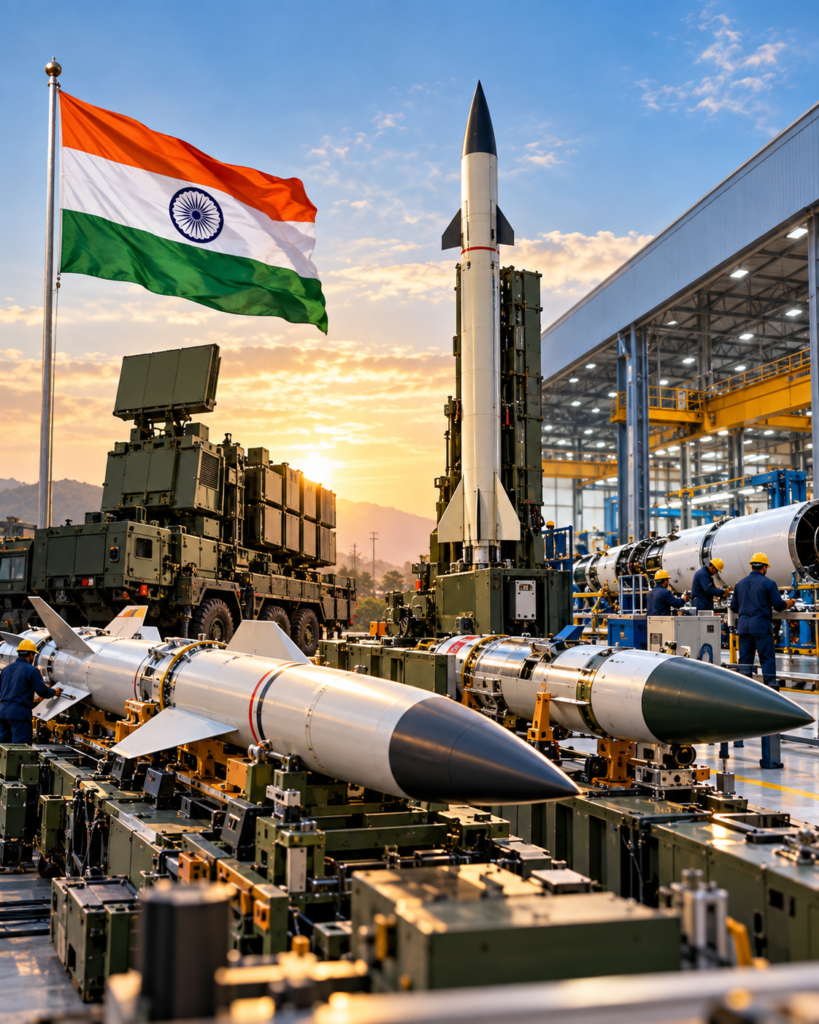
India’s Missile Industry Is Entering a New Phase
India’s missile programme is entering an important industrial phase.
For decades, the primary challenge was developing sophisticated missile systems domestically. India has built significant capabilities through organisations such as the Defence Research and Development Organisation (DRDO), while public-sector defence companies have played a major role in manufacturing and production.
The next challenge is different: how to convert indigenous technologies into larger, more flexible and scalable production capacity.
That is the context behind the government’s decision to expand the transfer of DRDO-developed conventional missile technologies to Indian industry.
On 25 August 2026, Defence Minister Rajnath Singh approved the transfer of technology for DRDO-developed conventional missile systems to Indian defence companies for domestic production. The Ministry of Defence said the initiative is intended to strengthen indigenous manufacturing, reduce import dependence and increase domestic value addition.
The development could broaden the industrial base supporting India’s missile ecosystem.
What the DRDO Technology Transfer Decision Means
Technology transfer, or ToT, is different from simply handing a weapon design to a company.
It involves transferring the technical knowledge, manufacturing processes and associated technologies required for an eligible industrial partner to produce a system under defined conditions.
The government has said that qualified Indian companies, including MSMEs and technology partners, can participate in the manufacturing ecosystem created through these transfers.
This creates a potential bridge between two parts of India’s defence system:
Industry → production, scaling and supply-chain expansion
The objective is not to replace DRDO’s research role. Instead, it is to allow more industrial capacity to develop around technologies that have already reached appropriate stages of maturity.
The Scale Is Larger Than a Single Missile Programme
The government’s September 2026 VIMARSH event provided an important indication of the scale of the initiative.
According to the Ministry of Defence, technologies related to approximately 50 DRDO-developed missiles had been made available to industry. The same event highlighted more than 2,300 technology transfers involving over 1,100 industries across the wider defence ecosystem.
This makes the development broader than an individual missile contract.
It represents an attempt to create a larger network of companies capable of absorbing defence technologies and turning them into industrial products.
For India, that distinction matters.
A successful missile test demonstrates technological capability. A dependable production ecosystem determines how quickly that capability can be converted into operational inventory.
From DRDO Development to Industrial Production
Developing a missile involves highly specialised expertise.
The technology chain can include:
- Aerodynamics
- Propulsion
- Guidance and navigation
- Seeker technology
- Control systems
- Electronics
- Power systems
- Warhead-related technologies
- Launch systems
- Testing and integration
DRDO’s missile and strategic systems activities cover many of these technological areas.
Industrial production adds another layer of complexity.
A company must establish manufacturing processes, quality-control systems, specialised supply chains and testing arrangements while meeting the required military standards.
This is why technology transfer can become strategically important.
It creates the possibility of moving from technology creation to repeatable industrial production.
Why Private Industry Matters
A broader industrial base can provide additional manufacturing capacity.
Large defence companies can potentially act as prime contractors or system integrators, while smaller companies can supply specialised components, electronics, materials, software and subsystems.
This creates a layered industrial structure:
Large companies → system integration and major production
MSMEs → components and specialised manufacturing
Startups → emerging technologies and niche capabilities
DRDO → research, development and technology creation
Such an ecosystem can reduce dependence on a limited number of production facilities.
It can also create more opportunities for Indian companies to develop expertise that can later be applied to other defence systems.
The Role of MSMEs and Defence Startups
India’s defence-industrial strategy increasingly places emphasis on bringing smaller companies into high-technology manufacturing.
At VIMARSH 2026, the government highlighted measures intended to improve technology absorption and reduce barriers for industry, including greater access to DRDO testing infrastructure.
For MSMEs, access to advanced defence technologies can be significant.
A smaller company does not necessarily need to manufacture an entire missile.
It could specialise in a particular subsystem or component and become part of a larger production chain.
Over time, this can create a deeper domestic supplier base.
Reducing Import Dependence
Missile systems contain numerous components and technologies that can become supply-chain vulnerabilities if they depend heavily on foreign sources.
Building domestic manufacturing capacity therefore has implications beyond the final weapon.
It can strengthen India’s ability to maintain production and sustain equipment when international supply chains are disrupted.
The Ministry of Defence has specifically linked the technology-transfer initiative to reducing import dependence and increasing domestic value addition.
This is particularly relevant for a country seeking greater self-reliance across its defence supply chains.
India’s Missile Production Challenge Is Now About Scale
India has demonstrated the ability to develop and test increasingly sophisticated missile systems.
But development and production are fundamentally different challenges.
A missile programme must eventually answer several industrial questions:
Can the system be produced repeatedly?
Can critical components be sourced reliably?
Can manufacturing capacity be expanded quickly when required?
Can quality remain consistent at higher production volumes?
Can maintenance and replacement requirements be supported domestically?
Technology transfer can help address some of these challenges, but it does not automatically solve them.
Industry still needs investment, skilled manpower, specialised manufacturing infrastructure, testing capacity and reliable suppliers.
A Wider Defence-Industrial Transformation
The missile technology initiative forms part of a much broader effort to expand India’s defence-industrial base.
Government data released in September 2026 showed that India’s defence production reached approximately ₹1.78 lakh crore in FY2025–26, with the government targeting ₹3 lakh crore of annual defence production by 2029.
Missiles are therefore one part of a much larger industrial transformation involving:
- Aircraft
- Helicopters
- Air-defence systems
- Armour vehicles
- Naval systems
- Drones
- Electronic warfare
- Sensors
- Space-related defence technologies
- Precision weapons
The objective is increasingly not just to design indigenous equipment, but to build the industrial capacity required to manufacture and sustain it.
What the Move Does Not Mean
The technology-transfer decision should not be interpreted as India opening every missile programme to private manufacturing.
The government’s announcement specifically concerns conventional missile systems.
Strategic missile programmes operate under different arrangements and requirements.
This distinction is important because India’s missile inventory includes systems developed for very different operational and strategic purposes.
The current initiative should therefore be understood as an expansion of industrial participation in eligible conventional missile technologies, rather than a blanket transfer of India’s entire strategic missile technology base.
The Strategic Significance
The most important aspect of the move may ultimately be the industrial network that develops around the missile systems.
A stronger domestic missile ecosystem could create:
More production capacity
More domestic suppliers
Greater technology absorption
Higher domestic value addition
Reduced dependence on imported components
More opportunities for defence startups and MSMEs
It could also give Indian industry experience that can be applied across multiple defence programmes.
That makes the initiative relevant not only to missile manufacturing but to India’s broader defence-industrial strategy.
The Challenges India Still Has to Solve
Technology transfer is an important step, but production capability cannot be created overnight.
Indian industry will still need to overcome challenges involving:
Manufacturing capacity
Advanced weapons require specialised production infrastructure and stringent quality control.
Skilled workforce
Missile manufacturing requires engineers, technicians and specialised manufacturing expertise.
Supply chains
Domestic production is only as resilient as the suppliers supporting it.
Testing and certification
Companies need access to appropriate testing facilities and certification processes.
Technology absorption
Receiving technology does not automatically mean that a company can immediately manufacture it efficiently at scale.
Long-term orders
Industrial investment becomes easier when companies have predictable demand and clear procurement pathways.
These factors will determine how effectively the technology-transfer policy translates into actual production.
From Indigenous Weapons to Indigenous Capacity
India’s defence-industrial journey is moving beyond the question of whether the country can develop sophisticated weapons.
The next question is whether India can produce them at scale, sustain them domestically and build a resilient industrial ecosystem around them.
The transfer of DRDO-developed conventional missile technologies to Indian industry represents one step in that direction.
If successfully implemented, the initiative could connect India’s defence research establishment more closely with a wider network of manufacturers, MSMEs and technology companies.
That would make India’s missile programme not just a story about indigenous technology—but about building the industrial capacity required to turn that technology into sustained defence capability.