
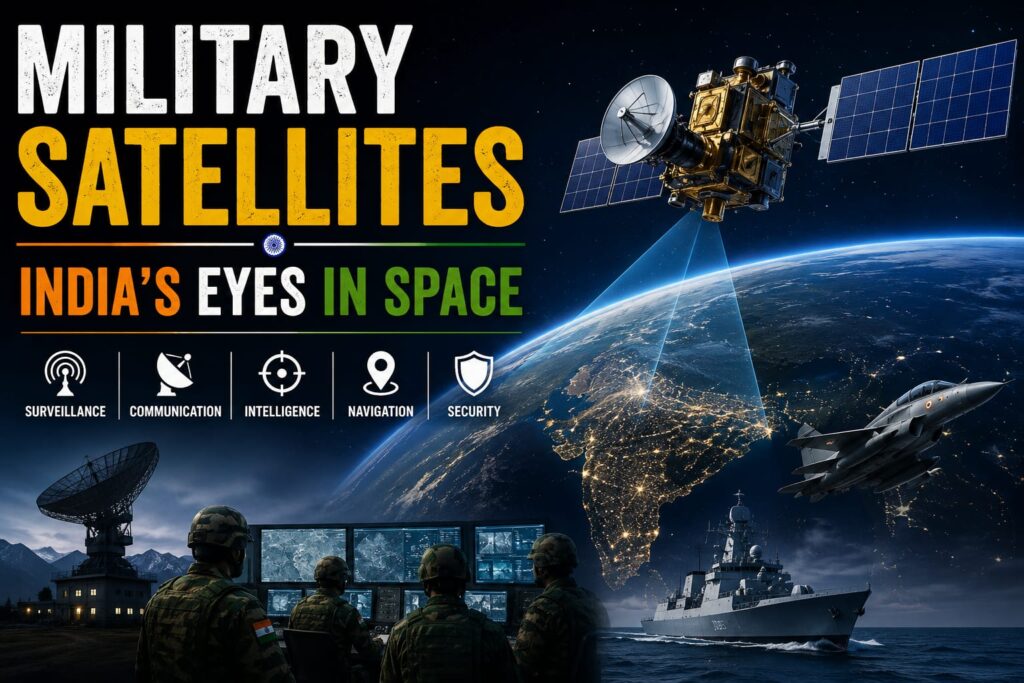
Modern warfare is no longer confined to land, sea and air. Space has emerged as a critical strategic domain where satellites provide nations with the intelligence, communication and navigation capabilities needed to protect their interests.
For India, military satellites have become indispensable assets that strengthen national security, improve battlefield awareness and support the operations of the Armed Forces. As geopolitical competition intensifies, space-based capabilities are playing an increasingly important role in safeguarding India’s sovereignty.
What Are Military Satellites?
Military satellites are spacecraft designed to support defence and national security missions.
They perform a wide range of tasks, including:
- Intelligence gathering
- Surveillance
- Reconnaissance
- Secure communications
- Navigation
- Weather monitoring
- Missile warning
These capabilities allow military commanders to make faster and better-informed decisions during both peace and conflict.
Why Military Satellites Matter
Modern military operations depend heavily on real-time information.
Satellites provide:
- Continuous monitoring of border regions
- Secure communication between military units
- Accurate navigation for aircraft, ships and missiles
- Early warning of potential threats
- Support for disaster response and humanitarian operations
Without satellites, modern armed forces would face significant operational limitations.
India’s Military Satellite Programme
India has steadily expanded its military space capabilities over the past two decades.
The country has launched several satellites dedicated to defence applications while also using dual-use satellites that support both civilian and military requirements.
Key organisations involved include:
- Indian Space Research Organisation (ISRO)
- Defence Research and Development Organisation (DRDO)
- Indian Armed Forces
These institutions work together to strengthen India’s space-based security architecture.
Types of Military Satellites
Communication Satellites
Secure communication satellites enable reliable connectivity between military headquarters, naval fleets, aircraft and troops deployed across difficult terrain.
Surveillance and Reconnaissance Satellites
These satellites monitor border regions, maritime areas and strategic installations using advanced optical and radar imaging systems.
Navigation Satellites
India’s NavIC satellite navigation system provides accurate positioning and timing information, reducing dependence on foreign navigation networks.
Weather Satellites
Weather satellites help military planners assess atmospheric conditions before conducting operations.
Supporting Border Security
Military satellites play a vital role in monitoring India’s borders with China and Pakistan.
They assist in:
- Tracking troop movements
- Monitoring infrastructure development
- Observing maritime activity
- Supporting high-altitude operations
This information improves situational awareness and strengthens national security.
Maritime Security
India’s interests extend far beyond its land borders.
Military satellites help monitor:
- The Indian Ocean Region
- Shipping lanes
- Naval deployments
- Illegal maritime activities
Space-based surveillance enhances India’s maritime domain awareness and supports the Indian Navy.
The Role of Space in Modern Warfare
Recent conflicts have demonstrated that control of information can be as important as control of territory.
Military satellites enable:
- Precision targeting
- Network-centric warfare
- Intelligence sharing
- Rapid command and control
As warfare becomes increasingly technology-driven, space assets will continue to grow in importance.
Future Challenges
India faces several challenges in strengthening its military space capabilities.
These include:
- Counter-space technologies
- Cyber threats
- Space debris
- Satellite resilience
- Rapid technological competition
Continued investment in innovation and indigenous capability will be essential.
Looking Ahead
India is expected to expand its military space programme through:
- Advanced surveillance satellites
- Secure communication networks
- Improved navigation systems
- Space situational awareness
- Greater civil-military cooperation
These developments will enhance the country’s ability to respond to future security challenges.
Conclusion
Military satellites have become one of the most important pillars of India’s national security architecture.
From monitoring borders and securing communications to supporting maritime operations and precision navigation, these space-based assets provide critical advantages to the Armed Forces.
As technology evolves and strategic competition increasingly extends into space, India’s investment in military satellites will remain essential for protecting its sovereignty and strengthening its defence capabilities.
India’s military space programme complements projects such as DFP-2026, Advanced Landing Grounds, and the Border Roads Organisation’s strategic infrastructure.