
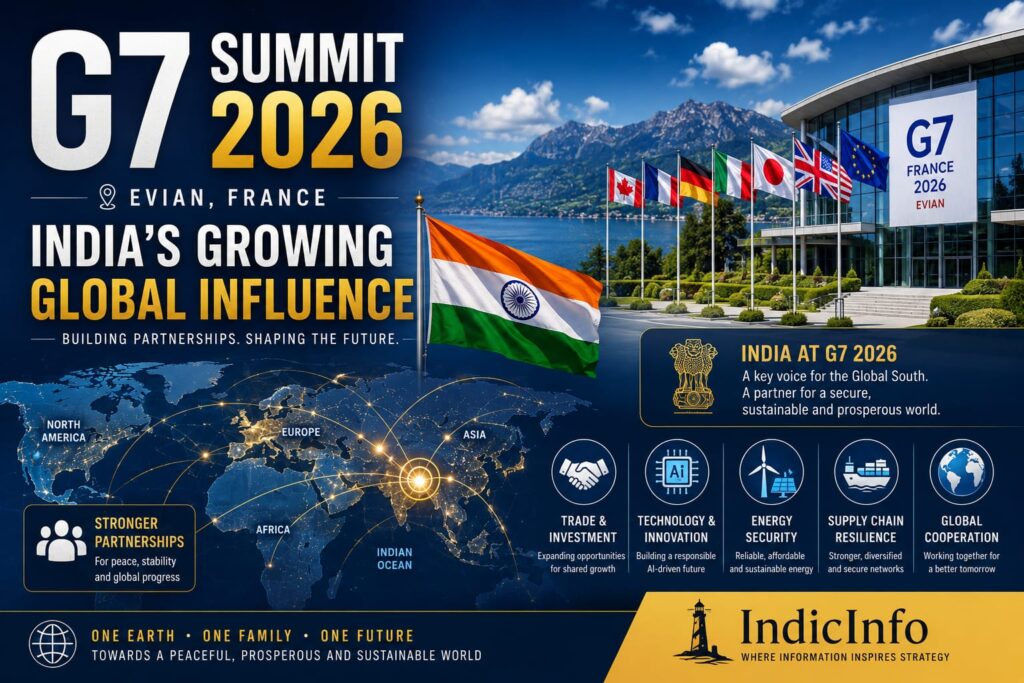
The G7 Summit 2026 in Evian, France, comes at a time of significant geopolitical change. Although India is not a member of the G7, Prime Minister Narendra Modi’s participation highlights the country’s growing importance in global affairs. As major powers navigate economic uncertainty, technological competition, energy security challenges and regional conflicts, India’s role as a leading voice of the Global South continues to expand.
The summit provides an important platform for India to strengthen strategic partnerships and advance its national interests on the global stage.
What is the G7?
The Group of Seven (G7) consists of:
- Canada
- France
- Germany
- Italy
- Japan
- United Kingdom
- United States
Together, these countries represent some of the world’s largest advanced economies. The G7 discusses major international issues including economic growth, security, climate change, energy and emerging technologies.
India has increasingly been invited as a partner country due to its growing economic and geopolitical influence.
Why India’s Participation Matters
India’s presence at the G7 reflects several important realities:
Rising Economic Power
India is among the fastest-growing major economies in the world. Its large market, expanding manufacturing sector and digital transformation make it an important partner for developed nations.
Voice of the Global South
India has positioned itself as a bridge between developed and developing countries. New Delhi frequently advocates for the concerns of emerging economies regarding climate finance, development and global governance reforms.
Strategic Importance
India occupies a crucial position in the Indo-Pacific region and plays a key role in maintaining regional stability and maritime security.
Key Issues for India at the Summit
Trade and Investment
India seeks greater economic cooperation with advanced economies to support growth, technology transfer and manufacturing expansion.
Technology and Artificial Intelligence
The rapid development of AI and emerging technologies has become a major global concern. India aims to strengthen partnerships while ensuring inclusive technological development.
Energy Security
Global energy markets remain volatile due to geopolitical tensions. India continues to focus on securing reliable and affordable energy supplies while expanding renewable energy capacity.
Supply Chain Resilience
Many countries are looking to diversify supply chains. India’s manufacturing sector presents an attractive alternative for companies seeking reliable production hubs.
Bilateral Meetings and Strategic Partnerships
The summit allows India to hold bilateral discussions with major world leaders. These meetings often focus on:
- Defence cooperation
- Economic partnerships
- Technology collaboration
- Counter-terrorism
- Regional security issues
Such engagements strengthen India’s diplomatic network and expand strategic opportunities.
India’s Growing Global Influence
Over the past decade, India’s international profile has risen significantly.
Several factors contribute to this growth:
- Strong economic performance
- Expanding defence capabilities
- Leadership in digital innovation
- Active diplomatic engagement
- Strategic location in the Indo-Pacific
India is increasingly viewed as an essential partner in addressing global challenges.
Challenges Ahead
Despite its growing influence, India faces several challenges:
- Managing complex relations with major powers
- Ensuring economic growth amid global uncertainty
- Addressing energy and resource security concerns
- Maintaining strategic autonomy in a polarized world
Balancing these priorities will remain a key objective of Indian foreign policy.
Conclusion
The G7 Summit 2026 demonstrates India’s emergence as a major global player. Prime Minister Modi’s participation reflects international recognition of India’s economic strength, strategic importance and diplomatic influence.
As global power dynamics continue to evolve, India is likely to play an increasingly important role in shaping international discussions on security, technology, trade and development. The summit serves as another step in India’s journey toward becoming one of the defining powers of the twenty-first century.
India’s strategic outlook has evolved significantly in recent years. Read our analysis of India’s National Security Doctrine in the 21st Century.
India’s growing global role is also connected to its efforts to strengthen strategic infrastructure. Learn more in India-China Border Infrastructure Race: Who Has the Advantage?.