
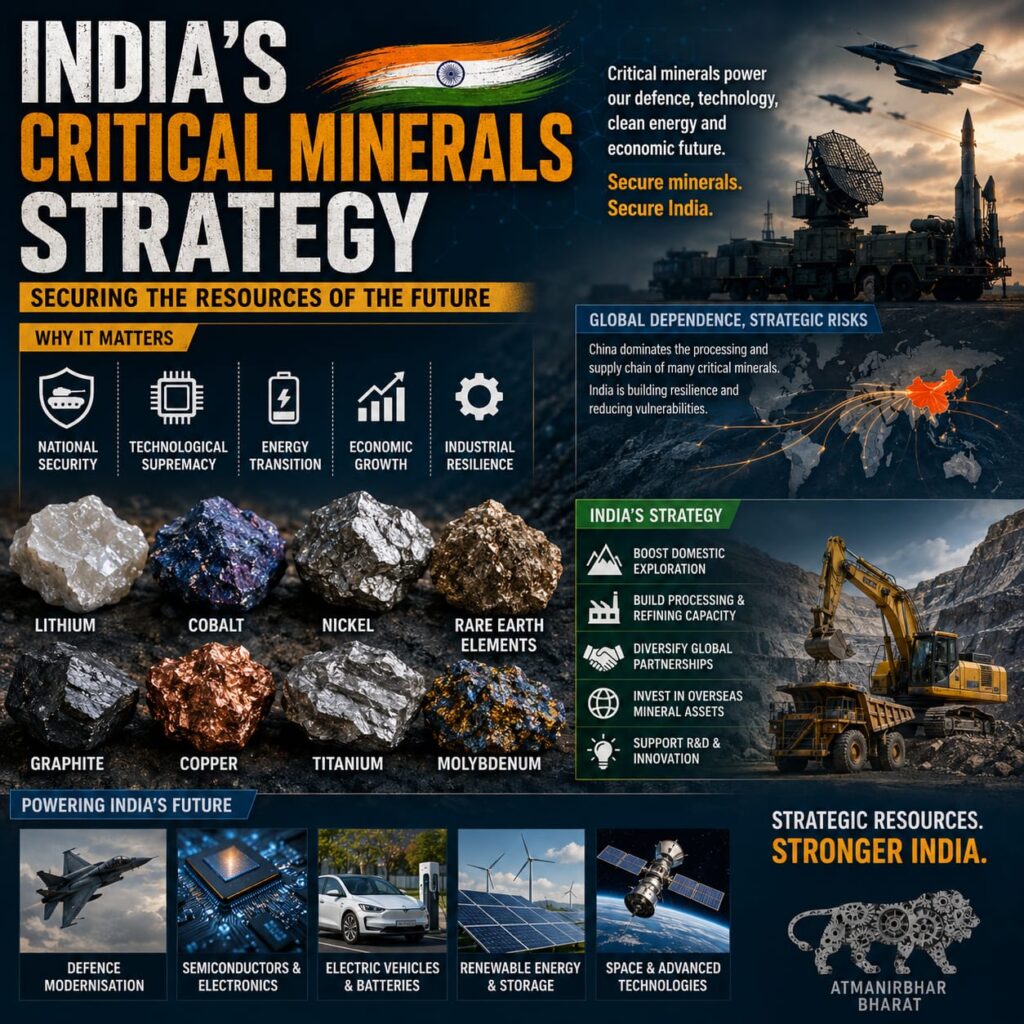
In the 21st century, national power is no longer determined solely by military strength or economic size. Increasingly, countries are competing for access to critical minerals that power modern technologies, defence systems, electric vehicles and advanced industries.
From lithium batteries and semiconductor chips to fighter aircraft and missile systems, critical minerals have become the foundation of technological and strategic competitiveness.
Recognising this reality, India has launched an ambitious critical minerals strategy aimed at reducing dependence on foreign suppliers and strengthening long-term national security.
What Are Critical Minerals?
Critical minerals are resources that are essential for economic development, technological innovation and national security.
These include:
- Lithium
- Cobalt
- Nickel
- Graphite
- Rare Earth Elements (REEs)
- Copper
- Molybdenum
- Titanium
These minerals are used in:
- Electric vehicle batteries
- Defence equipment
- Semiconductors
- Renewable energy systems
- Telecommunications infrastructure
- Aerospace technologies
Without secure access to these resources, modern economies face significant strategic vulnerabilities.
Why Critical Minerals Matter for India
India’s economic ambitions depend heavily on advanced manufacturing and technology-driven growth.
Major national initiatives such as:
- Make in India
- Atmanirbhar Bharat
- Semiconductor Mission
- Electric Vehicle Expansion
- Defence Modernisation
all require reliable access to critical minerals.
As demand increases globally, securing supply chains has become a strategic necessity.
India’s push for strategic autonomy complements the goals outlined in India’s National Security Doctrine in the 21st Century and supports defence capabilities discussed in India’s Air Defence Shield Explained.
China’s Dominance in Critical Minerals
One of the biggest challenges facing India is China’s dominant position in global critical mineral supply chains.
China controls a significant share of:
- Rare earth processing
- Battery material production
- Critical mineral refining
- Global supply networks
This dominance gives Beijing considerable leverage in emerging technologies and industrial sectors.
For many countries, including India, reducing excessive dependence on Chinese supply chains has become a strategic priority.
India’s Critical Minerals Mission
To address these challenges, India has identified dozens of minerals as strategically important.
The government has taken steps to:
- Expand domestic exploration
- Increase mining activity
- Encourage private-sector participation
- Build processing capabilities
- Secure overseas mineral assets
The objective is to create resilient supply chains capable of supporting India’s long-term development goals.
India has also expanded exploration efforts through initiatives supported by the Ministry of Mines.
Overseas Resource Partnerships
India is also pursuing international partnerships to secure access to critical minerals.
Countries rich in mineral resources include:
- Australia
- Argentina
- Chile
- Brazil
- Namibia
- Zambia
By investing in overseas mining projects and forming strategic partnerships, India aims to diversify its supply sources.
This approach reduces risks associated with supply disruptions and geopolitical tensions.
Critical Minerals and National Security
Critical minerals play an increasingly important role in defence preparedness.
Modern military platforms require advanced materials for:
- Fighter aircraft
- Missiles
- Radar systems
- Satellites
- Naval platforms
- Electronic warfare systems
A disruption in supply chains could affect defence manufacturing and operational readiness.
For this reason, critical minerals are now viewed as an essential component of national security.
The Semiconductor Connection
Semiconductors have become the backbone of modern technology.
Everything from smartphones and automobiles to military systems depends on advanced chips.
Many semiconductor manufacturing processes require critical minerals and rare earth elements.
India’s efforts to establish a domestic semiconductor ecosystem therefore depend partly on securing reliable mineral supplies.
Energy Security and the Green Transition
India’s transition toward cleaner energy also depends on critical minerals.
Electric vehicles, solar panels and battery storage systems require large quantities of:
- Lithium
- Nickel
- Cobalt
- Graphite
As the global green energy transition accelerates, competition for these resources is expected to intensify.
Countries that secure supply chains early will enjoy significant strategic advantages.
Challenges Ahead
India still faces several obstacles.
These include:
- Limited domestic reserves of some minerals
- Processing capacity gaps
- Global competition for resources
- Supply chain vulnerabilities
- Technological dependence
Addressing these challenges will require long-term investment and policy coordination.
The Road Ahead
India’s critical minerals strategy is about far more than mining.
It is about securing the foundations of future economic growth, technological innovation and national security.
As global competition increasingly shifts from territory to resources and technology, critical minerals will play a decisive role in shaping geopolitical power.
Countries that control these resources will influence the industries of the future.
Conclusion
Critical minerals have emerged as one of the most important strategic resources of the modern era. They power advanced technologies, support defence industries and drive economic growth.
India’s efforts to secure domestic supplies, diversify international partnerships and build resilient supply chains represent a major step toward strengthening national security and achieving long-term strategic autonomy.
In the coming decades, critical minerals may prove just as important to national power as oil was in the twentieth century.