
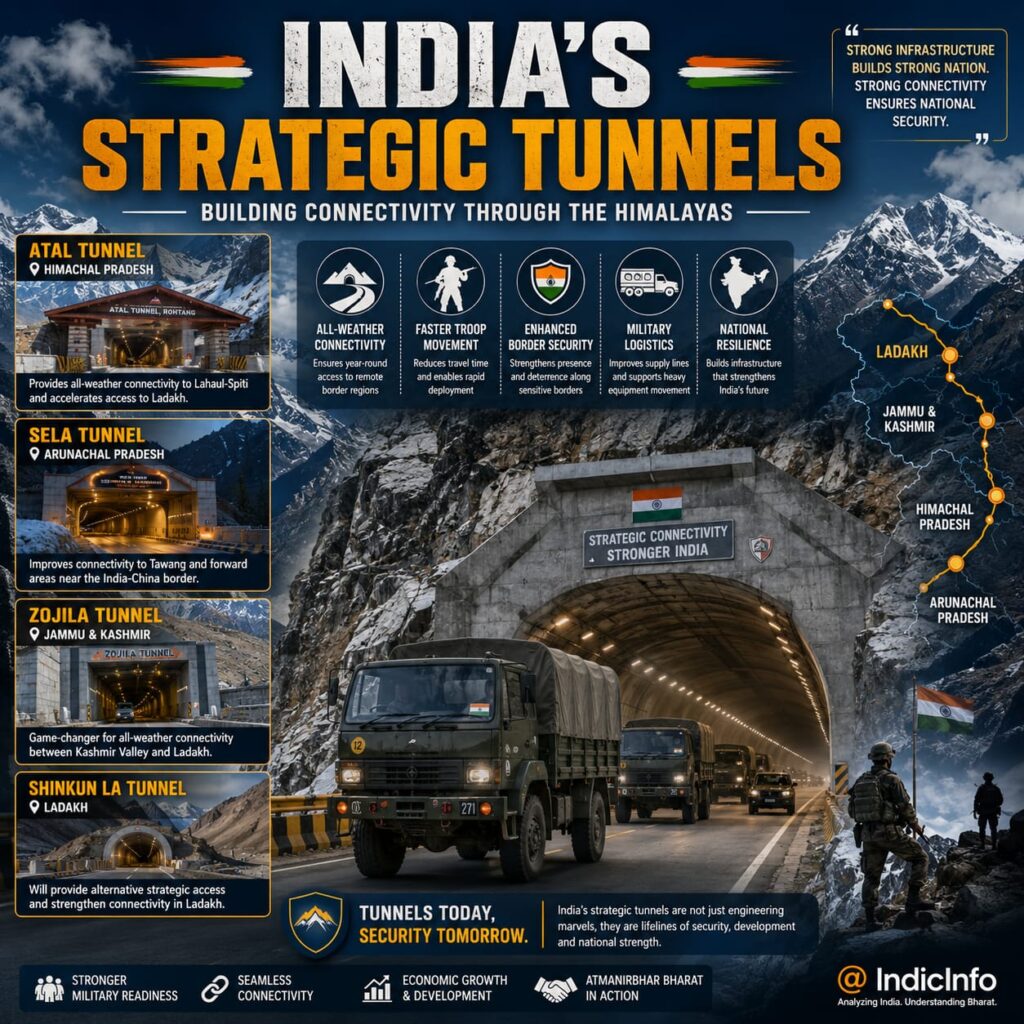
India’s Himalayan frontier presents some of the world’s most challenging geographical conditions. High-altitude mountain passes, heavy snowfall, landslides and harsh winters often disrupt connectivity in strategically important regions.
To overcome these challenges, India has launched an ambitious programme of constructing strategic tunnels across the Himalayas. These projects are not merely infrastructure initiatives; they are critical components of India’s national security strategy.
By improving year-round connectivity, strategic tunnels strengthen military logistics, support economic development and enhance India’s ability to respond rapidly to security challenges along its borders.
India’s strategic tunnels complement the work of the Border Roads Organisation (BRO) and strengthen the country’s wider transportation network. Together with India’s Strategic Railway Network and National Security, these projects improve military mobility and support the objectives outlined in India’s National Security Doctrine in the 21st Century.
Why Himalayan Connectivity Matters
The Himalayas form a natural barrier between India and its northern neighbours. While this geography provides defensive advantages, it also creates significant logistical challenges.
Many border areas remain vulnerable to weather-related disruptions, especially during winter months. Roads passing through high-altitude mountain passes can become inaccessible for extended periods.
In a security environment where rapid mobilisation is essential, reliable transportation infrastructure is a strategic necessity.
The Military Importance of Strategic Tunnels
Modern warfare depends heavily on logistics.
Military forces require:
- Continuous supply lines
- Rapid troop deployment
- Transportation of heavy equipment
- Reliable access to border regions
Strategic tunnels help eliminate bottlenecks by providing all-weather connectivity and reducing dependence on vulnerable mountain passes.
As a result, military formations can maintain higher levels of readiness and operational flexibility.
Atal Tunnel: Transforming Connectivity to Ladakh
One of India’s most significant infrastructure achievements is the Atal Tunnel in Himachal Pradesh.
The tunnel provides all-weather connectivity between Manali and the Lahaul-Spiti region while significantly improving access towards Ladakh.
Its strategic benefits include:
- Reduced travel time
- Improved military logistics
- Faster troop movement
- Enhanced economic connectivity
The Atal Tunnel has become a symbol of India’s commitment to strengthening border infrastructure.
Sela Tunnel and the Northeast Frontier
The Sela Tunnel in Arunachal Pradesh is another strategically important project.
Located near the India-China border, the tunnel improves connectivity to Tawang and surrounding regions.
The project helps:
- Ensure year-round access
- Improve military mobility
- Strengthen border infrastructure
- Support local economic development
Given Arunachal Pradesh’s strategic importance, improved connectivity is a major national security asset.
Zojila Tunnel: Connecting Kashmir and Ladakh
The Zojila Tunnel is expected to become one of India’s most important strategic infrastructure projects.
Once completed, it will provide all-weather connectivity between Kashmir and Ladakh.
The tunnel is expected to:
- Improve military logistics
- Reduce weather-related disruptions
- Strengthen supply chains
- Enhance regional connectivity
Its strategic significance has grown considerably in recent years due to evolving security dynamics in the region.
Shinkun La Tunnel and Future Projects
India continues to expand its network of strategic tunnels.
Projects such as the Shinkun La Tunnel are designed to provide alternative routes and improve resilience in sensitive border regions.
These initiatives form part of a broader effort to strengthen transportation infrastructure across the Himalayan frontier.
Strategic Tunnels and India’s China Challenge
Infrastructure has become an important dimension of India’s competition with China.
Over the past two decades, China has invested heavily in roads, railways and tunnels near its border regions.
India has accelerated its own infrastructure development efforts in response.
Strategic tunnels allow India to:
- Improve military readiness
- Enhance logistical resilience
- Increase operational flexibility
- Reduce deployment times
As a result, they contribute directly to deterrence and border security.
Economic Benefits Beyond Security
While national security remains the primary motivation, strategic tunnels also generate significant economic benefits.
Improved connectivity supports:
- Tourism
- Trade
- Healthcare access
- Education
- Regional development
This dual-use nature makes strategic infrastructure particularly valuable.
The Future of Himalayan Infrastructure
India’s focus on border infrastructure is expected to continue in the coming decades.
Future priorities include:
- Additional tunnels
- Strategic highways
- Railway connectivity
- Logistics corridors
- Border region development
Together, these projects will strengthen both economic growth and national security.
Conclusion
India’s strategic tunnels are far more than engineering achievements. They are critical assets that improve military mobility, strengthen border security and enhance national resilience.
Projects such as the Atal Tunnel, Sela Tunnel, Zojila Tunnel and Shinkun La Tunnel demonstrate how infrastructure has become a key element of modern national security strategy.
As geopolitical competition intensifies and border management becomes increasingly important, strategic tunnels will continue to play a vital role in protecting India’s interests and ensuring connectivity across the Himalayas.
According to the Ministry of Road Transport and Highways, strategic connectivity projects are essential for improving mobility and regional development.