
Introduction
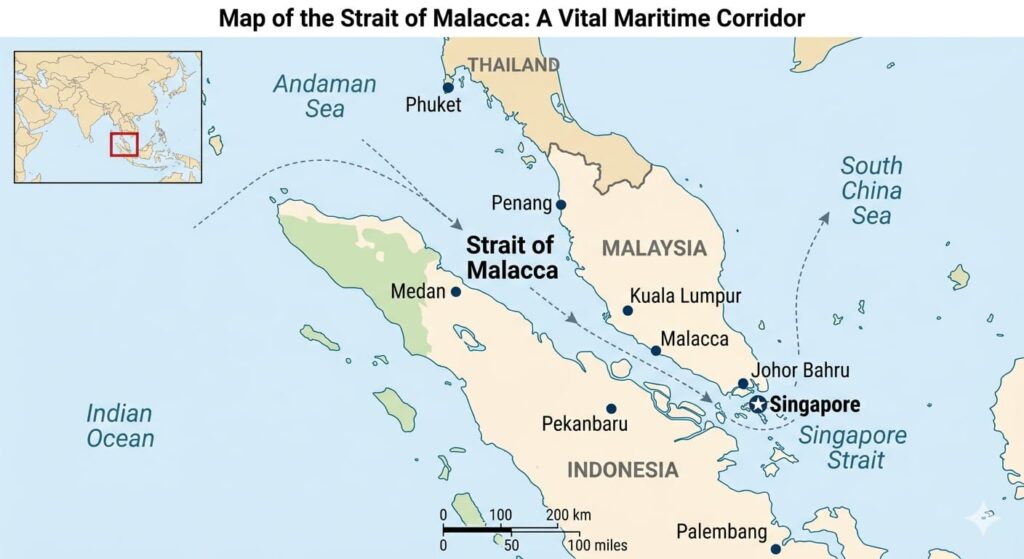
The Strait of Malacca is one of the most important maritime chokepoints in the world. Located between the Malay Peninsula and the Indonesian island of Sumatra, it connects the Indian Ocean to the Pacific Ocean.
For India, this narrow sea passage plays a crucial role in trade, energy imports and strategic security.
What Is the Strait of Malacca?
The Strait of Malacca is a narrow shipping lane through which a large portion of global maritime trade passes.
It is:
- one of the busiest sea routes in the world
- a key connector between Asia, the Middle East and Europe
- critical for energy transportation
Because of its geography, it is difficult to bypass and easy to monitor.
Why the Strait of Malacca Matters for India
- Trade Lifeline
A major share of India’s trade with East Asia passes through this route.
This includes:
- exports to Southeast Asia
- imports from China, Japan and South Korea
Any disruption here directly affects India’s economy.
The importance of the Strait of Malacca becomes clearer when viewed within the broader network of strategic chokepoints.
- Energy Security
A significant portion of oil and gas shipments to Asia passes through this strait.
India, being energy-dependent, is directly impacted by:
- disruptions
- blockades
- instability
- Strategic Location
The strait lies close to India’s maritime sphere of influence.
Its proximity to the Andaman and Nicobar Islands makes it strategically important for monitoring and surveillance.
Military Importance
The Strait of Malacca is not just an economic route but also a strategic military zone.
Naval forces monitor this region to:
- ensure safe passage of trade
- maintain regional stability
- prevent hostile control
Control or influence over this chokepoint can shape regional power balance.
Risks and Vulnerabilities
Despite its importance, the strait faces several risks:
- congestion due to heavy traffic
- piracy and security threats
- potential geopolitical tensions
Even minor disruptions can have large global consequences.
India’s geographic vulnerabilities can also be seen in the case of the Siliguri Corridor.
India’s Strategic Approach
India has taken steps to secure its interests in the region:
- strengthening naval presence
- enhancing surveillance capabilities
- developing infrastructure in Andaman and Nicobar Islands
- cooperating with regional partners
These measures aim to ensure stability and uninterrupted trade flow.
India’s maritime strategy continues to evolve to secure critical sea lanes and trade routes.
Connection with Strategic Chokepoints
The Strait of Malacca is part of a broader network of global chokepoints.
Its importance becomes clearer when viewed alongside other key routes like the Strait of Hormuz and Bab el-Mandeb.
Together, these chokepoints shape global trade and security dynamics.
Strategic Conclusion
The Strait of Malacca remains one of the most critical maritime routes for India.
Its importance goes beyond trade, extending into energy security and geopolitical strategy.
For India, securing access to this chokepoint is essential for long-term stability and growth.