
For centuries, global power was decided on land.
In the 21st century, it will be decided at sea — and no body of water matters more than the Indian Ocean.
Carrying the bulk of global trade, energy flows, and strategic naval movement, the Indian Ocean is no longer a quiet maritime space. It has become the central arena where economics, security, and geopolitics intersect.
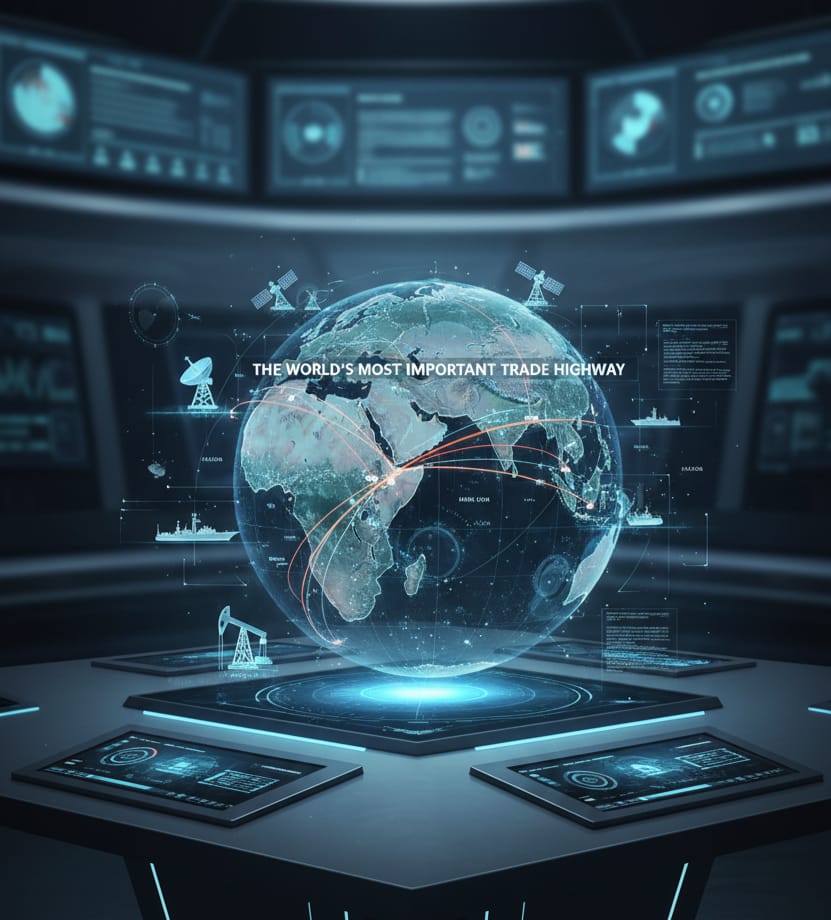
The World’s Most Important Trade Highway
The Indian Ocean connects:
- East Asia
- The Middle East
- Africa
- Europe
Nearly two-thirds of the world’s oil shipments and around 40% of global trade pass through its waters. From crude oil and LNG to containerised goods, global supply chains depend on uninterrupted access to this ocean.
Any disruption here doesn’t remain regional — it becomes global.
Chokepoints That Control the World Economy
What makes the Indian Ocean uniquely powerful is not just its size, but its narrow maritime chokepoints.
Key routes include:
- Malacca Strait
- Bab-el-Mandeb
- Strait of Hormuz
These narrow passages act as pressure valves for the global economy. Control, surveillance, or influence over them provides disproportionate strategic leverage — far greater than traditional military strength alone.
From Commerce to Conflict: The Militarisation of the Indian Ocean
As trade increased, so did naval presence.
Major powers now operate regularly in the Indian Ocean:
- Carrier strike groups
- Nuclear submarines
- Long-range surveillance aircraft
- Undersea cable monitoring systems
What was once an economic corridor is now a contested strategic space.
Naval power today is not just about warfighting — it is about deterrence, visibility, and influence.
India’s Central Position in the Indian Ocean
Geography places India at the heart of this ocean — a reality that shapes its strategic outlook.
India’s long coastline, island territories, and proximity to key chokepoints give it natural advantages that no external power can replicate.
Strategic locations such as the Andaman & Nicobar Islands give India forward presence and maritime depth in the eastern Indian Ocean.
This positioning allows India to monitor shipping lanes, deter hostile activity, and respond rapidly to regional crises.
Infrastructure as Maritime Power
Maritime dominance is not achieved by ships alone.
Ports, coastal infrastructure, logistics hubs, and connectivity determine how effectively a nation can project power and sustain operations.
In modern geopolitics, infrastructure is strategy.
The China Factor in the Indian Ocean
China’s expanding presence in the Indian Ocean has altered strategic calculations.
Through port access agreements, naval deployments, and dual-use facilities, Beijing seeks to secure its trade routes and energy lifelines.
However, China remains geographically constrained.
Its access to the Indian Ocean depends on narrow chokepoints — most notably the Malacca Strait — making it vulnerable to monitoring and pressure.
This asymmetry is a key reason why the Indian Ocean remains strategically decisive.
Beyond Military Power: Diplomacy and Stability
The Indian Ocean is not only about rivalry.
It is also central to:
- Disaster relief operations
- Anti-piracy missions
- Evacuation of civilians
- Regional stability partnerships
India’s role in humanitarian assistance and maritime security enhances its credibility as a net security provider, not an expansionist force.
According to India’s Ministry of Defence, maritime security in the Indian Ocean is directly linked to economic stability and national security.
Conclusion: The Ocean That Will Decide the Century
The Indian Ocean is no longer a background feature of global affairs.
It is where:
Trade routes converge
Naval power is tested
Economic security is defended
Strategic patience matters more than aggression
Nations that understand the Indian Ocean will shape the global order.
Those that ignore it will be shaped by others.
In the 21st century, the road to global power runs through the Indian Ocean.