
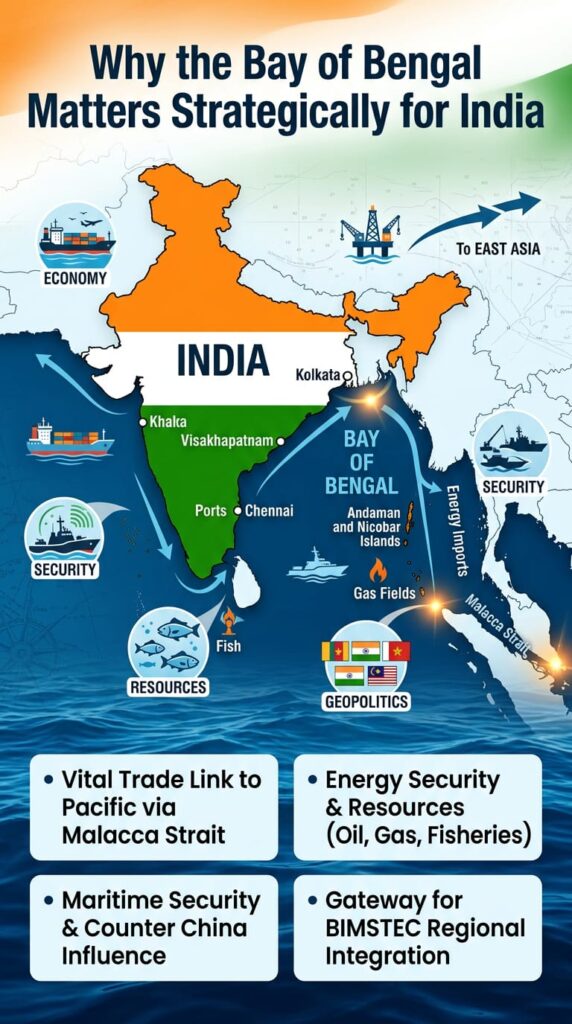
Introduction
The Bay of Bengal is no longer only a regional maritime space connecting India to Southeast Asia. It is increasingly becoming one of the most strategically important maritime zones in India’s long-term security environment.
As maritime competition expands across the wider Indo-Pacific, the Bay of Bengal now carries growing importance for naval access, trade continuity, military logistics, and regional strategic influence.
For India, this eastern maritime space is becoming central to future strategic planning because geography, sea routes, and regional competition now converge here.
Why the Bay of Bengal Matters Geographically
The Bay of Bengal connects India’s eastern coast to Southeast Asia and opens directly toward some of the world’s most important maritime routes.
This maritime space links India to:
- Southeast Asian trade corridors
- Pacific-bound sea lanes
- Strategic shipping routes
- Regional naval movement
Because of this, any instability or military pressure in this region immediately affects India’s eastern maritime calculations.
Connection to the Strait of Malacca
One of the most important reasons the Bay of Bengal matters strategically is its proximity to the Strait of Malacca.
This narrow passage remains one of the busiest maritime chokepoints in the world.
A large share of commercial shipping and energy movement between the Indian Ocean and the Pacific moves through this route.
For India, strategic awareness near this corridor has long-term value because disruptions there affect wider regional stability.
Andaman and Nicobar Give India Strategic Depth
India’s strongest advantage in the Bay of Bengal comes from the Andaman and Nicobar Islands.
These islands extend India’s strategic reach far beyond the mainland and provide important forward positioning near major maritime traffic.
They improve:
- Surveillance capability
- Naval access
- Air operations
- Maritime monitoring
This gives India strategic depth that few regional countries possess.
Naval Competition Is Increasing in the Eastern Maritime Space
The eastern Indian Ocean and Bay of Bengal are seeing increasing naval attention.
As regional powers expand maritime presence, India must maintain sustained awareness across this zone.
This is not simply about conflict.
It is about ensuring uninterrupted maritime access and preserving strategic flexibility.
India’s eastern maritime strategy is closely linked to its broader Indian Ocean security framework.
Why Trade Security Matters Here
A major share of India’s trade movement depends on uninterrupted eastern maritime routes.
Ports on India’s eastern coast remain linked to critical commercial flows moving toward Southeast Asia and beyond.
This means the Bay of Bengal is directly linked to economic resilience.
Future Strategic Importance Will Continue to Grow
As Indo-Pacific competition expands, the Bay of Bengal will likely become even more important.
Future strategic discussions will increasingly focus on:
- Naval presence
- Maritime partnerships
- Undersea infrastructure
- Sea lane security
India’s eastern maritime thinking must therefore continue evolving.
Conclusion
The Bay of Bengal is becoming one of the most important strategic spaces in India’s maritime future.
Its importance comes from geography, proximity to chokepoints, trade dependence, and naval relevance.
As maritime competition grows, India’s ability to shape stability in the Bay of Bengal will become an increasingly important part of national strategy.
Eastern maritime planning also depends on long-term naval capability and official force development.