
Introduction
The Siliguri Corridor is one of the most strategically sensitive stretches of land in India. Located in northern West Bengal, this narrow strip connects mainland India with the eight northeastern states.
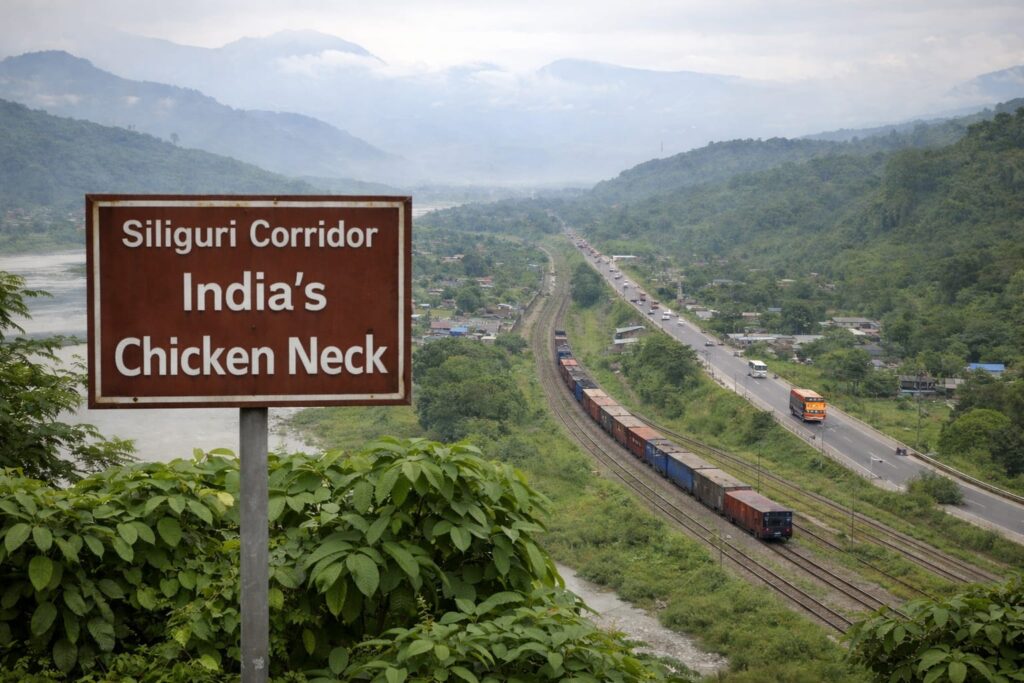
Although small in width, its strategic importance is far greater than its physical size suggests. Over time, it has become widely known as India’s “Chicken Neck” because of its narrow geographical shape and its critical role in national connectivity.
For India, this corridor is far more than a transport route. It is a strategic lifeline that links territory, infrastructure, logistics and military movement.
Why It Is Called Chicken Neck
The phrase “Chicken Neck” comes from the corridor’s narrow shape when viewed on the map.
At its narrowest point, the corridor is only a small distance wide, creating the image of a thin neck connecting a larger landmass.
This narrow geography immediately attracts strategic attention because such corridors naturally become sensitive points in national planning.
A disruption in this narrow stretch could affect physical access between mainland India and the northeast.
That is why the name has remained widely used in strategic discussions.
Where the Corridor Is Located
The corridor lies between Nepal, Bangladesh and Bhutan, making its location unusually sensitive.
This narrow strip passes through northern West Bengal and carries major road, railway and communication routes.
Because of the surrounding geography, the corridor remains one of the most strategically watched land stretches in India.
Its location also means that regional developments around it often receive close strategic attention.
Why the Corridor Matters Strategically
The corridor carries major transport and communication links that support both civilian and strategic movement.
Railways, highways and communication networks passing through this route connect large parts of northeastern India to the rest of the country.
This means the corridor influences not only transport but also broader national resilience.
Its strategic value comes from the fact that a narrow geography supports multiple layers of national connectivity simultaneously.
According to India’s Ministry of Road Transport and Highways, the corridor remains critical for northeastern connectivity.
Why Northeast India Depends on It
The northeastern states depend heavily on this corridor for physical access to mainland India.
Essential goods, fuel movement, passenger transport and strategic logistics all pass through this route.
Because alternative routes remain limited, uninterrupted functioning of the corridor remains extremely important.
This is one reason why infrastructure around the corridor continues to receive attention.
Military Importance of the Corridor
For defence planning, the corridor supports rapid movement of personnel, equipment and supplies toward the northeast.
In strategic terms, secure connectivity remains essential for maintaining military readiness in frontier regions.
The corridor therefore carries significance that goes beyond ordinary transport value.
Military logistics often depend on dependable routes, and narrow corridors naturally gain more strategic relevance in this context.
This narrow corridor becomes even more important when viewed through the wider strategic role of the Siliguri Corridor in India’s national security planning.
Why the Corridor Continues to Draw Strategic Attention
As regional military competition evolves, narrow corridors become even more important.
Strategic planners closely observe such areas because resilience in narrow connectivity zones affects wider national stability.
Infrastructure expansion, transport upgrades and communication resilience therefore matter significantly in this corridor.
Strategic Conclusion
The Siliguri Corridor is called India’s Chicken Neck because of its narrow geography and exceptional strategic importance.
Though physically small, it remains one of the most important land corridors in India because it connects territory, logistics and strategic mobility.
Its importance ensures that it will remain central to Indian strategic thinking for many years ahead.