
Introduction
The Siliguri Corridor is one of the most strategically sensitive land stretches in India because it connects mainland India with the entire northeastern region. Although often discussed in military and geopolitical terms, its deeper importance lies in the fact that millions of people, major state economies and critical transport systems in Northeast India depend on this narrow corridor every day.
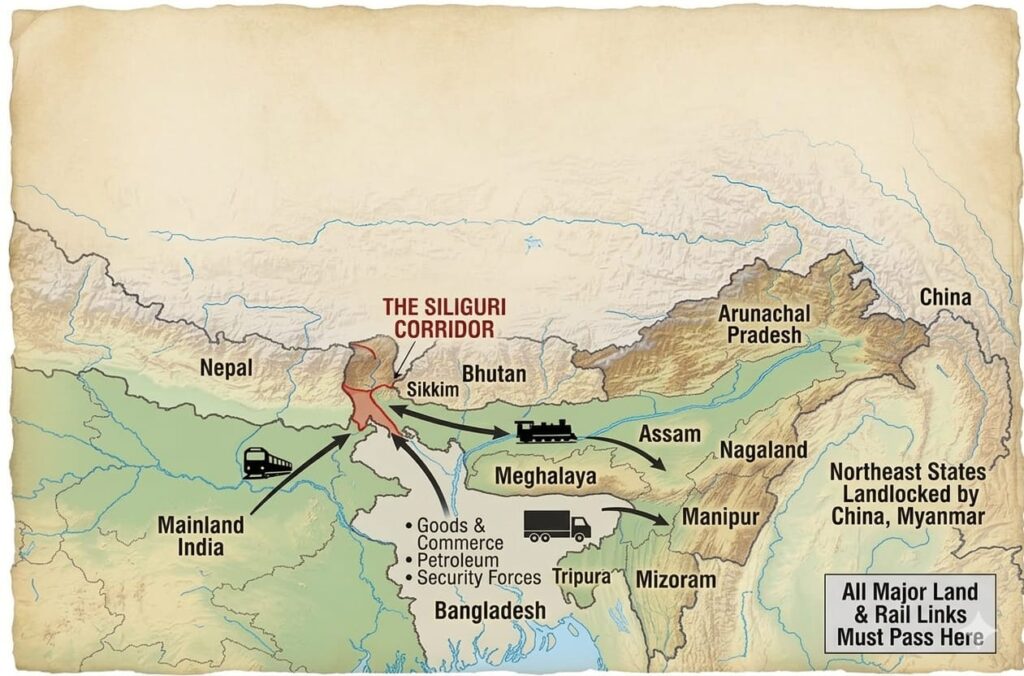
Located in northern West Bengal, this narrow strip is only around 20–22 kilometres wide at its narrowest point. It lies between Nepal and Bangladesh, while Bhutan and China remain strategically close to the northern side. Because of this geography, nearly all major land connectivity between mainland India and the northeastern states passes through this corridor.
For India, this is not simply a narrow route on the map. It is one of the most important physical links holding together a major strategic region.
Why the Corridor Matters for Northeast India
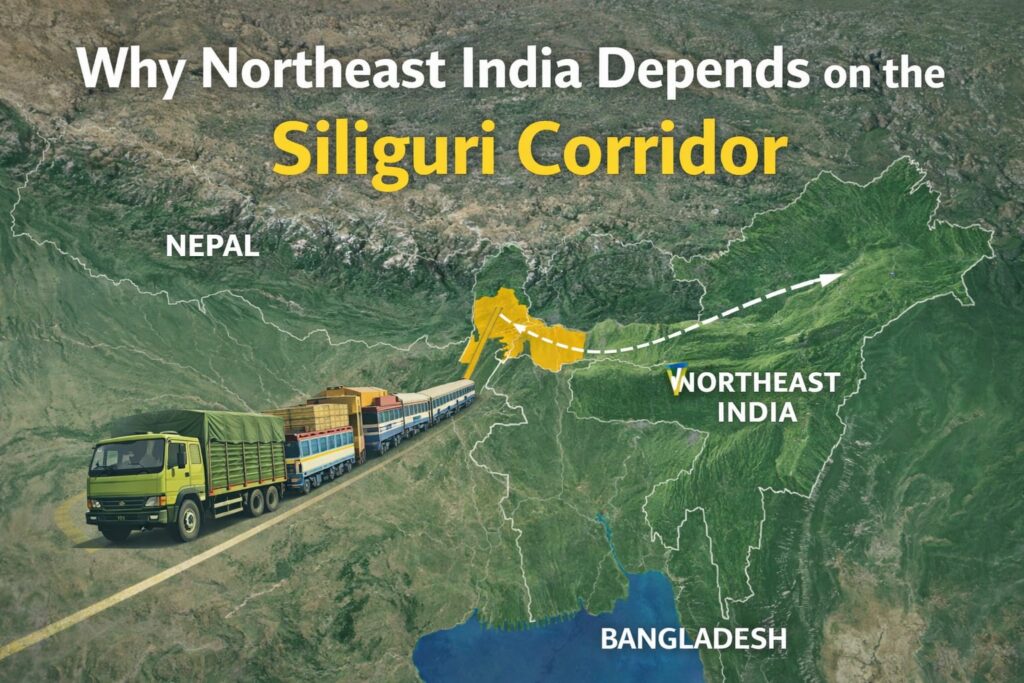
The northeastern region includes Assam, Arunachal Pradesh, Meghalaya, Nagaland, Manipur, Mizoram, Tripura and Sikkim.
These states depend heavily on the corridor because most land-based movement from mainland India enters the region through this route.
Essential goods, passenger movement, fuel supplies, industrial material and communication infrastructure all rely heavily on uninterrupted corridor access.
This makes the corridor central not only for movement but also for economic continuity.
This dependence becomes even clearer when examined through the broader strategic role of the Siliguri Corridor.
Rail Connectivity Through the Corridor
A major part of railway movement into Northeast India passes through the Siliguri sector.
Rail lines entering Assam and further northeastern states move through this corridor before branching deeper into the region.
This supports:
- passenger trains
- freight transport
- petroleum supply
- food grain movement
- construction material logistics
Rail connectivity remains especially important because large-volume transport depends on dependable rail movement.
India’s railway expansion in the northeast has been guided by long-term national connectivity priorities.
Road Transport and Supply Chains
National highways crossing the corridor support heavy truck movement into the northeast.
Fuel, medicines, LPG, diesel, cement, food products and consumer goods all move through this route in large quantities.
This means the corridor supports daily supply chains that affect both urban and rural parts of the northeastern region.
When movement slows in the corridor, logistics pressure is often felt quickly in downstream areas.
Why Assam Is Especially Important in This Network
Assam functions as the central distribution zone once goods enter the northeast.
Because of this, movement through Siliguri influences supply chains far beyond one state.
Transport entering Assam later spreads toward other northeastern states through connected road and rail systems.
This explains why corridor continuity matters at regional scale.
Strategic Importance for Defence Supply
The corridor is equally important for defence logistics.
Military movement toward eastern sectors depends heavily on reliable corridor access.
Troop movement, fuel supply, equipment transfer and strategic logistics all benefit from uninterrupted connectivity.
This gives the corridor strategic significance beyond ordinary infrastructure.
Why Geography Creates Strategic Sensitivity
The corridor’s narrow width creates unusual strategic attention.
At some points, the land width reduces sharply, which means a narrow stretch supports very large movement volumes.
This is why the corridor is often called India’s Chicken Neck.
Its narrow geography means resilience becomes more important than size.
Why India Is Expanding Alternative Connectivity
India is gradually reducing overdependence by strengthening parallel infrastructure.
This includes:
- stronger border roads
- expanded rail projects
- bridge construction
- regional air links
- inland connectivity improvements
However, none of these reduce the central importance of Siliguri itself.
Economic Impact on Northeast India
Trade entering Northeast India depends heavily on uninterrupted corridor movement.
Businesses across Assam and adjoining states rely on regular freight flow through Siliguri.
Any prolonged disruption can increase transport costs and delay essential supplies.
This gives the corridor direct economic importance.
Strategic Conclusion
The Siliguri Corridor remains one of India’s most important national corridors because Northeast India depends on it every day.
It supports transport, supply chains, defence movement and economic continuity.
For India, securing this corridor means securing uninterrupted connection with one of the country’s most strategically important regions.