
India has taken a major leap in strengthening its air power preparedness with the development of Emergency Landing Facilities (ELFs) on highways. These specialised stretches allow fighter jets and transport aircraft to land and take off during emergencies, war-like situations, or when regular airbases are compromised.
This strategy significantly enhances India’s defence readiness, especially in sensitive border regions.
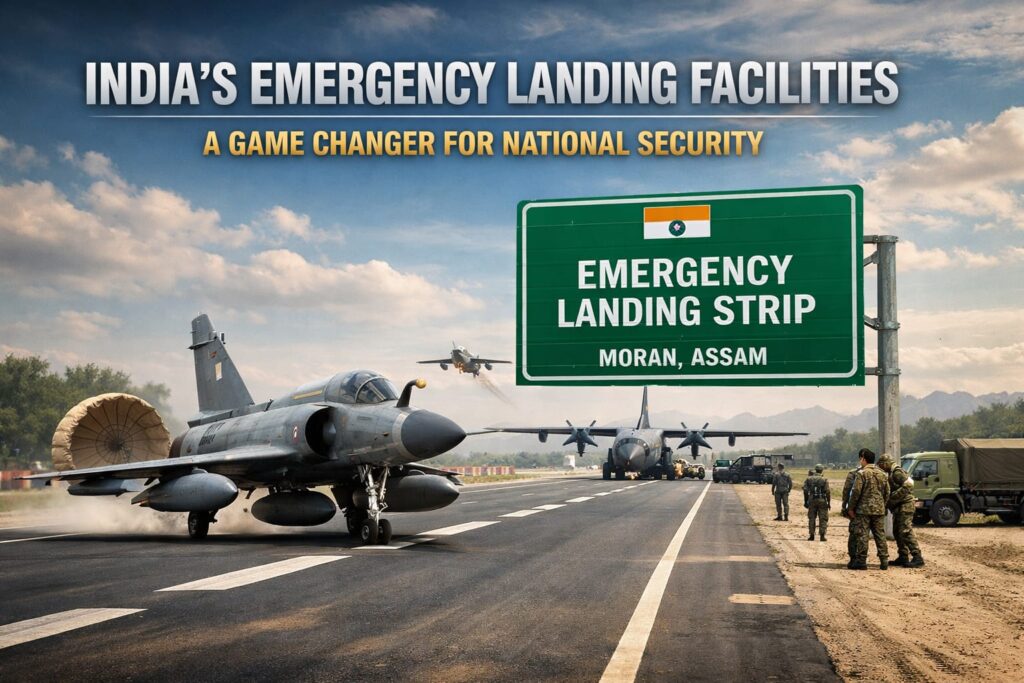
What Is an Emergency Landing Facility?
An Emergency Landing Facility (ELF) is a straight, reinforced stretch of a national highway designed to function as a temporary runway for military aircraft.
These facilities are built with:
- Extra-strong concrete layers
- Removable crash barriers and streetlights
- Clear approach paths for aircraft
- Rapid deployment capability
Unlike traditional airbases, ELFs are harder to detect and target, making them ideal during conflicts.
India’s First Northeast Highway Airstrip
Recently, the Indian Air Force successfully conducted trial landings at an ELF in Moran, Assam, located on National Highway 127.
This marked:
- The first highway-based emergency landing facility in Northeast India
- A major boost to India’s eastern air operations
- Enhanced readiness near the India–China frontier
Aircraft from the Indian Air Force performed touch-and-go operations to validate the runway’s operational readiness.
Why Emergency Landing Facilities Matter for India
1️⃣ Reduced Dependence on Fixed Airbases
Traditional airbases are known targets during wars. ELFs allow aircraft to operate even if major bases are damaged.
2️⃣ Faster Military Response
Fighter jets can refuel, rearm, and redeploy closer to conflict zones, cutting response time drastically.
3️⃣ Strategic Advantage in Border Regions
Highway airstrips in Assam, Ladakh, Rajasthan, and central India provide flexibility against threats from both eastern and western fronts.
4️⃣ Civil–Military Infrastructure Integration
Using highways for defence purposes ensures efficient use of public infrastructure without massive additional land acquisition.
Lessons from Other Countries
Countries like:
- Sweden
- Finland
- Taiwan
have long used highway runways as part of their air defence doctrine. India’s adoption of this model shows a shift toward modern, dispersed warfare strategies.
Role in a Two-Front War Scenario
India faces the possibility of a two-front challenge involving China and Pakistan. In such a scenario:
- Fixed airbases may be targeted early
- ELFs provide surprise, flexibility, and survivability
- Air operations can continue even under sustained attacks
This makes ELFs a force multiplier rather than just backup infrastructure.
More ELFs Planned Across India
The government plans to develop several more highway airstrips across:
- Uttar Pradesh
- Rajasthan
- Madhya Pradesh
- Ladakh region
- Assam
These projects align with India’s long-term goal of self-reliant defence and rapid military mobilisation.
How Emergency Landing Facilities Work During Conflict
During conflict, fixed airbases are among the first targets. However, highway landing strips offer a safer alternative.
As a result, fighter jets can operate from multiple locations. This improves survivability and ensures continued air operations.
Conclusion
India’s Emergency Landing Facilities are not just engineering achievements — they are a strategic statement. They signal preparedness, adaptability, and the ability to sustain air operations under extreme conditions.
As regional security challenges evolve, such innovations ensure that India stays one step ahead, both in the skies and on the ground.
India has also been investing heavily in defence infrastructure and air force modernisation to counter emerging security challenges.