
By IndicInfo | Defence & Strategic Affairs
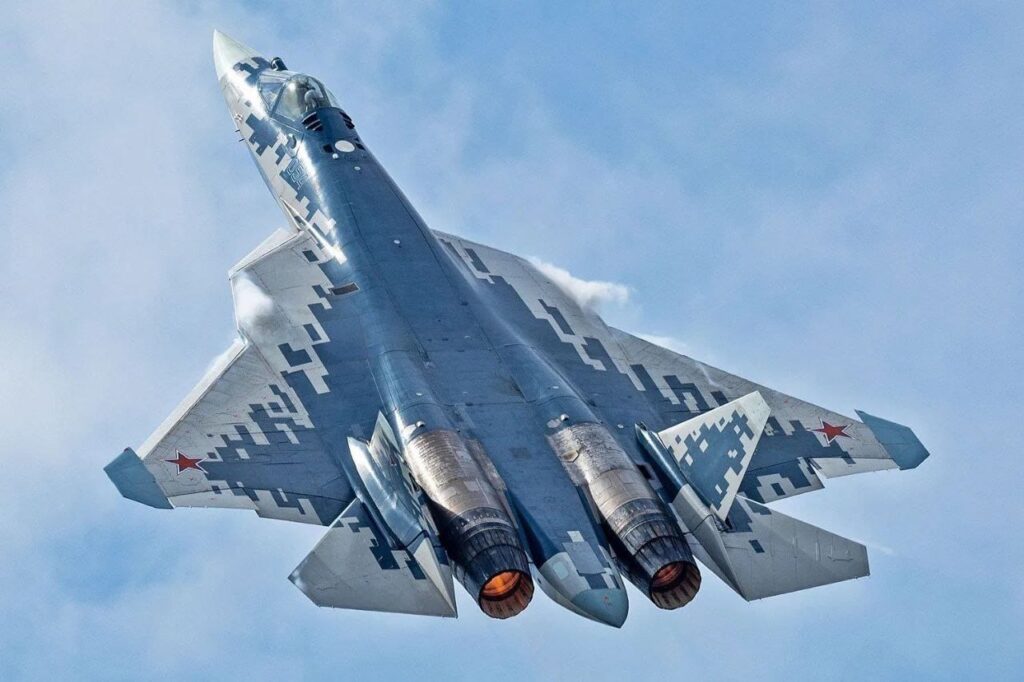
Russia has confirmed that talks with India on the joint production of the Su-57E fifth-generation fighter aircraft have entered an advanced technical stage, marking a potentially significant shift in India’s combat aviation and defence-industrial trajectory.
The confirmation comes from senior leadership of Russia’s aerospace industry and has been echoed across multiple defence-focused publications and strategic watchers.
If concluded, the deal would represent India’s deepest access yet to fifth-generation fighter technologies, while also reshaping long-term Indo-Russian defence cooperation.
What Is the Su-57E?
The Su-57 is Russia’s fifth-generation stealth multirole fighter, designed for air superiority, deep strike, and network-centric warfare. The Su-57E is its export variant, tailored for foreign partners with flexibility in weapons and avionics integration.
Unlike earlier Russian fighters operated by India, the Su-57 belongs to an entirely new generation, comparable in role — though not identical in design philosophy — to aircraft such as the F-35 and J-20.
What Russia Is Offering India
According to available details, Russia’s proposal to India goes far beyond a simple purchase.
Key elements of the offer include:
- Licensed production in India, potentially using existing Hindustan Aeronautics Limited (HAL) facilities, similar to the Su-30MKI program
- Deep integration of Indian industry, systems, and weapons
- Access to avionics source code, a rare offer in modern fighter programs
- Engine technology cooperation, including the advanced Izdeliye-177S engine
- Stealth know-how, including radar cross-section (RCS) reduction methods and materials
- Weapons integration flexibility, including Indian missiles and select Russian long-range systems
- Direct R&D support for India’s indigenous fifth-generation fighter program
This level of technology sharing is virtually unmatched by Western platforms, which usually impose strict restrictions on source codes, weapons integration, and upgrades.
Why This Matters for India
- Bridging the Fifth-Generation Gap
India currently lacks an operational fifth-generation fighter. While the AMCA program is progressing, it is still several years away from induction.
The Su-57E could serve as a capability bridge, allowing the Indian Air Force to gain fifth-generation operational experience while AMCA matures. - Industrial and Technological Leap
Joint production would:
Strengthen India’s aerospace manufacturing ecosystem
Accelerate mastery over stealth materials and advanced engines
Reduce long-term dependence on imports
Create spillover benefits for indigenous programs like AMCA, TEDBF, and UAV platforms
The Su-30MKI program previously transformed India’s fighter-manufacturing base; a Su-57E program could do the same — at a much higher technological level. - Strategic Autonomy
India has consistently prioritised strategic autonomy over bloc politics. Unlike Western fifth-generation fighters, which come with geopolitical conditions, the Russian offer aligns with India’s long-standing preference for operational sovereignty.
Access to source codes and local upgrades means India would not be dependent on foreign political approvals during crises.
Why India Is Still Cautious
Despite the advanced talks, India has not yet issued an official confirmation or commitment. There are clear reasons for this caution:
Past experience with the FGFA project raised concerns over cost and timelines
India wants assurances on engine maturity and stealth performance
The Indian Air Force is simultaneously modernising its fleet with Tejas Mk-1A, Mk-2, and Rafale
Budgetary prioritisation remains a key factor
New Delhi is likely evaluating whether the Su-57E fits into a balanced long-term force structure rather than acting as a standalone solution.
The Bigger Picture
If the deal moves forward, it would signal:
A renewed depth in Indo-Russian defence ties
India’s intent to enter the fifth-generation era without surrendering autonomy
A pragmatic approach to capability gaps while indigenous programs mature
Equally, if India declines, it will reinforce New Delhi’s commitment to fully indigenous fifth-generation development, even if that means a longer wait.
Conclusion
Russia’s Su-57E proposal places a serious option on India’s table — one that combines advanced capability, industrial growth, and strategic independence.
Whether India chooses to proceed or not, the talks themselves highlight a critical reality:
fifth-generation air power is no longer optional — it is inevitable.
For India, the question is not if, but how and with whom.