
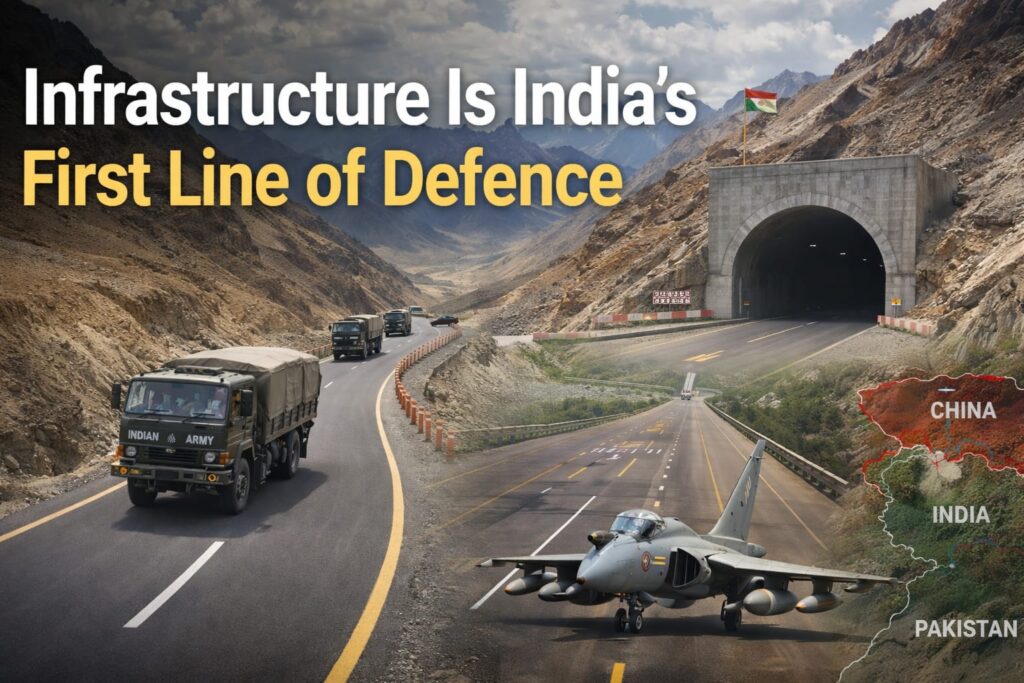
Infrastructure Is No Longer Just Development — It Is Strategy
For decades, infrastructure in India was seen as a symbol of development. Roads, railways, ports, and airports were treated as economic assets.
Today, that thinking is outdated.
In the 21st century, infrastructure has become a core pillar of national security. A nation’s ability to move troops, supplies, fuel, and equipment quickly can decide the outcome of a conflict even before the first shot is fired.
This reality is shaping India’s strategic planning in an increasingly unstable neighbourhood.
Why Infrastructure Decides Modern Wars
Modern wars are fought as much through logistics and mobility as through weapons.
A country with:
- Faster troop movement
- Reliable supply chains
- Redundant transport routes
holds a decisive advantage.
Military strength collapses if roads cannot carry heavy armour, bridges cannot support convoys, or airstrips are too far from conflict zones.
According to official defence planning documents, infrastructure development is closely linked with operational readiness.
India’s Strategic Geography Needs Strategic Infrastructure
India faces two active fronts:
- The western front with Pakistan
- The northern and eastern front with China
Large parts of these borders lie in mountainous, high-altitude terrain, where infrastructure gaps directly weaken military readiness.
This is why roads, tunnels, bridges, and rail lines near borders are no longer civilian projects — they are strategic assets.
India’s strategic vulnerabilities are most visible in regions like the Siliguri Corridor, a narrow land bridge connecting the Northeast to the mainland.
Border Roads, Tunnels, and Bridges: Silent Force Multipliers
Over the last decade, India has accelerated construction in sensitive regions:
- All-weather roads in Ladakh and Arunachal Pradesh
- Strategic tunnels reducing travel time from days to hours
- Load-bearing bridges designed for tanks and missile carriers
These projects quietly change the balance on the ground.
A road completed today can:
- Cut troop deployment time by 60–70%
- Enable winter logistics
- Maintain continuous supply lines during conflict
Infrastructure does not grab headlines — but it wins wars quietly.
Highways as Airstrips: A New Defence Doctrine
India’s move toward Emergency Landing Facilities (ELFs) on highways reflects this new thinking.
Highways capable of hosting fighter aircraft provide:
- Backup airbases during war
- Dispersal capability against missile attacks
- Rapid air response deep inside the mainland
This blurs the line between civilian and military infrastructure — exactly what modern defence planning demands.
China’s Infrastructure Model and the Strategic Lesson for India
China has invested heavily in:
- Dual-use highways
- Rail networks connected to military bases
- Airfields close to contested borders
These assets allow China to mobilise forces at scale and speed.
India’s recent push to close this gap is not escalation — it is strategic necessity.
Infrastructure parity is essential to deterrence.
Infrastructure as Deterrence, Not Provocation
Strong infrastructure does not invite conflict.
It prevents miscalculation.
When adversaries know that India can:
- Mobilise rapidly
- Sustain long operations
- Protect supply chains
they are less likely to test red lines.
In this sense, roads and railways act as silent deterrents.
The Civilian-Military Overlap Is the Future
In modern national security planning:
- A port supports trade in peace and naval operations in war
- A railway moves passengers in peace and armour in crisis
- A highway serves commuters today and fighter jets tomorrow
This overlap maximises efficiency while strengthening security.
Conclusion: Infrastructure Is India’s Strategic Backbone
National security is no longer defined only by missiles, tanks, or aircraft.
It is defined by:
- How fast forces can move
- How reliably supplies flow
- How resilient transport networks remain under pressure
For India, infrastructure is not a support system — it is the backbone of national security.
Every road built near a border, every tunnel through a mountain, and every upgraded airstrip strengthens India’s ability to protect itself in an uncertain world.