
Introduction
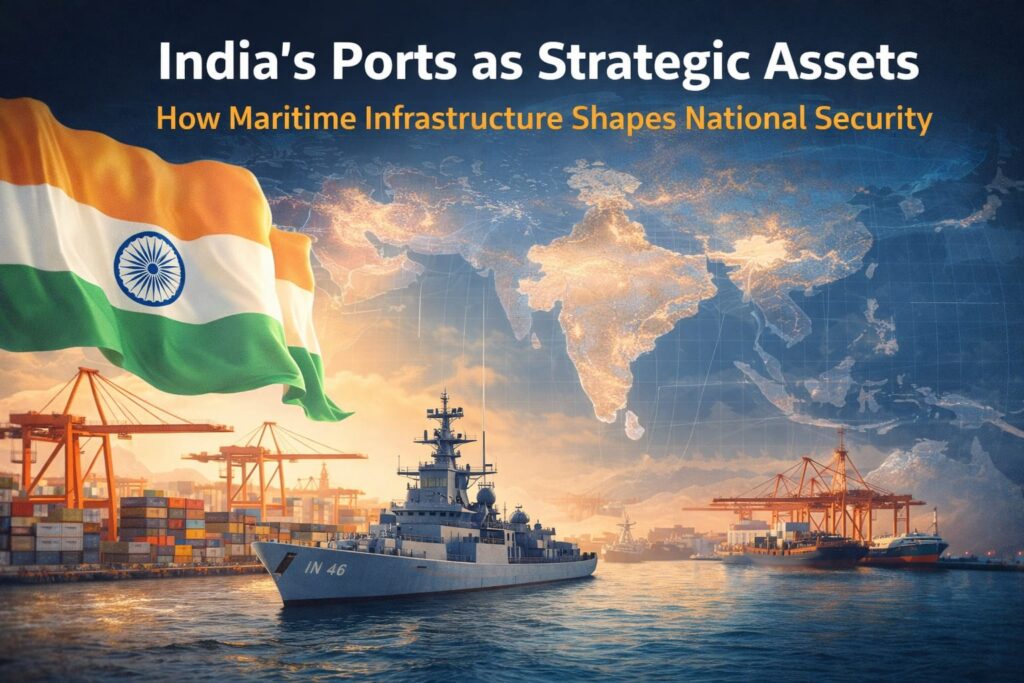
In the 21st century, wars are no longer fought only on borders or battlefields. They are fought across supply chains, sea lanes, ports, and logistics hubs. For India, a nation that depends on maritime trade for nearly 90% of its commerce by volume, ports are no longer just economic gateways — they are strategic assets.
Maritime infrastructure today sits at the heart of national security. Control over ports determines trade resilience, energy security, military mobility, and geopolitical influence. As global power competition intensifies, India’s coastline has become a frontline.
Why Ports Matter to National Security
Ports are where economics and security intersect.
- Over 90% of India’s trade by volume moves through sea routes
- Energy imports, including crude oil and LNG, arrive via ports
- Military logistics, naval deployment, and humanitarian operations depend on port access
Any disruption to ports can paralyse the economy, weaken military readiness, and expose strategic vulnerabilities.
This is why modern conflicts increasingly target infrastructure rather than armies.
Maritime Trade Routes: Invisible Battle Lines
India sits astride some of the world’s most critical Sea Lines of Communication (SLOCs).
Key routes include:
- The Indian Ocean Region (IOR)
- The Strait of Hormuz
- The Malacca Strait
These routes carry:
Energy supplies from West Asia
Trade flows between Asia, Africa, and Europe
Military and commercial shipping
Control, surveillance, and protection of these routes are now core security objectives.
Ports are the anchors of this system.
This strategic reality mirrors land-based chokepoints like the Siliguri Corridor, where geography directly shapes India’s national security.
According to India’s Ministry of Defence, the Indian Ocean Region remains central to India’s maritime security strategy.
Andaman & Nicobar: India’s Unsinkable Aircraft Carrier
The Andaman & Nicobar Islands represent India’s most strategic maritime asset.
Their importance lies in:
- Proximity to the Malacca Strait
- Ability to monitor Chinese naval movement
- Forward deployment of Indian naval and air assets
Modernising ports and infrastructure in these islands allows India to project power deep into the Indo-Pacific while safeguarding its eastern seaboard.
This is deterrence through geography.
The Andaman & Nicobar Command plays a critical role in monitoring key sea lanes in the Indo-Pacific.
China’s Port Strategy vs India’s Response
China has long understood the strategic value of ports.
Through the Belt and Road Initiative, Beijing has built or acquired influence over ports in:
- Gwadar (Pakistan)
- Hambantota (Sri Lanka)
- Djibouti
- Kyaukpyu (Myanmar)
These ports are marketed as commercial projects but possess clear military utility.
India’s response has been measured but strategic:
- Strengthening domestic ports
- Investing in maritime surveillance
- Expanding naval presence in the IOR
- Building partnerships with like-minded maritime nations
Ports are no longer neutral infrastructure — they are geopolitical tools.
Ports, Supply Chains, and Economic Warfare
Supply chain disruption has emerged as a weapon of modern conflict.
A blocked port can:
- Halt industrial production
- Spike inflation
- Disrupt food and energy supplies
- Undermine public confidence
India’s push to modernise ports under infrastructure development programs is therefore not just about efficiency — it is about resilience.
A resilient port network ensures:
- Faster military mobilisation
- Trade continuity during crises
- Reduced dependence on foreign chokepoints
Economic security is national security.
This aligns with India’s evolving understanding that supply chains are the new battle lines in modern national security planning.
Naval Power and Port Infrastructure
A strong navy requires strong ports.
Ports support:
- Ship maintenance and refuelling
- Rapid deployment of forces
- Joint operations with allies
- Disaster relief and evacuation missions
Without modern port infrastructure, naval power remains limited.
India’s maritime ambitions in the Indo-Pacific depend as much on docks and logistics as on warships.
Conclusion: Ports Are the New Frontlines
India’s strategic environment is changing. Borders still matter, but so do coastlines, harbours, and sea routes.
Ports today:
- Enable economic growth
- Secure supply chains
- Strengthen deterrence
- Project national power
In an era where wars may begin without a single shot being fired, infrastructure determines survival.
India’s ports are no longer just gateways to trade — they are gateways to national security.