
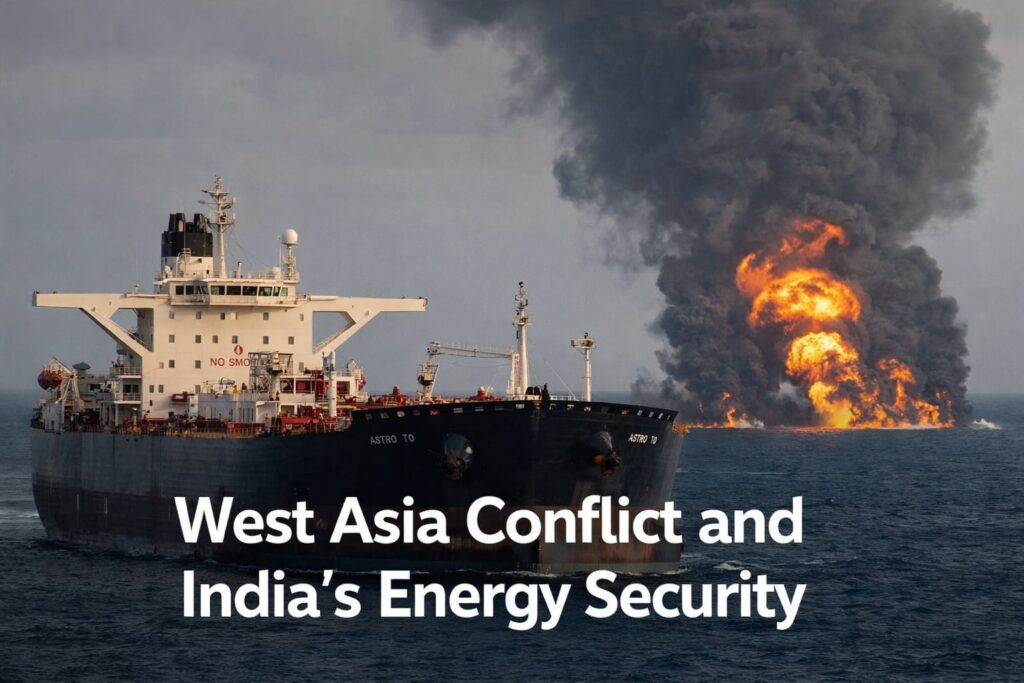
Rising Tensions in West Asia
The rapidly escalating conflict in West Asia has triggered serious concerns about global energy supply chains and regional stability. The situation intensified after military strikes and retaliatory actions involving Iran, Israel and the United States, raising fears of a wider regional confrontation.
For countries heavily dependent on imported energy such as India, the developments carry significant economic and strategic implications.
Energy Security Comes Into Focus
One of the biggest concerns for India is its dependence on West Asian energy supplies.
India imports more than 85% of its crude oil requirements, with a large portion coming from the Gulf region. Any disruption in shipping routes or production could directly affect fuel prices and economic stability.
Analysts warn that disruption in the Strait of Hormuz could sharply raise global oil prices.
A prolonged conflict may lead to:
- Rising fuel prices
- Inflationary pressure
- Higher transport costs
- Increased industrial costs
Government Monitoring the Situation
The Indian government is closely monitoring developments through inter-ministerial coordination.
Officials are assessing possible effects on trade routes, shipping insurance costs and strategic reserves.
India’s diversified crude sourcing, including supplies from Russia, provides some flexibility during global disruptions.
India’s maritime preparedness has become increasingly important. Read also: https://indicinfo.in/indias-national-security-doctrine-in-the-21st-century/
Economic Risks for India
A prolonged crisis in West Asia could affect multiple sectors of the Indian economy.
Imports linked to crude oil, LNG, fertilisers and industrial materials may face volatility if tensions continue.
Financial analysts also warn that prolonged energy price shocks could affect inflation and growth projections.
Strategic Implications
The crisis also reinforces the importance of India’s maritime strategy.
Sea lanes in the Indian Ocean remain critical for energy security. Any instability in Gulf shipping routes immediately becomes a strategic concern for New Delhi.
This is why naval readiness and supply-chain resilience are increasingly central to India’s strategic planning.
According to the International Energy Agency, global oil markets remain sensitive to geopolitical disruptions.
Conclusion
The evolving West Asia crisis once again shows how deeply geopolitics affects energy security.
For India, the priority remains clear: maintain supply stability, monitor maritime routes and prepare for prolonged uncertainty.
In the current global environment, energy security and national strategy are closely linked.