
India has taken an important step in advanced semiconductor research.
Researchers at the Indian Institute of Science (IISc), Bengaluru, have solved a long-standing problem in Gallium Nitride (GaN) power devices, making them safer, more reliable, and better suited for high-power applications.
This breakthrough may not look dramatic at first glance.
But in the long run, it can play a key role in India’s push towards semiconductor self-reliance.
This breakthrough also aligns with the broader global supply chain shift, where India is positioning itself as an alternative manufacturing hub for critical technologies.
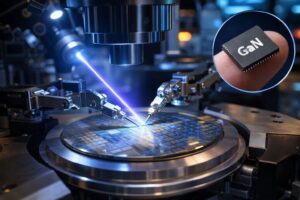
What Is Gallium Nitride (GaN) and Why It Matters
Gallium Nitride, or GaN, is a next-generation semiconductor material.
It is far more efficient than traditional silicon when it comes to handling high power and high voltage.
GaN devices are crucial for:
- Electric vehicles (EVs) and fast chargers
- Data centres and cloud infrastructure
- Defence and aerospace systems
- Renewable energy and smart power grids
Globally, countries like the US, China, Japan, and the EU are investing heavily in GaN-based technologies.
The Core Problem With GaN Devices
Despite its advantages, GaN has one major technical challenge.
Gate leakage.
In simple terms, GaN transistors tend to leak unwanted current at the gate.
This leakage reduces reliability and increases the risk of device failure, especially in high-power environments.
Another issue is low threshold voltage, which can cause accidental switching.
For applications like EVs or defence systems, this is a serious safety concern.
These issues have slowed down large-scale GaN adoption worldwide.
What IISc Researchers Achieved
IISc researchers identified the missing physics behind GaN gate behaviour.
Based on this understanding, they engineered a new gate stack design that:
- Dramatically reduces gate leakage
- Raises the threshold voltage
- Improves overall device stability
In practical terms, this means GaN devices that are safer, more robust, and industry-ready.
This is not a minor tweak.
It addresses one of the most critical bottlenecks in GaN power electronics.
Why This Breakthrough Is Important for India
India currently imports most of its advanced power semiconductor components.
GaN devices are expensive and strategically sensitive.
This IISc breakthrough matters because:
- It strengthens India’s domestic research base
- It supports the India Semiconductor Mission
- It reduces long-term dependence on foreign technologies
- It helps build a local power electronics ecosystem
India may not yet have large commercial GaN fabs, but foundational research is the first step in building any semiconductor industry.
Impact on EVs, Data Centres, and Defence
Electric Vehicles
GaN enables faster charging, smaller chargers, and higher efficiency.
Improved reliability makes GaN more viable for mass EV adoption.
Data Centres
GaN power devices reduce energy loss and heat generation.
This lowers electricity costs and improves system stability.
Defence and Aerospace
High-power, high-reliability electronics are essential for radars, missiles, and avionics.
Safer GaN devices are a strategic advantage.
India’s Position in the Global GaN Race
Globally, GaN research is moving fast.
China and the US already dominate manufacturing and patents.
India’s strength lies in high-quality research and engineering talent.
Breakthroughs like this help India enter the global value chain at the right level — innovation, not just assembly.
Over time, such research can attract:
- Industry collaboration
- Technology transfer
- Indigenous manufacturing investments
What Happens Next
The next challenge is scaling.
- Lab results must translate to industrial production
- Industry partnerships will be crucial
- Government support can accelerate adoption
This is a long-term journey, not an overnight success.
But every semiconductor ecosystem starts with solving hard problems — and that is exactly what IISc has done.
Conclusion
India’s semiconductor ambitions cannot rely only on mega fabs and foreign partnerships.
They must be backed by strong, original research.
The IISc breakthrough in GaN power devices shows that India is capable of solving globally relevant technology challenges.
It may not make headlines like a multi-billion-dollar fab announcement.
But in the long run, it could prove far more important.