
Introduction
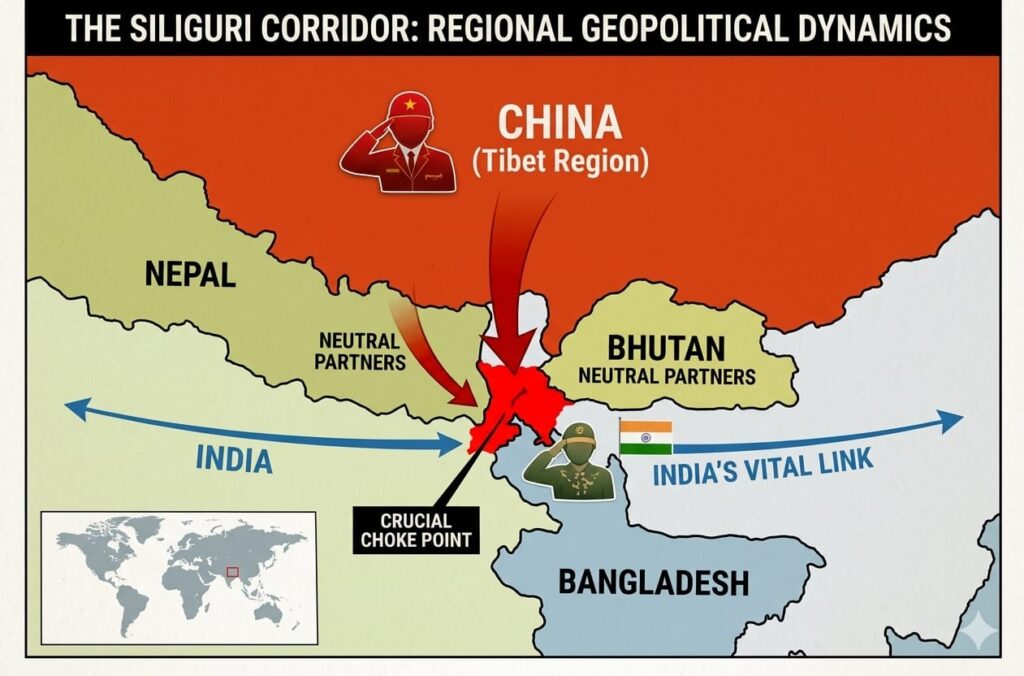
The Siliguri Corridor has become one of the most discussed strategic land stretches in South Asia because of its unique geography and its direct role in connecting mainland India with the northeastern states.
Located in northern West Bengal, this narrow corridor lies between Nepal, Bhutan and Bangladesh, making it one of the most sensitive land connectors in the region.
Because of this location, the corridor attracts strategic attention not only inside India but also in wider regional geopolitical thinking.
Why the Corridor Draws Chinese Strategic Attention
Any narrow land corridor that supports major national connectivity naturally becomes strategically important in regional planning.
The Siliguri Corridor carries road networks, rail links, logistics movement and communication infrastructure that connect India’s northeast with the rest of the country.
For regional strategic observers, such narrow corridors are often studied because they influence mobility, supply continuity and territorial resilience.
This is one reason why the corridor appears repeatedly in discussions related to South Asian strategic geography.
Geographic Sensitivity of the Corridor
The corridor lies close to the India-Bhutan border and remains geographically near areas where regional military attention has periodically increased.
Its narrow width means that even small geographical stretches carry major strategic meaning.
This narrowness makes infrastructure resilience especially important because large volumes of movement pass through a limited physical space.
That is why maps of South Asian strategic geography often highlight this corridor.
According to India’s Ministry of External Affairs, regional geography continues to shape long-term strategic policy.
Why Narrow Corridors Matter in Strategic Thinking
In military and geopolitical analysis, narrow corridors often receive high attention because they combine territorial dependency with limited physical width.
Such geography does not automatically imply vulnerability, but it means strategic planning must account for resilience and continuity.
Countries often strengthen infrastructure around narrow corridors because uninterrupted connectivity becomes essential.
This is why narrow corridors across the world are often discussed far beyond their size.
The corridor’s strategic importance becomes clearer when linked to India’s broader Siliguri Corridor security calculations.
Why Infrastructure Around Siliguri Matters
India has steadily strengthened road, railway and communication systems around the corridor because reliable connectivity remains essential.
The stronger the transport network, the greater the resilience of strategic movement.
Infrastructure expansion therefore changes how such corridors are viewed externally.
A corridor supported by stronger infrastructure is often seen as more resilient in long-term strategic assessment.
Chinese Strategic Literature and Regional Geography
Regional strategic discussions often focus on how geography shapes long-term state planning.
Because the Siliguri Corridor connects a large region through a narrow passage, it naturally appears in broader discussions of South Asian geography.
This attention is driven mainly by geography itself rather than by temporary events.
Narrow connectors always receive attention because geography shapes strategic options over long periods.
Why Northeast Connectivity Matters in Regional Analysis
The northeastern states depend heavily on this corridor for transport, supply movement and communication.
This means that any discussion of India’s northeast naturally includes the corridor.
Its role in linking large territory through a narrow passage makes it strategically distinctive.
This explains why external strategic observers continue to pay attention to it.
Why the Corridor Remains Important for India
For India, the corridor remains a critical national connector.
It supports civilian movement, logistics chains, fuel supply routes and strategic mobility.
This makes uninterrupted functioning of the corridor a long-term national priority.
The corridor therefore remains central to infrastructure planning as well as strategic thinking.
Strategic Conclusion
China views the Siliguri Corridor strategically because narrow land corridors always matter in regional geopolitical thinking.
Its location, infrastructure and connectivity make it one of the most important geographic points in South Asia.
For India, maintaining resilience around this corridor remains central to long-term strategic planning.