
India’s Economic Survey 2025–26 presents a picture of macroeconomic stability and resilience at a time of global uncertainty. Growth remains robust, financial buffers are strong, and systemic risks in banking have significantly declined. However, beneath the headline numbers lies a critical challenge: whether India can convert macro strength into sustained manufacturing-led growth.
GDP Growth: Stability Over Spectacle
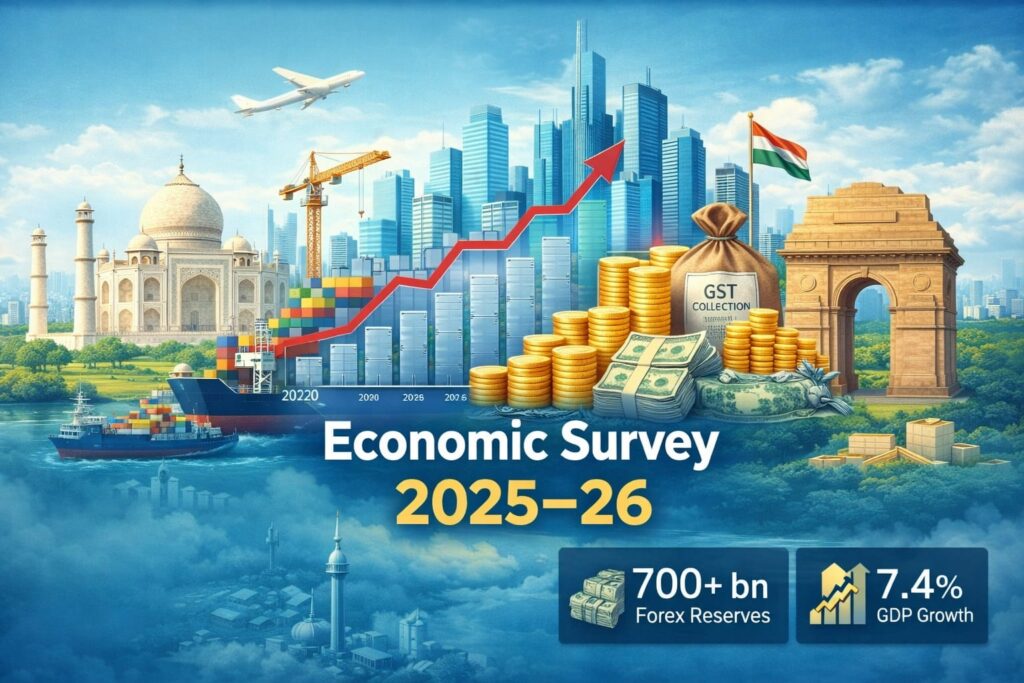
The Survey projects real GDP growth of 7.4% for FY26 (First Advance Estimates), placing India among the fastest-growing major economies globally. For FY27, growth is expected to moderate to a 6.8–7.2% range, reflecting global headwinds, tighter financial conditions, and geopolitical risks.
Importantly, the Survey estimates India’s potential growth rate at around 7%, suggesting that current performance is close to its structural capacity. This shifts the policy focus from demand stimulus to productivity, competitiveness, and capital formation.
External Strength: Forex Reserves Cross $700 Billion
India’s foreign exchange reserves reached $701.4 billion as of January 16, 2026, providing import cover of nearly 11 months and covering about 94% of external debt. This reserve position offers strong protection against global financial volatility, currency shocks, and sudden capital outflows.
The accumulation reflects steady capital inflows, controlled current account dynamics, and prudent reserve management by the RBI.
Banking System: Cleanest Balance Sheets in Decades
One of the most significant structural improvements highlighted in the Survey is the health of the banking sector:
Gross NPAs declined to ~2.2% (September 2025) — a multi-decadal low
Net NPAs fell close to 0.5%
Capital adequacy and provisioning levels remain strong
This cleanup restores banks’ ability to support credit expansion, particularly for infrastructure, MSMEs, and manufacturing.
Fiscal Consolidation Continues
The Survey confirms continued progress on fiscal consolidation, with the fiscal deficit estimated at ~4.8% of GDP for FY25. Rising tax buoyancy, especially through GST, has strengthened revenue quality without excessive dependence on borrowing.
GST & Revenue: Formalisation Deepens
Gross GST collections reached a record ₹22.1 lakh crore in FY 2024–25, nearly 50% higher than FY22 levels. This reflects:
Expansion of the formal economy
Improved compliance
Digital tax administration
Sustained revenue growth provides fiscal space for capital expenditure without compromising stability.
Agriculture: Record Foodgrain Output
India achieved its highest-ever foodgrain production at 357.7 million tonnes in AY 2024–25, reinforcing food security and rural income stability. However, the Survey cautions that productivity growth, crop diversification, and climate resilience remain long-term priorities.
FTAs & Trade: Opportunity, Not Automatic Success
India has signed eight Free Trade Agreements since 2021, including major deals with the UAE, Australia, UK, EU (announced), and EFTA. While these open market access and investment opportunities, the Survey implicitly acknowledges a key risk:
Trade agreements alone do not guarantee manufacturing competitiveness.
Without rapid scaling of domestic manufacturing, logistics efficiency, and product quality, FTAs may increase imports faster than exports.
The Real Challenge Ahead
India’s macro fundamentals are strong:
High growth
Stable finances
Strong external buffers
Clean banking system
But the next phase of development will depend on:
Manufacturing scale-up
Integration into global value chains
Productivity-led growth
Export competitiveness
Macroeconomic stability is now an enabler — not the destination.
Conclusion
The Economic Survey 2025–26 confirms that India has built a resilient economic foundation. The question going forward is not whether India can grow — but how it grows. Converting stability into industrial strength will define India’s economic trajectory over the next decade.