
National Security, Strategic Affairs

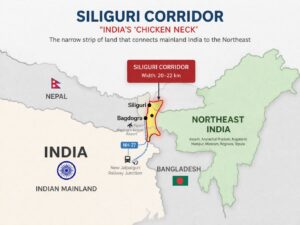
Can India Secure the Siliguri Corridor in Wartime?

The Siliguri Corridor is one of India’s most strategically sensitive regions. This narrow strip of land connects mainland India to the entire northeastern region, making it a critical lifeline for transport, supply chains and military movement. In peacetime, it functions as a vital logistical artery. In wartime, however, its importance multiplies. The central question is

Defence, National Security

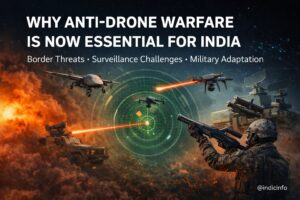
Why Anti-Drone Warfare Is Now Essential for India

Introduction Modern warfare is increasingly shaped by systems that are small, mobile and difficult to detect. Among these, drones have emerged as one of the most disruptive technologies in recent conflicts. Unmanned aerial systems now influence surveillance, reconnaissance, targeting and even direct attacks. Their relatively low cost and growing accessibility have made them important tools

National Security, Strategic Affairs

Why India’s Island Territories Matter More Than Ever in Modern Warfare

Introduction In modern strategic planning, geography often determines long-term military advantage before a crisis even begins. For India, this principle is especially important because some of its most valuable strategic assets are not located on the mainland but far into the surrounding ocean. India’s island territories are often discussed in administrative or tourism terms, yet

National Security, Strategic Affairs

India’s Energy Security Beyond West Asia: Long-Term Strategy

Why Energy Security Has Become a Strategic Priority Energy security is now one of the most important pillars of India’s long-term strategic planning. As one of the world’s fastest-growing major economies, India depends heavily on imported crude oil, natural gas and industrial energy inputs to sustain economic growth. Any disruption in global supply routes can

Geopolitics, National Security

How India Rewrote Deterrence After 2016

Introduction: A Structural Shift in India’s Security Posture For decades, India followed a restrained strategic culture. Cross-border provocations were often absorbed. Escalation was avoided. Responses were calibrated and discreet. Since 2016, that posture has evolved. India’s deterrence is now more visible, more declaratory and more multidimensional. The shift is not limited to military action. It

National Security

Hybrid Warfare Against India: Terrorism, Drones & Narrative Wars

Introduction: War Without a Declaration Wars are no longer fought only by armies crossing borders. In the 21st century, states weaken rivals without firing a formal first shot. They use terrorists instead of soldiers, drones instead of jets, misinformation instead of missiles, and internal fault lines instead of frontlines. This is hybrid warfare — a

National Security

India’s National Security Doctrine in the 21st Century

Introduction: From Survival to Strategic Shaping India’s approach to national security has undergone a fundamental transformation in the 21st century. For decades after independence, India’s security thinking was shaped by scarcity—limited economic power, technological constraints, and the trauma of Partition and early wars. The primary objective was survival and territorial integrity. Today, India is no

National Security

Why the Andaman & Nicobar Islands Are India’s Unsinkable Aircraft Carrier

When discussions turn to India’s national security and maritime power, one region quietly dominates every serious strategic calculation: the Andaman & Nicobar Islands. Located far from mainland India yet central to Indo-Pacific geopolitics, this island chain functions as India’s unsinkable aircraft carrier—a permanent, immovable platform projecting power across the Indian Ocean. This is not rhetoric.

National Security

India’s Supply Chain Strategy Is a National Security Strategy

Supply Chains Are the New Battle Lines National security is no longer decided only on borders or battlefields.In the 21st century, power is increasingly shaped by who controls supply chains—of energy, food, technology, medicine, and critical minerals.Disrupt a country’s supply chains, and you weaken its economy, military readiness, and political stability—without firing a single shot.For

Scroll to Top