
Geopolitics, Strategic Affairs

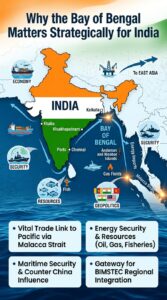
Why the Bay of Bengal Is Becoming Strategically Critical for India

Introduction The Bay of Bengal is no longer only a regional maritime space connecting India to Southeast Asia. It is increasingly becoming one of the most strategically important maritime zones in India’s long-term security environment. As maritime competition expands across the wider Indo-Pacific, the Bay of Bengal now carries growing importance for naval access, trade
Current Affairs, Geopolitics

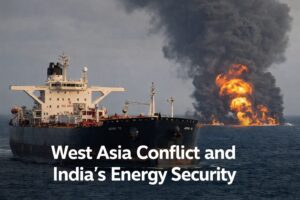
India Closely Monitoring West Asia Conflict as Energy Security Concerns Rise

Rising Tensions in West Asia The rapidly escalating conflict in West Asia has triggered serious concerns about global energy supply chains and regional stability. The situation intensified after military strikes and retaliatory actions involving Iran, Israel and the United States, raising fears of a wider regional confrontation. For countries heavily dependent on imported energy such

Geopolitics

China’s Military-Civil Fusion Strategy and What It Means for India

Introduction: Power Is No Longer Built Only Through Armies Modern strategic competition is no longer shaped only by armies, missiles, and military deployments. Increasingly, power is built through the ability of a state to convert civilian strength into military advantage. No major power has pursued this model more systematically than China. Through what Beijing calls

Geopolitics, National Security

How India Rewrote Deterrence After 2016

Introduction: A Structural Shift in India’s Security Posture For decades, India followed a restrained strategic culture. Cross-border provocations were often absorbed. Escalation was avoided. Responses were calibrated and discreet. Since 2016, that posture has evolved. India’s deterrence is now more visible, more declaratory and more multidimensional. The shift is not limited to military action. It

Geopolitics, National Security

Why India Is Quietly Becoming a Defence Manufacturing Power

For decades, India was known as one of the world’s largest importers of defence equipment. Fighter jets, submarines, artillery, and rifles were mostly sourced from abroad. Today, that image is changing—quietly, steadily, and strategically.India is no longer just buying weapons. It is designing, manufacturing, and exporting them. From Import Dependence to Strategic Self-Reliance India’s shift

Geopolitics

India and France Near €300 Million SCALP Missile Deal: What It Means for Indian Air Power

India and France are close to a €300 million SCALP missile deal, strengthening the Indian Air Force’s long-range precision strike capability. If concluded, the agreement would significantly strengthen India’s precision deep-strike capabilities and further deepen strategic defence ties between the two countries.The proposed deal is believed to involve 100–150 SCALP missiles, which are already integrated

Geopolitics, National Security

Why India Is Quietly Winning the Global Supply Chain Shift

For decades, the global economy revolved around a simple idea: manufacture in China, sell to the world. That model is now breaking—and India is emerging as one of its biggest beneficiaries.This shift isn’t loud. It isn’t dramatic. But it is real—and it is reshaping global trade. According to global trade assessments by the World Bank,

Geopolitics, National Security

India–US BTA Framework Explained: What Piyush Goyal’s Announcement Really Means

The recently announced India–United States Bilateral Trade Agreement (BTA) framework has generated significant attention across policy, business, and farming communities. Union Commerce and Industry Minister Piyush Goyal described it as a balanced, India-first trade arrangement that expands market access while firmly protecting domestic interests. According to official statements and international reporting, the India–US BTA framework

Geopolitics, National Security

Why Chabahar Port Matters to India: Strategic, Economic and Geopolitical Explained

ndia’s investment in Iran’s Chabahar Port is one of the most strategically important yet least understood foreign policy moves made by New Delhi in recent years.Unlike headline-grabbing defence deals or summit diplomacy, Chabahar represents a quiet, long-term bet on India’s strategic autonomy, regional connectivity, and economic reach. In February 2026, the Government of India confirmed

Scroll to Top