
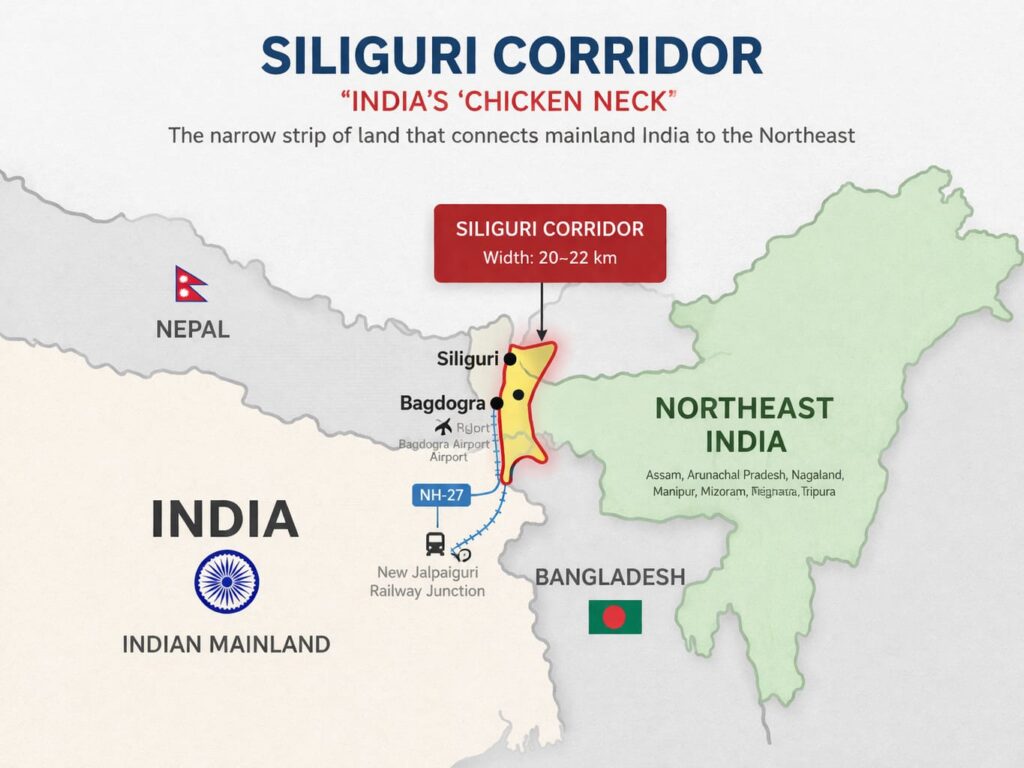
The Siliguri Corridor is one of India’s most strategically sensitive regions. This narrow strip of land connects mainland India to the entire northeastern region, making it a critical lifeline for transport, supply chains and military movement.
In peacetime, it functions as a vital logistical artery. In wartime, however, its importance multiplies. The central question is not just whether it is important, but whether India can effectively secure it under sustained pressure.
Why the Corridor Is Strategically Sensitive
The Siliguri Corridor is only about 20–22 kilometres wide at its narrowest point. This creates a unique geographic condition where:
- multiple transport routes pass through a limited space
- railways, highways and communication lines converge
- disruption in a small area can have large-scale impact
This narrowness is why it is often called India’s “Chicken Neck.”
The challenge is not simply vulnerability — it is maintaining continuous operational resilience.
The region’s dependence is evident in how Northeast India relies on this corridor for connectivity.
The strategic importance of the Siliguri Corridor becomes clearer when examining its role in connecting Northeast India.
The situation becomes more complex when considering China’s strategic view of the corridor.
Types of Wartime Threats
A realistic assessment must consider multiple types of threats, not just conventional warfare.
- Peripheral Military Pressure
Instead of directly targeting the corridor, pressure can be applied in nearby sectors. This can:
- slow reinforcement
- divert resources
- create operational uncertainty
Even indirect pressure can affect corridor stability.
- Air and Precision Strike Threats
Modern warfare allows targeted strikes on infrastructure.
Possible targets include:
- railway junctions
- highway choke points
- logistics hubs
- fuel depots
Even temporary disruption can affect movement.
- Electronic and Cyber Disruption
Modern conflicts increasingly involve non-kinetic methods.
This includes:
- communication disruption
- navigation interference
- cyber attacks on logistics systems
Such disruptions reduce coordination efficiency.
- Drone-Based Threats
Low-cost drones can:
- monitor movement
- disrupt logistics nodes
- create operational pressure
They may not cause large damage but can create continuous friction.
India’s Defensive Advantages
Despite these risks, India has several structural advantages.
- Layered Defence Structure
Security is not limited to the corridor itself.
India uses layered defence:
- forward deployment near borders
- interior protection zones
- rear logistics and coordination
This reduces reliance on a single defensive line.
- Surveillance and Monitoring
Continuous monitoring improves early warning.
Better detection allows:
- faster response
- better coordination
- reduced surprise
In narrow geography, early detection is critical.
- Mobility and Rapid Reinforcement
Improved infrastructure allows faster movement.
This includes:
- better road quality
- faster rail movement
- pre-positioned logistics
Speed reduces vulnerability.
Infrastructure Resilience: The Key Factor
In wartime, infrastructure determines outcomes more than numbers.
India has focused on:
- improving highways
- strengthening bridges
- expanding rail networks
- enhancing logistics hubs
Resilience comes from:
- redundancy
- repair capability
- alternative routing
The goal is not zero disruption — but quick recovery.
Logistics Under Pressure
The corridor must support continuous movement even during disruption.
Key priorities include:
- maintaining fuel flow
- managing traffic priority
- securing critical supply routes
- avoiding congestion
Efficient logistics planning can offset damage.
Alternative Connectivity Efforts
India is also reducing dependence on a single route.
Efforts include:
- improving internal Northeast connectivity
- expanding rail networks
- increasing air logistics capacity
- strengthening border infrastructure
These add strategic depth.
Scenario-Based Assessment
Security depends on the type of conflict:
- Short-duration conflict: Corridor remains functional
- Limited disruption: Managed through rapid repair
- Sustained pressure: Requires full system coordination
In most realistic scenarios, complete isolation is unlikely if systems function properly.
What “Securing the Corridor” Really Means
Security does not mean zero risk.
It means:
- maintaining connectivity
- ensuring continuous movement
- restoring infrastructure quickly
- integrating defence systems
In simple terms:
resilience over perfection
Strategic Conclusion
Can India secure the Siliguri Corridor in wartime?
Yes — if security is understood as sustained resilience rather than absolute invulnerability.
India has already strengthened:
- infrastructure
- defence posture
- logistics systems
The corridor will always remain strategically sensitive due to its geography. But with preparation, coordination and continuous investment, it can remain operational even under pressure.
India continues to strengthen defence planning and infrastructure resilience in sensitive regions.