
For decades, the global economy revolved around a simple idea: manufacture in China, sell to the world. That model is now breaking—and India is emerging as one of its biggest beneficiaries.
This shift isn’t loud. It isn’t dramatic. But it is real—and it is reshaping global trade.
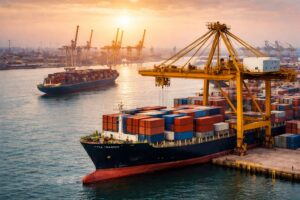
According to global trade assessments by the World Bank, companies are increasingly diversifying supply chains beyond China.
The End of “China as the World’s Factory”
The global supply chain shock did not come from one event. It came from many.
Rising labour costs, strict lockdowns, geopolitical tensions, and trade restrictions have made companies rethink their overdependence on China.
Multinational firms are no longer asking whether to diversify.
They are asking how fast they can do it.
This strategy is now widely known as China+1—keeping China in the mix, but adding at least one alternative manufacturing base.
Why Companies Are Looking Beyond China
Three forces are driving this shift:
- Geopolitical Risk
Trade wars, sanctions, and strategic rivalry—especially between China and the United States—have turned supply chains into security risks.
Companies want stability, not surprise tariffs. - Cost Pressures
China is no longer a low-cost manufacturing hub. Wages, compliance costs, and energy prices have all risen sharply. - Resilience Over Efficiency
After COVID-era disruptions, businesses now prefer resilient supply chains over ultra-efficient but fragile ones.
Why India Fits the Moment Perfectly
India didn’t suddenly become attractive.
The world simply caught up to India’s long-term advantages.
Massive Workforce
India has one of the youngest labour forces globally, offering scale that few countries can match.
Policy Push
Initiatives like Make in India and production-linked incentives have made manufacturing financially viable and politically supported.
Market + Manufacturing Combo
Unlike smaller alternatives such as Vietnam or Mexico, India offers both:
- a manufacturing base
- and a massive domestic consumer market
That dual advantage matters.
Not Just Assembly—Real Manufacturing
Earlier, India was seen mainly as a services economy. That perception is changing.
Today, India is expanding across:
- Electronics and semiconductors
- Pharmaceuticals and medical devices
- Defence manufacturing
- Renewable energy equipment
This is not subcontracting.
This is capacity building.
The Quiet Advantage: Strategic Neutrality
India’s foreign policy gives it a unique edge.
It trades with the West.
It maintains relations with Russia.
It engages with the Global South.
In a fractured world, neutral partners become valuable partners.
The Challenges Are Real—but Manageable. This shift also strengthens India’s position in the evolving global power structure.
India still faces issues:
- Infrastructure gaps
- Bureaucratic delays
- Skill mismatches
But the direction is clear—and investors care more about trajectory than perfection.
What This Means for the Future
The global supply chain is not leaving China overnight.
But it is spreading out.
And in that redistribution, India is not competing loudly—it is absorbing steadily.
The real winners of global shifts are rarely the noisiest.
They are the ones who are ready when the moment arrives.
India was ready.