
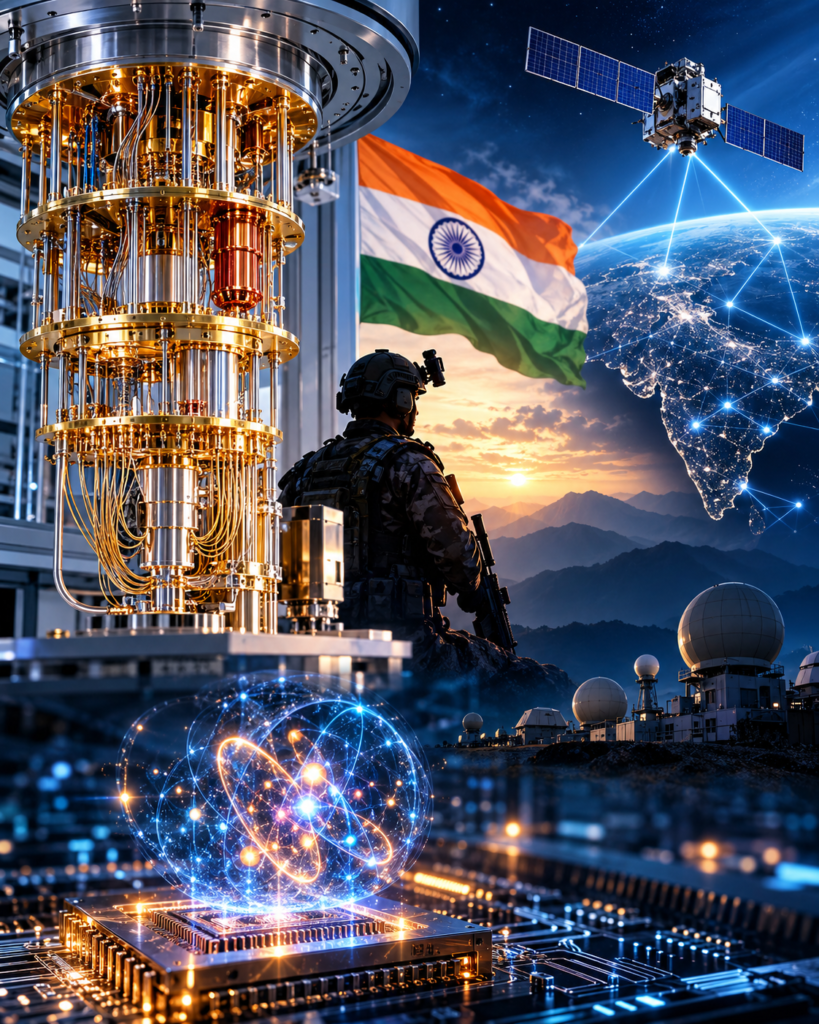
India’s Defence Sector Is Entering the Quantum Era
The next major transformation in military technology may not come from another missile, fighter aircraft or drone.
It may come from technologies that operate at the quantum level.
India has begun building a dedicated defence ecosystem around quantum communication, quantum computing, quantum sensing and quantum materials. The effort combines DRDO research, the armed forces, academic institutions and an expanding network of technology companies and startups. This wider technology ecosystem is also visible in India’s push for indigenous defence propulsion.
A significant new development came in September 2026, when DRDO signed its first high-value deep-tech agreement under the Technology Development Fund with Rajasthan-based startup Zero mK India Pvt Ltd to develop an indigenous 20 millikelvin dilution refrigerator for quantum applications.
The project may sound highly specialised, but its significance is broader: India is attempting to develop the underlying infrastructure needed for advanced quantum technologies within the country.
The 20 mK Project That Brings Quantum Technology Closer to Defence
On 24 September 2026, DRDO announced the agreement with Zero mK India for the indigenous development of a 20 mK-class dilution refrigerator.
The project is the first high-value agreement under a ₹500 crore corpus approved for deep-tech and cutting-edge technology projects through the Technology Development Fund.
A dilution refrigerator is a specialised cryogenic system capable of reaching extremely low temperatures in the millikelvin range.
These temperatures are important for operating and testing several types of quantum-computing platforms and associated technologies.
Developing such equipment domestically could therefore strengthen India’s capabilities not only in quantum computing but also in advanced cryogenics and other strategic technology areas.
The government says the project is also intended to reduce dependence on imported cryogenic infrastructure and strengthen India’s domestic quantum ecosystem.
Why a Dilution Refrigerator Matters
Quantum computers operate very differently from conventional computers.
Some quantum processors require extremely low temperatures to maintain the physical conditions needed for quantum operations.
That creates a technological dependency beyond the processor itself.
A country developing quantum computing capabilities also needs access to specialised:
- Cryogenic systems
- Control electronics
- Quantum processors
- Measurement systems
- Materials
- Sensors
- Software
- Communication infrastructure
The DRDO-Zero mK project therefore addresses one part of a much larger technology stack.
It is an example of how defence research is increasingly moving into deep technology infrastructure, rather than focusing exclusively on complete weapons systems.
India’s Military Quantum Mission
The latest project fits into a broader defence strategy.
In January 2026, Chief of Defence Staff General Anil Chauhan released India’s Military Quantum Mission Policy Framework.
The framework identifies four major pillars:
- Quantum Communication
- Quantum Computing
- Quantum Sensing and Metrology
- Quantum Materials and Devices
The framework is intended to provide a roadmap for integrating these technologies across India’s three armed services and connecting defence efforts with the National Quantum Mission.
This is significant because quantum technology is being treated as a potential military capability rather than simply an academic research field.
Quantum Computing and Future Defence Systems
Quantum computing remains an emerging technology, but defence organisations are already studying its potential.
DRDO’s technology roadmap includes a 7-qubit quantum processor based on superconducting circuit technology operating at millikelvin temperatures. Its quantum-technology programme also covers quantum machine learning and quantum-computing applications related to communication and network-centric operations.
Potential defence applications could eventually include highly specialised optimisation, simulation, cryptographic research and processing of complex datasets.
These developments will also intersect with the growing role of artificial intelligence in modern warfare.
However, it is important to distinguish current research from operational capability.
India’s present quantum-computing work does not mean that quantum computers are already replacing conventional military computing systems.
The technology is still developing.
The strategic objective is to ensure that India develops expertise and infrastructure before quantum technologies become more mature and widely deployed.
Quantum Communication and Secure Military Networks
Communication is another major area of interest.
Military networks require secure transmission of sensitive information across increasingly complex and distributed systems.
Quantum communication technologies, including quantum key distribution (QKD), are being researched as a potential component of future secure communications.
DRDO’s quantum-technology roadmap includes research into quantum key distribution approaches, quantum communication over wireless links and a measurement-device-independent quantum communication link.
The broader National Quantum Mission also includes long-distance secure quantum communication as one of its objectives, including satellite-based secure communication and long-distance quantum key distribution.
For defence planners, such technologies could eventually become relevant to the protection of high-value communications networks alongside capabilities such as electronic warfare.
Quantum Sensing Could Change the Battlefield
Quantum technology is not limited to computing and communications.
Quantum sensing could become particularly important for military applications.
DRDO’s programme includes atomic magnetometers and a magnetometer sensor package designed for extremely high sensitivity.
Highly sensitive quantum sensors could eventually support applications involving:
- Navigation
- Detection
- Timing
- Magnetic-field measurement
- Precision measurement
- Positioning in environments where conventional systems face limitations
This area is particularly important because future military operations may increasingly depend on alternatives to traditional satellite-based navigation and sensing.
The exact operational applications will depend on technological maturity and integration into military systems.
DRDO Is Already Moving Quantum Technology Toward Industry
The quantum push is not confined to government laboratories.
In August 2026, the government reported that DRDO had already transferred technologies including Quantum Random Number Generators (QRNGs) and an RFSoC-based Controller for Quantum Computer Processors to industry.
That matters because developing a technology inside a laboratory is only the first stage.
The next challenge is turning research into products that can be manufactured, tested, maintained and eventually integrated into larger systems.
Technology transfer can help create that bridge.
Why Startups Are Becoming Important
Quantum technology is developing rapidly, and some of the required expertise exists outside traditional defence companies.
The Zero mK agreement illustrates this changing model.
Instead of developing every component entirely within government laboratories, DRDO is working with a specialised startup on a highly technical piece of quantum infrastructure.
This approach can potentially give defence research organisations access to specialised capabilities in areas such as:
- Quantum hardware
- Cryogenics
- Photonics
- Advanced electronics
- Artificial intelligence
- Materials science
- Quantum software
For startups, defence-linked development programmes can provide an opportunity to convert research into practical technology.
The ₹500 Crore Deep-Tech Push
The Zero mK project is particularly notable because it is the first high-value agreement under the additional ₹500 crore TDF corpus for deep-tech and cutting-edge projects.
This reflects a wider attempt to push the defence innovation system beyond established technologies.
At the September 2026 VIMARSH DRDO-Industry Synergy Meet, the government also announced measures intended to reduce technical and financial barriers for MSMEs and deep-tech startups, including direct funding, incubation support and access to DRDO testing facilities.
The direction is clear: advanced defence technology development increasingly depends on cooperation between government laboratories, established industry, startups and academia.
India’s Quantum Ecosystem Is Larger Than Defence
India’s defence quantum programme is also connected to the broader National Quantum Mission.
The mission has an approved outlay of ₹6,003.65 crore over eight years and covers quantum computing, quantum communication, quantum sensing and metrology, and quantum materials.
It also aims to build research infrastructure, develop skilled manpower and support startups and industry collaboration.
This creates an important civil-military connection.
Research conducted for civilian quantum applications can contribute to defence capabilities, while defence requirements can accelerate the development of technologies with wider commercial applications.
The Challenge of Building a Domestic Quantum Supply Chain
India’s biggest challenge may not be producing a single quantum device.
It will be building the complete ecosystem around it.
That requirement is closely connected to India’s wider effort to build domestic defence manufacturing capacity through its Defence Industrial Corridors.
That means developing domestic capabilities in:
Quantum processors
Cryogenic systems
Control electronics
Photonics
Precision sensors
Quantum materials
Specialised software
Testing infrastructure
Skilled manpower
Manufacturing
The 20 mK refrigerator project is therefore significant precisely because it addresses an enabling technology rather than a finished military system.
A quantum processor cannot become a useful capability without the infrastructure surrounding it.
From Conventional Weapons to Quantum Advantage
India’s defence modernisation has traditionally focused heavily on platforms and weapons: missiles, aircraft, ships, air-defence systems, drones and electronic warfare.
Quantum technology represents a different layer.
It could influence how militaries communicate, navigate, sense, compute and secure information.
That makes quantum technology potentially relevant across multiple military domains rather than to a single weapons programme.
But the technology remains at different stages of development, and many potential applications are still being researched.
The immediate objective is therefore not to claim a ready-made “quantum weapon.”
It is to establish the scientific, industrial and technological foundation from which future defence capabilities can emerge.
What Comes Next
The DRDO-Zero mK agreement provides a useful indication of where India’s quantum-defence strategy is heading.
The country is working simultaneously on:
- Quantum computing
- Quantum communications
- Quantum sensing
- Quantum materials
- Cryogenic infrastructure
- Quantum processors
- Secure communications
- Industry technology transfer
- Startup participation
The next phase will be about turning individual research achievements into integrated systems.
That will require sustained investment, skilled personnel, industrial capacity and close cooperation between DRDO, the armed forces, universities, startups and established defence companies.
Conclusion
India’s quantum defence push is still at an emerging stage.
But the direction is becoming increasingly clear.
The release of the Military Quantum Mission Policy Framework, DRDO’s quantum technology research, technology transfers to industry and the new 20 mK dilution refrigerator project show that India is building capabilities across several layers of the quantum technology stack.
The strategic importance lies not in one refrigerator or one quantum processor.
It lies in India’s attempt to build the domestic scientific and industrial ecosystem needed for future military technologies.
For India’s defence sector, the quantum race is therefore no longer only a question of research.
It is becoming a question of infrastructure, industry, integration and long-term technological readiness.