
India’s defence-industrial strategy is moving beyond airframes and weapons toward one of the hardest technologies in aerospace: indigenous propulsion. From micro-turbine engines for drones to turbojets, scramjets and next-generation fighter engines, a wider ecosystem is now taking shape.
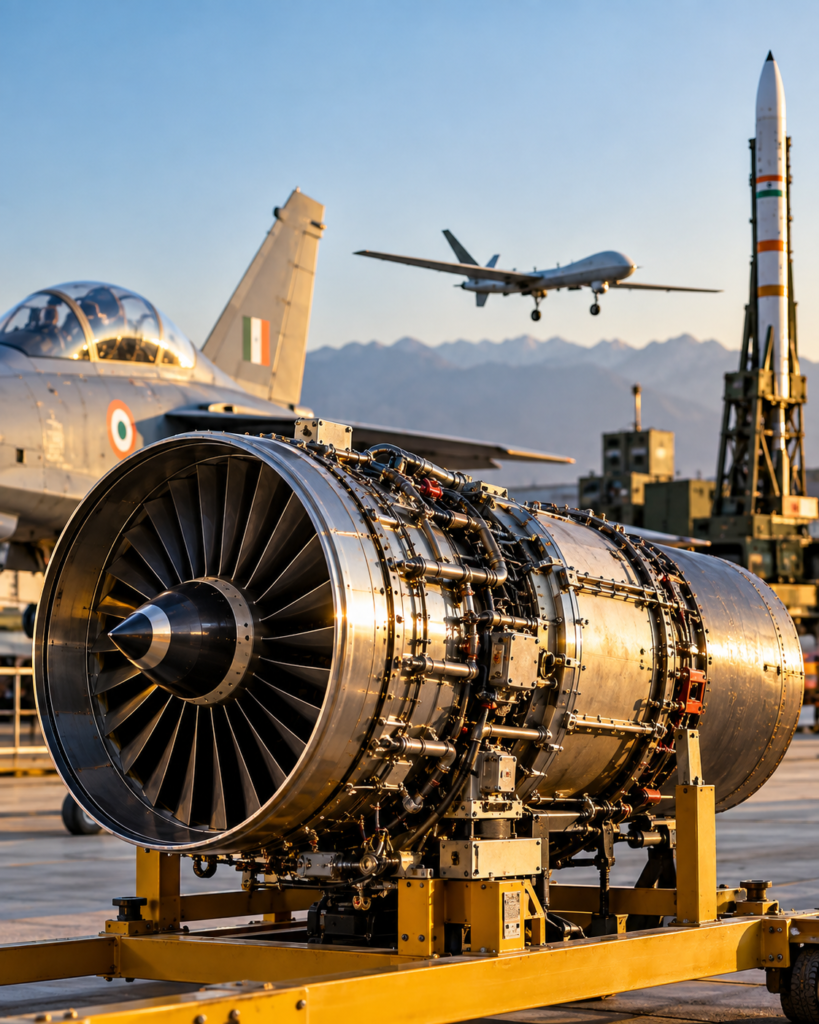
India’s drive for defence self-reliance is entering a technically demanding phase.
For years, discussions around indigenous defence production focused largely on aircraft, missiles, helicopters, radars and other visible platforms. But behind almost every advanced aerospace system lies a less visible technological challenge: the engine.
Propulsion determines how far a missile can travel, how long a drone can remain airborne, how much payload an unmanned aircraft can carry and how effectively a fighter aircraft can perform.
India has therefore been building capabilities across several propulsion categories rather than pursuing a single engine programme.
Recent developments indicate that this effort is expanding from established government laboratories into a broader ecosystem involving DRDO, CSIR laboratories, HAL, private engineering companies and specialised technology firms.
India’s defence innovation ecosystem is also being strengthened through initiatives such as DFP-2026, which aim to accelerate indigenous defence technology development.
India’s propulsion research now spans UAV engines, gas-turbine technology, missile propulsion and other advanced systems, according to the DRDO’s propulsion technology roadmap.
Why propulsion matters to India’s defence strategy
An aircraft can be assembled domestically without every component being indigenous.
The same is true for a missile or UAV.
But dependence on imported engines can remain a major strategic vulnerability.
A propulsion system requires expertise in areas such as:
- high-temperature materials
- turbine blades
- compressors
- combustion systems
- fuel control
- digital engine control
- precision manufacturing
- thermal management
- high-altitude testing
- durability and reliability testing
These technologies are difficult to master because an engine must operate reliably under extreme temperatures, pressures, vibration and rotational speeds.
This is why India’s propulsion push should be viewed as a long-term industrial capability-building exercise, rather than simply a programme to produce one particular engine.
A new layer of India’s unmanned warfare ecosystem
One of the clearest signs of progress is appearing in smaller propulsion systems.
In August 2026, CSIR-National Aerospace Laboratories unveiled three indigenous micro and small gas-turbine engines: NJ-05, NJ-50 and NJ-100, with thrust levels of 5 kg, 50 kg and 100 kg respectively.
According to the Ministry of Science & Technology, the engines are intended for applications including tactical UAVs, drone interceptors and compact missile systems.
This is strategically important because the future battlefield is expected to contain large numbers of relatively inexpensive unmanned systems.
Instead of relying on imported propulsion for every small UAV or expendable system, an indigenous engine family could provide a domestic source of propulsion for multiple classes of platforms.
The significance is therefore not limited to the individual engines.
It is about creating an industrial base capable of producing propulsion at different scales.
India’s indigenous UAV engine capability is also expanding
India already has experience developing piston and diesel propulsion for unmanned aircraft.
DRDO’s Vehicles Research and Development Establishment has developed a 180-horsepower diesel engine for UAV applications.
DRDO states that the engine produces constant take-off power of 180 hp up to 11,000 feet and has undergone testing for altitude performance, including trials up to 17,664 feet. The engine has also accumulated more than 1,100 hours of testing.
This illustrates an important distinction in India’s propulsion journey.
Developing an engine prototype is one challenge.
Demonstrating reliability, endurance and performance under operational conditions is another.
For UAVs, propulsion reliability becomes especially important because endurance, payload and range are directly connected to engine performance.
The push for indigenous propulsion is closely connected to India’s expanding drone and counter-drone capabilities.
A major 2026 milestone: India’s 350-kg-class turbojet
Perhaps the most notable recent development came in July 2026.
DRDO’s Gas Turbine Research Establishment successfully developed India’s first indigenous 350-kg-thrust-class expendable turbojet engine.
GTRE identified Hyderabad-based Azad Engineering as the industry partner for manufacturing and assembly, and the engine was successfully realised and delivered to GTRE on July 22, 2026.
The significance goes beyond the engine’s relatively modest thrust.
The project demonstrates a model in which:
DRDO design capability + private-sector manufacturing + precision engineering = indigenous propulsion production.
Such engines can potentially support classes of systems such as tactical cruise missiles, loitering munitions and other expendable aerospace applications, although individual operational applications should not be assumed unless officially confirmed.
The development is particularly relevant because small turbojet technology sits at an important intersection between unmanned systems and missile propulsion.
DRDO is developing propulsion across multiple technology levels
India’s propulsion effort is not confined to one engine family.
DRDO’s own technology roadmap lists work involving:
- small turbofan engines
- long-endurance small turbofans
- engines for air-launched cruise missiles
- gas generators
- aero-engine technology
- propulsion systems for unmanned combat aircraft
- compact aero engines
- advanced turbo gas generators
- digital engine-control systems
- advanced materials for turbine blades.
This reveals the larger picture.
India is attempting to develop a propulsion technology stack.
That stack stretches from small UAV engines at one end to much more demanding aircraft engines at the other.
The missile propulsion ecosystem is becoming more sophisticated
Propulsion is equally important for India’s missile programmes.
In January 2026, DRDO successfully conducted a long-duration ground test of a full-scale actively cooled scramjet combustor for India’s hypersonic missile programme.
The test achieved a run time of more than 12 minutes.
Scramjet propulsion is fundamentally different from conventional turbine engines. Instead of relying on rotating compressor and turbine stages in the same way as a conventional jet engine, the system uses the high-speed airflow associated with hypersonic flight and sustains combustion under supersonic conditions.
DRDO described the test as an important step for its hypersonic cruise missile development programme.
Then, in February 2026, DRDO successfully demonstrated Solid Fuel Ducted Ramjet (SFDR) technology.
The test involved a nozzle-less booster, solid-fuel ducted ramjet motor and fuel-flow controller, demonstrating another advanced air-breathing propulsion technology relevant to long-range air-to-air missile development.
Together, these programmes demonstrate that India’s propulsion ambitions extend well beyond conventional aircraft engines.
HAL’s role in larger aero-engine development
Hindustan Aeronautics Limited has also maintained an indigenous aero-engine development capability.
HAL’s Aero Engine Research and Development Centre works on small and medium engines and lists programmes including the HTFE-25 and HTSE-1200.
The HTFE-25 is a 25-kN-class turbofan development programme, while the HTSE-1200 represents a turboshaft engine effort.
HAL also identifies aircraft, helicopter and UAV development among its wider indigenous aerospace activities.
These programmes are important because India’s military aviation requirements extend across several categories.
A fighter aircraft needs a very different propulsion system from a helicopter.
A helicopter engine is different from a UAV engine.
A cruise missile requires another type of propulsion altogether.
The result is a diverse engineering challenge.
The fighter-engine problem remains the hardest challenge
India’s biggest propulsion challenge remains the development of high-performance engines for advanced combat aircraft.
This propulsion push is part of a wider effort to strengthen India’s domestic defence manufacturing and modernisation base.
The history of the Kaveri engine programme demonstrates why.
Developing a modern fighter engine requires mastery of technologies such as:
- high-pressure compressors
- advanced combustion
- single-crystal turbine blades
- high-temperature materials
- cooling technologies
- afterburners
- digital engine controls
- high-pressure turbine systems
- high-altitude performance
- long-term reliability
A fighter engine is therefore not simply a larger version of a UAV engine.
It represents a substantially different technological challenge.
India is consequently pursuing international industrial partnerships alongside indigenous research.
Reuters reported in August 2026 that Reliance Industries and Rolls-Royce announced a partnership proposal for jointly developing and manufacturing an engine for India’s AMCA programme, while French company Safran has also been pursuing cooperation related to Indian fighter-engine development.
The exact architecture and technology-transfer arrangements of future programmes will be crucial because manufacturing an engine under lice is not equivalent to independently designing one.
The government has also continued to support indigenous aero-engine development, including the Kaveri derivative programme for unmanned combat aircraft applications.
AMCA could become an important test for India’s propulsion ecosystem
India’s Advanced Medium Combat Aircraft programme is intended to create a new generation of indigenous combat-aircraft capability.
In May 2025, the Ministry of Defence approved an industry-partnership execution model for AMCA. The model allows eligible Indian companies to participate independently, through joint ventures or as consortia.
That decision matters for propulsion as well as airframe development.
A modern fighter programme requires a network of companies capable of producing:
engine components → advanced materials → electronics → sensors → flight-control systems → manufacturing equipment → testing infrastructure.
The AMCA programme could therefore stimulate demand for technologies beyond the aircraft itself.
The missing piece: large turbofans
The smaller propulsion systems now emerging in India should not be confused with the much larger engines required for transport aircraft or advanced fighter aircraft.
Large high-bypass turbofans are among the most technically demanding propulsion systems in aviation.
They require enormous engineering expertise in:
- large fan blades
- high-pressure compressors
- turbine materials
- thermal management
- fuel efficiency
- vibration control
- engine durability
- high-altitude operation
- certification
- long-term maintenance
India’s future aerospace ambitions therefore cannot be measured only by the number of indigenous engines produced.
The more important question is whether India can progressively build the industrial knowledge required for larger and more sophisticated propulsion systems.
From government laboratories to a wider industrial ecosystem
One of the most important changes is the growing participation of private industry.
The 350-kg turbojet project illustrates this clearly.
GTRE provided the design-development capability while Azad Engineering participated in manufacturing and assembly.
At the same time, CSIR-NAL’s micro-engine work demonstrates another pathway in which government-funded scientific institutions develop technology that can eventually support industrial applications.
This matters because a successful aerospace engine ecosystem requires far more than one government laboratory.
It needs:
designers + materials companies + precision manufacturers + testing facilities + certification agencies + suppliers + maintenance capability.
The wider the supplier ecosystem becomes, the easier it becomes to scale production.
Why India’s defence startups matter
The next phase could increasingly involve specialised private companies.
Large aerospace engines require enormous capital and decades of accumulated knowledge.
But smaller propulsion systems create opportunities for startups working on:
- micro-turbines
- UAV engines
- electric propulsion
- fuel systems
- engine-control electronics
- advanced materials
- additive manufacturing
- thermal-management technologies
- components for gas turbines
This creates a potential bridge between India’s traditional defence-industrial institutions and the country’s growing deep-tech ecosystem.
The objective should not simply be to replace an imported engine with an Indian-labelled product.
The deeper objective is to develop domestic design ownership, manufacturing knowledge and supply-chain resilience.
What India’s propulsion roadmap could mean by 2030
If current programmes continue to mature, India’s propulsion ecosystem could increasingly cover several layers:
| Propulsion segment | Indian capability/development |
|---|---|
| Small UAV engines | Indigenous piston/diesel and turbine developments |
| Micro gas turbines | NJ-05, NJ-50 and NJ-100 |
| Expendable turbojets | 350-kg-thrust-class GTRE programme |
| Cruise-missile propulsion | GTRE/DRDO technology programmes |
| Ramjet propulsion | SFDR |
| Hypersonic propulsion | Scramjet development |
| Helicopter propulsion | HTSE-1200 development |
| Medium turbofan | HTFE-25 development |
| Fighter propulsion | Kaveri-related work and international partnerships |
| Advanced combat aircraft | AMCA-linked engine ecosystem |
The table should be understood as a snapshot of development programmes and capabilities, not a claim that every listed engine has already entered operational service.
That distinction is essential.
The real objective is technological depth
India’s propulsion challenge is ultimately bigger than any individual engine.
The country needs an ecosystem capable of repeatedly designing, testing, improving and manufacturing gas-turbine systems.
That requires progress in areas such as advanced metallurgy, precision manufacturing, computational modelling, testing infrastructure and industrial supply chains.
DRDO’s aeronautical-systems cluster itself covers unmanned aircraft, aero gas-turbine engine technology and airborne systems, demonstrating how closely propulsion is linked to the broader aerospace ecosystem.
The recent appearance of smaller indigenous engines is therefore significant not because they immediately solve India’s largest engine requirements, but because they add another layer to the country’s propulsion base.
Propulsion is only one part of the technological transformation, alongside capabilities such as electronic warfare that are increasingly important on the modern battlefield.
These systems will increasingly operate alongside space-based surveillance and military satellite networks that provide critical intelligence and situational awareness.
Conclusion: India’s next aerospace battle is inside the engine
India has made substantial progress in designing and manufacturing many defence platforms.
The next technological frontier is propulsion.
Recent developments — from micro gas turbines and UAV engines to indigenous turbojets, scramjets and deducted-ramjet technology — indicate that India’s propulsion ecosystem is becoming broader and more diverse.
But the hardest challenge remains the development and industrialisation of high-performance engines for advanced combat aircraft.
That is why the coming decade will be important.
If India can connect its government laboratories, universities, private manufacturers, deep-tech startups and international technology partnerships into a sustained propulsion ecosystem, the result could be more significant than any single engine programme.
It could provide the technological foundation for India’s next generation of drones, missiles, helicopters, fighter aircraft and other aerospace systems.
The future of India’s defence self-reliance may therefore depend not only on what the country can build — but on what it can make fly.
Taken together, these developments form part of a broader transformation in India’s approach to national security and strategic autonomy.