
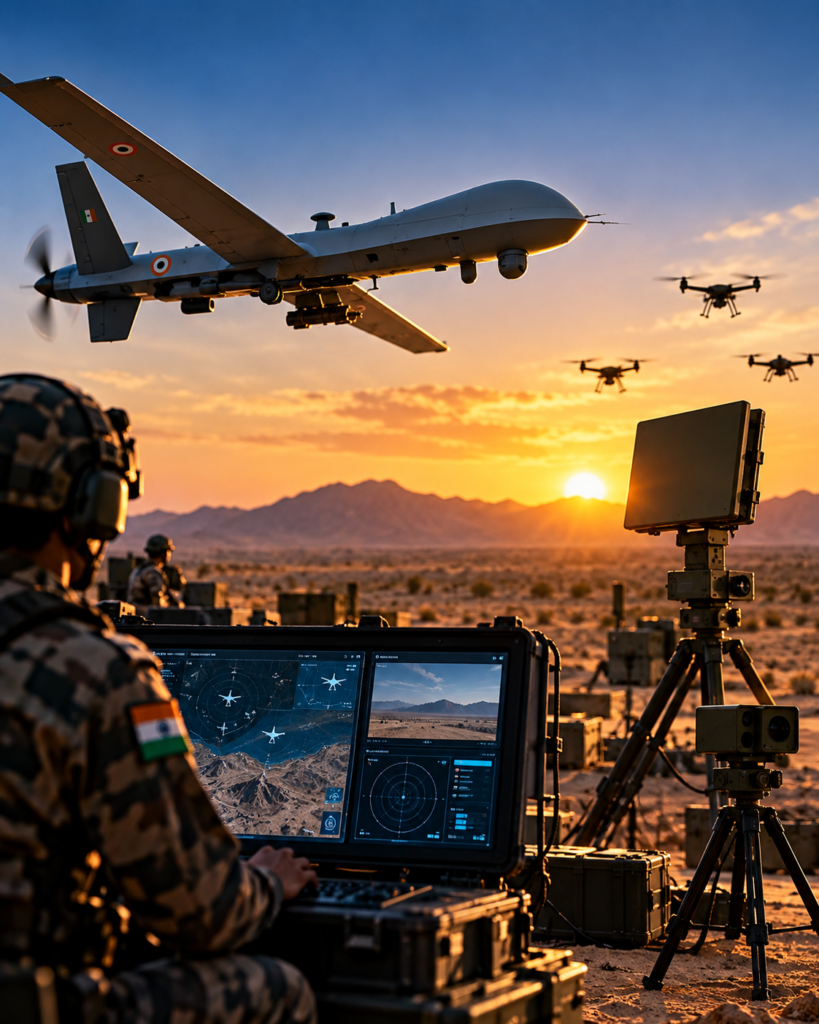
IAF Dronathon 2026 marks a new phase for India’s drone ecosystem as the Indian Air Force moves beyond laboratory demonstrations and begins evaluating unmanned technologies under realistic operational conditions.
The first IAF Dronathon-2026 was conducted at the Pokhran Field Firing Range in Jaisalmer, Rajasthan, from September 14 to 16, 2026. The event brought together more than 20 defence companies, startups, MSMEs, defence public-sector organisations and innovators working on unmanned systems.
The exercise focused not only on drones but also on the technologies needed to detect, manage and counter them—including counter-UAS systems, autonomous operations, swarm technology, electronic warfare and airspace management.
Why IAF Dronathon 2026 Matters
The IAF’s stated objective was to move from technology demonstration to operational effect.
That distinction is important.
A drone that works successfully during a controlled demonstration still needs to prove that it can operate reliably in demanding field conditions, adapt to changing requirements and function as part of a wider military network.
At Pokhran, the participating systems were therefore assessed for reliability, effectiveness in demanding and contested environments, and their ability to adapt to emerging threats.
The event also allowed the IAF to interact directly with India’s rapidly expanding unmanned-systems industry.
This creates a feedback loop between the military, technology developers and researchers: the armed forces can communicate operational requirements while companies can demonstrate what their systems can actually deliver.
From Individual Drones to an Entire Unmanned Ecosystem
One of the biggest takeaways from Dronathon-2026 is that India’s unmanned warfare strategy is not limited to developing airframes.
The IAF identified a much broader ecosystem covering:
- Propulsion
- Sensors
- Payloads
- Communications
- Autonomous systems
- Electronic warfare
- Countermeasures
- Airspace management
The official description therefore presents unmanned warfare as an integrated technology ecosystem rather than a collection of individual drone platforms.
This approach becomes particularly important as drones become smaller, more autonomous and increasingly capable of operating in groups.
The IAF’s New UAS Roadmap
During the opening day of Dronathon-2026, the Vice Chief of the Air Staff released the IAF UAS Roadmap.
The roadmap is intended to provide Indian industry, academia and research organisations with greater clarity about the IAF’s future capability priorities.
Its purpose is to help developers align their research and innovation with the capabilities that the Air Force expects to require in the future.
This could become an important bridge between India’s defence-technology industry and military requirements.
Instead of companies developing technologies without a clear understanding of future operational needs, the roadmap provides a framework around which research and development can be organised.
Vayu UTtaM: Managing India’s Growing Drone Traffic
One of the most notable demonstrations at Dronathon-2026 was Vayu UTtaM, an indigenous multi-mode Unmanned Traffic Management (UTM) system.
During its real-time demonstration at Pokhran, the system detected and tracked both military and civilian unmanned aerial systems.
The technology is designed to support coordinated management of drones in increasingly congested airspace.
It can also support the identification and timely mitigation of unauthorised or rogue drones.
The IAF says the potential applications extend beyond military operations to areas such as airspace safety, civil aviation, critical infrastructure and public safety.
This highlights another emerging challenge: as drone use expands, India needs systems capable of maintaining a common picture of low-altitude airspace.
Why Counter-Drone Warfare Is Becoming Critical
The rapid proliferation of unmanned systems has created a corresponding requirement for counter-UAS capabilities.
A modern counter-drone architecture can involve multiple layers:
Detection → Identification → Tracking → Electronic disruption → Interception
Depending on the threat, different technologies may be required.
Radar and other sensors can detect and track drones. Electronic warfare systems can interfere with communications or navigation. Kinetic systems can physically intercept hostile platforms.
The challenge becomes significantly more complicated when multiple drones operate simultaneously.
That is why the IAF’s focus at Dronathon included both UAS and Counter-UAS technologies. The event was originally designed specifically to allow domestic manufacturers to demonstrate capabilities in both areas.
Swarm Technology and Autonomous Operations
Another major focus area was swarm technology.
Instead of operating a single drone independently, coordinated unmanned systems can potentially work together to perform surveillance, reconnaissance or other missions.
The IAF included swarm technologies and autonomous operations among the principal areas of interest at Dronathon-2026.
This means future unmanned warfare could increasingly involve systems that can share information, coordinate their behaviour and operate with decreasing levels of direct human control.
However, technological demonstration does not automatically translate into operational deployment. Reliability, communications, navigation, cybersecurity, command-and-control and the ability to function under contested conditions remain important challenges.
Electronic Warfare Meets Drone Warfare
Electronic warfare is another important part of the unmanned battlefield.
Modern drones can depend on communications links, navigation systems, sensors and data networks.
That creates two parallel requirements.
First, India’s own unmanned systems need secure and resilient communications and navigation.
Second, Indian forces need the ability to detect and counter hostile unmanned platforms that depend on those systems.
The IAF specifically identified electronic warfare among the focus areas of Dronathon-2026, placing it alongside surveillance, autonomy, swarm technologies and counter-UAS capabilities.
Pokhran Was More Than a Backdrop
The choice of the Pokhran Field Firing Range is significant because the event was designed around operational testing rather than a conventional technology exhibition.
Recent independent reporting described the exercise as an effort to determine whether Indian-made unmanned and counter-drone systems could function under the conditions in which they might eventually be required to operate.
This is important because military technology must perform outside controlled demonstrations.
Heat, dust, electromagnetic interference, communications limitations and changing battlefield conditions can all affect unmanned systems.
The real test is therefore not simply whether a drone can fly.
It is whether the complete system can continue performing its mission when conditions become difficult.
India’s Defence Industry Takes a Bigger Role
More than 20 defence companies, startups, MSMEs, DPSUs and individual innovators participated in Dronathon-2026.
That participation reflects the increasing role of India’s domestic defence industry in developing unmanned technologies.
Startups and smaller technology companies can contribute specialised capabilities in areas such as:
- Artificial intelligence
- Autonomous navigation
- Sensors
- Robotics
- Communications
- Electronic warfare
- Counter-drone technology
- Software
The challenge for the ecosystem is then to move from promising prototypes to systems that can be produced, maintained and upgraded at scale.
As recent analysis of the Dronathon noted, the difficult step comes after the demonstration: integrating sensors, software, electronic warfare, weapons and unmanned platforms into a functioning architecture and creating the industrial capacity to sustain it.
From Drone Platforms to Networked Warfare
The larger direction emerging from Dronathon-2026 is therefore clear.
India’s unmanned-warfare requirements are expanding beyond the question of which drone to buy.
The more complex question is how drones interact with:
Sensors + communications + electronic warfare + artificial intelligence + air defence + command networks + airspace management.
A drone operating in isolation has limited value compared with one that can exchange information with the wider military network.
Similarly, a counter-drone system becomes more useful when its detection and tracking data can be integrated into a broader air-defence architecture.
This network-centric approach is one of the key strategic implications of the IAF’s UAS roadmap and Dronathon initiative.
The Road Ahead for India’s Drone Warfare Capability
Dronathon-2026 should therefore be viewed as one part of a longer development process.
The immediate demonstrations are only one stage.
The next challenges include:
- Turning successful prototypes into deployable systems
- Scaling domestic production
- Improving reliability in contested environments
- Integrating different sensors and networks
- Developing effective counter-swarm capabilities
- Strengthening electronic warfare resilience
- Improving autonomous operations
- Creating sustainable domestic supply chains
The IAF’s roadmap is intended to help industry and research organisations align their development efforts with future capability requirements.
Conclusion
IAF Dronathon-2026 represents a shift in how India is approaching unmanned warfare.
The focus is no longer simply on producing more drones.
The larger objective is to develop an integrated ecosystem covering unmanned aircraft, sensors, communications, autonomy, electronic warfare, counter-UAS systems and airspace management.
The demonstration of Vayu UTtaM and the release of the IAF UAS Roadmap further indicate that the Air Force is looking at unmanned systems as part of a broader operational architecture.
The next test will be turning these technologies and demonstrations into reliable, scalable and interoperable capabilities.
For India’s defence industry, that could be the more consequential phase of the country’s growing unmanned-systems push.