
Every day, billions of digital transactions, financial transfers, emails, video calls and cloud services depend on a network that most people never see—undersea fibre-optic cables.
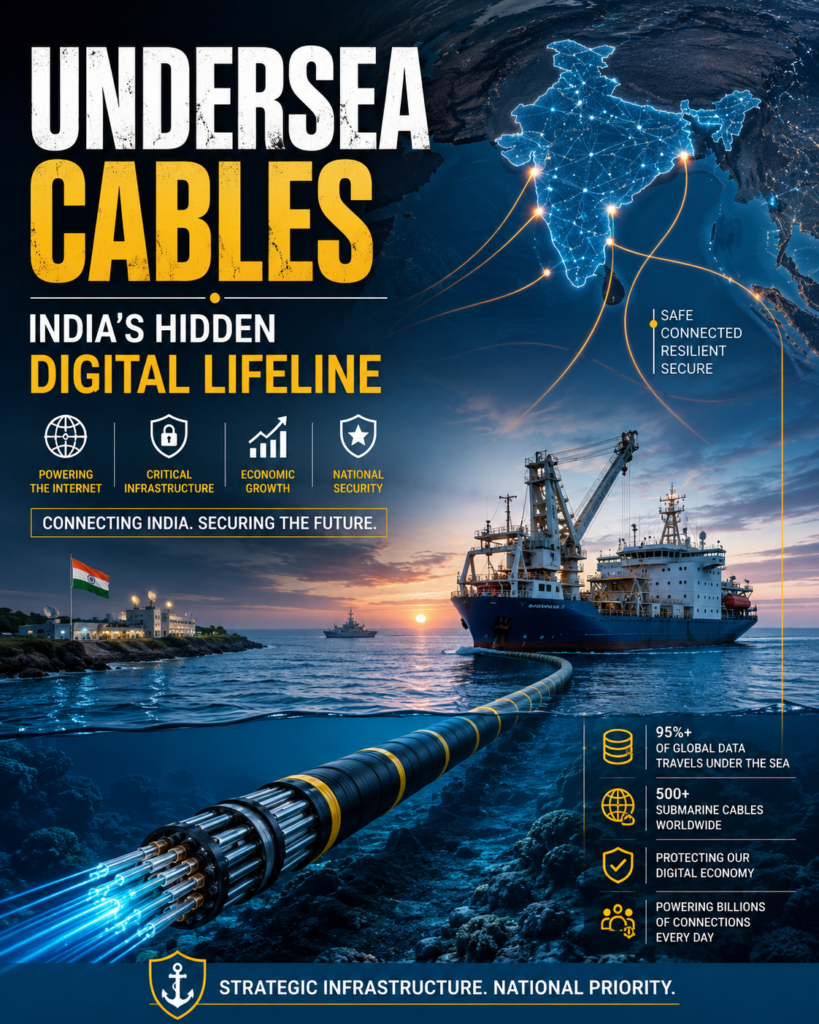
Although satellites play an important role in global communications, the vast majority of international internet traffic travels through these submarine cables laid across the ocean floor.
For India, whose economy, financial markets, defence communications and digital infrastructure are becoming increasingly interconnected, protecting undersea cables is now an important element of national security.
India’s digital infrastructure is becoming as strategically important as the defence capabilities discussed in our article on India’s National Security Doctrine in the 21st Century.
What Are Undersea Cables?
Undersea cables are fibre-optic communication lines laid beneath the oceans to connect countries and continents.
These cables carry:
- Internet traffic
- Financial transactions
- Government communications
- Business data
- Cloud services
- International telecommunications
They form the backbone of the global digital economy.
Why Are They Important?
More than 95% of international data traffic is transmitted through submarine fibre-optic cables.
These cables enable:
- Global banking
- International trade
- Online education
- Digital payments
- Video conferencing
- Defence communications
Without them, modern economies would face severe disruption.
India’s Growing Dependence
India has become one of the world’s largest digital economies.
Major sectors relying on international connectivity include:
- Banking
- IT services
- E-commerce
- Digital payments
- Cloud computing
- Government services
As India’s digital footprint expands, secure international connectivity becomes increasingly important.
National Security Implications
Undersea cables are considered critical infrastructure.
Any disruption—whether caused by natural disasters, accidents or deliberate interference—can affect communications and economic activity.
From a security perspective, governments seek to:
- Improve network resilience
- Diversify cable routes
- Enhance monitoring
- Strengthen cybersecurity
- Develop rapid repair capabilities
These measures reduce the impact of potential disruptions.
Space-based surveillance and secure communications, discussed in Military Satellites: How Space Strengthens India’s National Security, also contribute to protecting critical infrastructure.
Maritime Security and the Indian Ocean
India’s location in the Indian Ocean places it near several important global sea lanes and submarine cable routes.
Protecting maritime infrastructure complements India’s broader objectives of:
- Maritime domain awareness
- Secure sea lines of communication
- Regional stability
- Economic security
This makes cooperation between civilian agencies, the Navy and international partners increasingly important.
Emerging Challenges
The submarine cable network faces several risks, including:
- Earthquakes and underwater landslides
- Fishing activity and ship anchors
- Equipment failures
- Cybersecurity threats targeting network operations
Building resilient infrastructure helps minimise these risks.
Emerging technologies such as Electronic Warfare: India’s Invisible Battlefield demonstrate how modern conflicts increasingly target information and communication networks.
India’s Strategic Response
India is strengthening digital infrastructure through:
- Expansion of domestic data centres
- International connectivity projects
- Improved cybersecurity frameworks
- Maritime surveillance
- Cooperation with global partners
Together, these efforts support both economic growth and national resilience.
India is also strengthening its digital infrastructure through initiatives led by the Ministry of Electronics and Information Technology (MeitY).
The Future of Digital Infrastructure
As artificial intelligence, cloud computing and digital services continue to expand, demand for secure international connectivity will increase.
Future priorities include:
- Additional cable landing stations
- Greater network redundancy
- Faster repair capabilities
- Advanced monitoring technologies
- Stronger international cooperation
These investments will help ensure reliable connectivity for decades to come.
Conclusion
Undersea fibre-optic cables may remain invisible beneath the oceans, but they are among the world’s most important strategic assets.
For India, protecting these networks is about far more than internet access. It is about safeguarding economic activity, supporting government functions, strengthening digital resilience and ensuring national security in an increasingly connected world.
As the digital economy grows, undersea cable security will become an even more important component of India’s long-term strategic planning.