
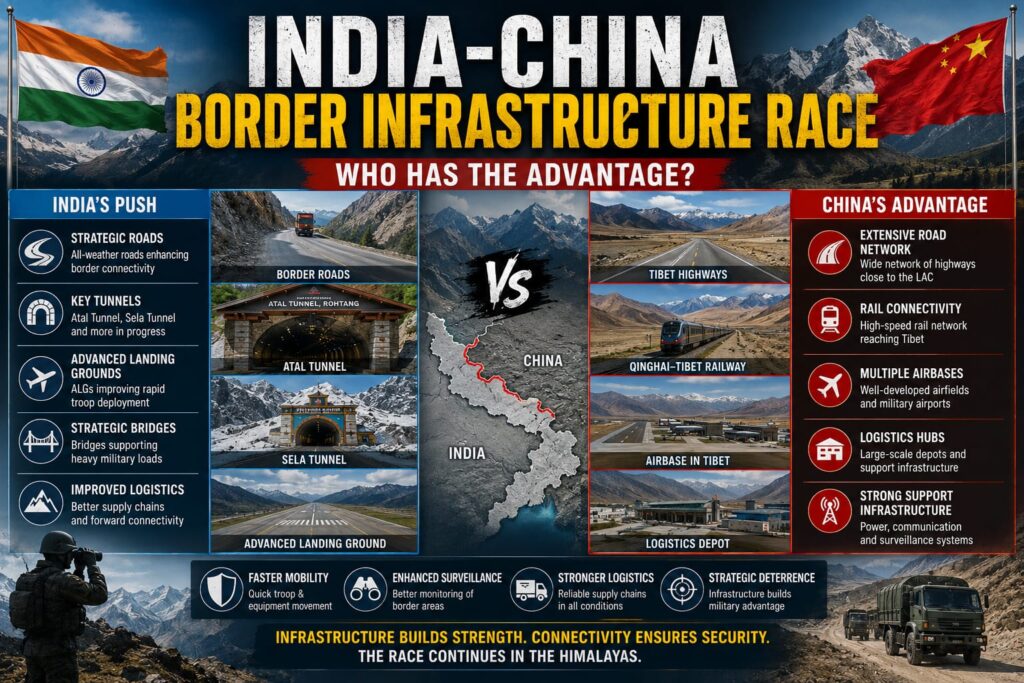
The India-China border is one of the world’s most strategically sensitive frontiers. Stretching across the Himalayas, the Line of Actual Control (LAC) has become a focal point of military competition and infrastructure development. In recent years, both India and China have accelerated the construction of roads, tunnels, railways, airfields, and logistics hubs near the border.
This infrastructure race is not merely about economic development. It directly affects military mobility, border security, and strategic deterrence. The ability to move troops, equipment, and supplies quickly can significantly influence the outcome of any future crisis along the LAC.
Why Border Infrastructure Matters
Modern warfare depends heavily on logistics. Armies that can deploy forces rapidly enjoy a significant advantage.
Border infrastructure enables:
- Faster movement of troops and equipment.
- Improved surveillance and reconnaissance.
- Year-round access to remote areas.
- Better supply chains during emergencies.
- Enhanced deterrence against potential adversaries.
For countries separated by difficult mountainous terrain, infrastructure often becomes a decisive strategic asset.
China’s Infrastructure Advantage
Over the past two decades, China has invested heavily in Tibet and Xinjiang.
Key developments include:
- Extensive highway networks connecting border regions.
- High-speed rail expansion into Tibet.
- Multiple military airbases near the LAC.
- Modern logistics hubs and supply depots.
- Improved communications and power infrastructure.
China’s relatively flat Tibetan plateau allows easier construction and faster military mobilization compared to India’s mountainous terrain.
India’s Infrastructure Push
Recognizing the strategic gap, India has significantly increased investment in border infrastructure.
Major projects include:
Border Roads Organisation (BRO)
The BRO has emerged as the backbone of India’s border connectivity efforts. It is responsible for constructing roads, bridges, tunnels, and strategic infrastructure across difficult terrain.
Atal Tunnel
The Atal Tunnel provides all-weather connectivity to Ladakh and improves military logistics in the northern sector.
Sela Tunnel
Located in Arunachal Pradesh, the Sela Tunnel strengthens access to the eastern sector and supports troop deployment near the China border.
Strategic Bridges
India has built numerous bridges capable of supporting heavy military vehicles, reducing deployment times in sensitive areas.
Airfields and Advanced Landing Grounds
India has also upgraded several Advanced Landing Grounds (ALGs) in Arunachal Pradesh and other frontier regions.
These facilities allow:
- Rapid troop deployment.
- Emergency logistics support.
- Improved surveillance operations.
- Faster response during border tensions.
Challenges Facing India
Despite significant progress, several challenges remain:
- Difficult Himalayan terrain.
- Harsh weather conditions.
- Landslides and natural disasters.
- Environmental restrictions.
- Higher construction costs.
These factors often slow infrastructure development compared to China’s side of the border.
Who Has the Advantage?
China currently retains an overall infrastructure advantage due to decades of investment and easier terrain.
However, India has narrowed the gap considerably through:
- Increased infrastructure spending.
- Faster project execution.
- Expansion of strategic tunnels.
- Improved road connectivity.
- Enhanced military logistics capabilities.
The infrastructure balance is becoming more competitive than at any time in recent history.
Conclusion
The India-China border infrastructure race is shaping the future of security in the Himalayas. Roads, tunnels, airfields, and logistics networks are becoming as important as traditional military assets.
While China still possesses significant advantages, India’s rapid infrastructure development is strengthening its strategic position and improving its ability to respond to future challenges along the Line of Actual Control.
As both nations continue investing in border connectivity, infrastructure will remain a critical factor in determining the balance of power across the Himalayas.