
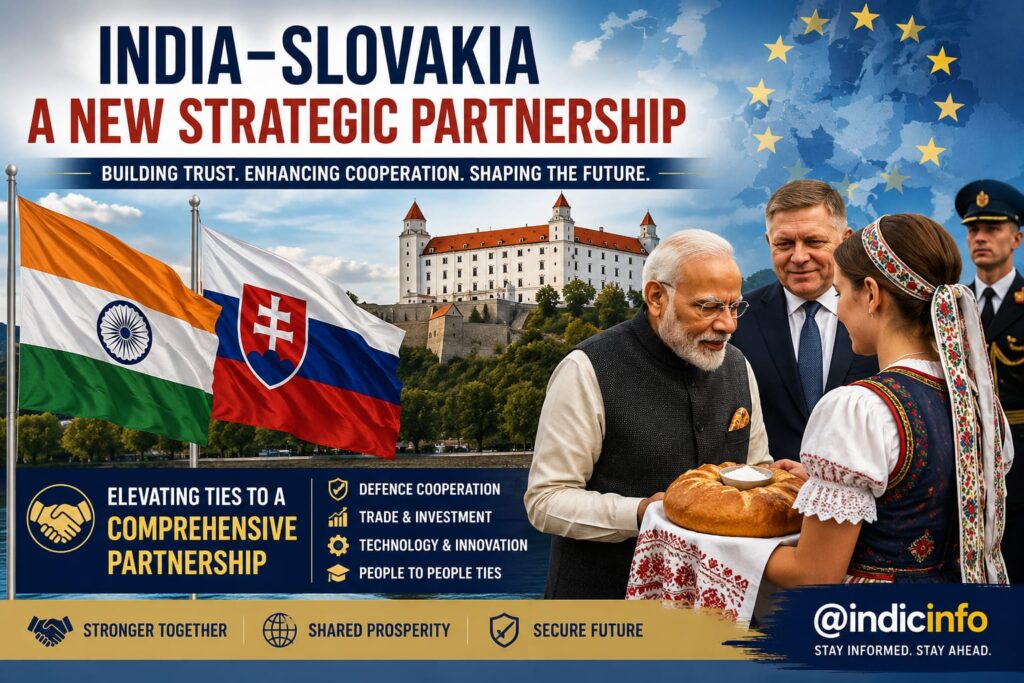
Prime Minister Narendra Modi’s visit to Slovakia marks an important moment in India’s engagement with Europe. While larger European powers such as France, Germany, and the United Kingdom often dominate headlines, India’s growing partnership with smaller but strategically positioned European nations is becoming increasingly significant.
The visit reflects India’s broader effort to strengthen its diplomatic, economic, technological, and defence relationships across Europe. It also demonstrates how New Delhi is diversifying its partnerships in an increasingly uncertain global environment.
Why the Visit Is Historic
The visit is significant because it represents a major step forward in bilateral relations between India and Slovakia. Both countries have expressed interest in expanding cooperation in trade, technology, innovation, defence manufacturing, and industrial partnerships.
For India, the visit reinforces its strategy of engaging with the entire European continent rather than focusing only on major powers. For Slovakia, deeper ties with India provide access to one of the world’s fastest-growing major economies.
The strengthening of relations comes at a time when global supply chains are being reshaped and countries are seeking reliable economic and strategic partners.
Understanding the India–Slovakia Partnership
India and Slovakia already maintain friendly diplomatic relations, but the recent engagement signals a desire to elevate cooperation across multiple sectors.
Key areas of collaboration include:
- Defence and security cooperation
- Industrial manufacturing
- Automotive technology
- Innovation and research
- Information technology
- Higher education partnerships
- Trade and investment
Both nations see opportunities to leverage their respective strengths for mutual benefit.
Defence Cooperation and Strategic Importance
One of the most important aspects of the growing partnership is defence cooperation.
India has emerged as a major defence manufacturing hub under the “Make in India” initiative. At the same time, European countries are looking to diversify defence supply chains and explore new industrial partnerships.
Closer India–Slovakia defence ties could contribute to:
- Joint defence production opportunities
- Technology sharing
- Industrial cooperation
- Expansion of defence exports
- Stronger strategic engagement between India and Europe
For India, every new defence partnership in Europe strengthens its position as an emerging security and manufacturing partner.
Slovakia’s Strategic Position in Europe
Although Slovakia is not among Europe’s largest countries, it occupies an important position within the European Union.
The country is known for:
- Advanced manufacturing capabilities
- Strong automotive industry
- Skilled industrial workforce
- Access to European markets
- Participation in European supply chains
These advantages make Slovakia an attractive partner for Indian companies seeking deeper integration into European markets.
As India aims to become a global manufacturing powerhouse, partnerships with industrial economies such as Slovakia can help accelerate this goal.
Strengthening India’s European Strategy
India’s engagement with Slovakia should be viewed within a broader strategic context.
Over the past decade, India has strengthened ties with:
- France
- Germany
- Italy
- Greece
- Poland
- Czech Republic
- Nordic countries
The objective is clear: build a diversified network of partnerships across Europe.
This approach reduces dependence on any single partner while increasing India’s diplomatic influence across the continent.
A stronger European presence also supports India’s goals in trade, technology cooperation, energy security, and defence manufacturing.
India’s growing engagement with Europe complements its broader strategic vision outlined in our analysis of India’s National Security Doctrine in the 21st Century.
Economic Opportunities Ahead
Economic cooperation remains one of the most promising aspects of the relationship.
Potential areas of growth include:
Manufacturing
Indian and Slovak firms can cooperate in industrial production and advanced manufacturing.
Technology
Collaboration in emerging technologies can support innovation in both countries.
Automotive Sector
Slovakia is one of Europe’s leading automotive manufacturing hubs, creating opportunities for Indian suppliers and investors.
Investment
Growing bilateral trust can encourage greater investment flows in both directions.
Supply Chain Resilience
As companies seek alternatives to concentrated supply chains, India and Slovakia can benefit from increased economic cooperation.
Stronger European partnerships also support India’s efforts to build resilient supply chains, discussed in India’s Supply Chain Strategy as a National Security Tool.
What the Partnership Means for India’s Global Standing
India’s rise on the global stage is not driven solely by relations with major powers. It is also shaped by the country’s ability to build meaningful partnerships across regions.
The strengthening of India–Slovakia relations demonstrates:
- India’s expanding diplomatic reach
- Growing economic influence
- Rising attractiveness as a manufacturing destination
- Increasing importance in global supply chains
- Stronger role in European strategic calculations
Such partnerships help India build long-term influence while supporting national economic and security objectives.
Conclusion
Prime Minister Narendra Modi’s visit to Slovakia is more than a diplomatic event. It reflects India’s broader strategy of deepening engagement with Europe, expanding defence and economic partnerships, and strengthening its position in an evolving global order.
As India continues its rise as a major global power, partnerships with countries like Slovakia will play an increasingly important role in shaping the future of India’s economic growth, strategic influence, and international standing.
The visit may not attract the same attention as engagements with larger powers, but its long-term significance for India’s European strategy should not be underestimated.
According to the Ministry of External Affairs, both countries discussed expanding cooperation in trade, defence and technology sectors.