
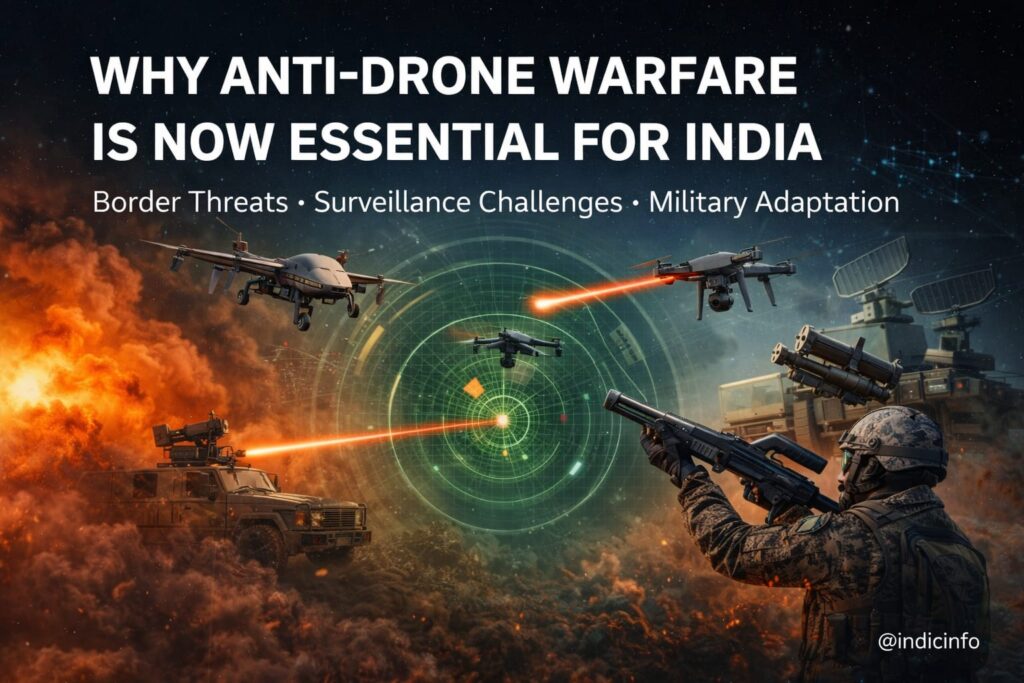
Introduction
Modern warfare is increasingly shaped by systems that are small, mobile and difficult to detect. Among these, drones have emerged as one of the most disruptive technologies in recent conflicts.
Unmanned aerial systems now influence surveillance, reconnaissance, targeting and even direct attacks. Their relatively low cost and growing accessibility have made them important tools not only for advanced militaries but also for irregular threats.
For India, this has created a new defence challenge. Border security, military installations and sensitive infrastructure increasingly require protection against aerial systems that may be difficult to detect using conventional methods.
Why Drones Have Changed Modern Warfare
Drones have altered battlefield dynamics because they combine surveillance and strike potential at relatively low cost.
They can monitor movement, gather intelligence and in some cases deliver payloads without exposing pilots to risk.
This means even small aerial systems can create disproportionate tactical effects.
Modern conflict has shown that drones are no longer limited to surveillance. They increasingly influence targeting and operational pressure.
India has also expanded anti-drone work through DRDO-linked defence development programmes.
Why Anti-Drone Capability Matters for India
For India, drone-related threats are relevant across multiple security environments.
Sensitive border regions require continuous monitoring against low-altitude aerial systems.
Military bases and strategic installations also require new protection layers because traditional radar systems may not always detect small drones effectively.
This means anti-drone capability is becoming a practical requirement rather than a future option.
Anti-drone systems are closely linked to capabilities discussed in How Electronic Warfare Is Becoming Critical for India.
Electronic Warfare and Drone Defence
Anti-drone systems increasingly depend on signal disruption and electronic response.
This directly connects with India’s growing focus on electronic warfare.
Signal jamming, communication interruption and detection systems are often the first layer of drone defence.
This means anti-drone warfare is closely linked to wider control over the electromagnetic spectrum.
Border Security and Surveillance
For the Indian Army, anti-drone systems are becoming more relevant in difficult terrain where conventional surveillance faces limitations.
Small aerial systems can exploit terrain, distance and low visibility.
This creates pressure for rapid detection and response.
Drone detection also complements surveillance discussed in Why India’s Military Satellites Matter More Than Ever in Modern Warfare.
Maritime Relevance
Anti-drone systems are also becoming relevant for maritime security in the Indian Ocean.
Naval assets increasingly require protection from aerial observation and low-cost drone threats.
For the Indian Navy, anti-drone readiness adds another layer to maritime security planning.
Strategic Conclusion
Anti-drone warfare is no longer a specialised defence issue. It is becoming central to modern military preparedness.
For India, drones represent both a technological challenge and a strategic reality across land, air and maritime environments.
As warfare becomes more technology-driven, the ability to detect, disrupt and neutralise drones will remain increasingly important.