
Introduction
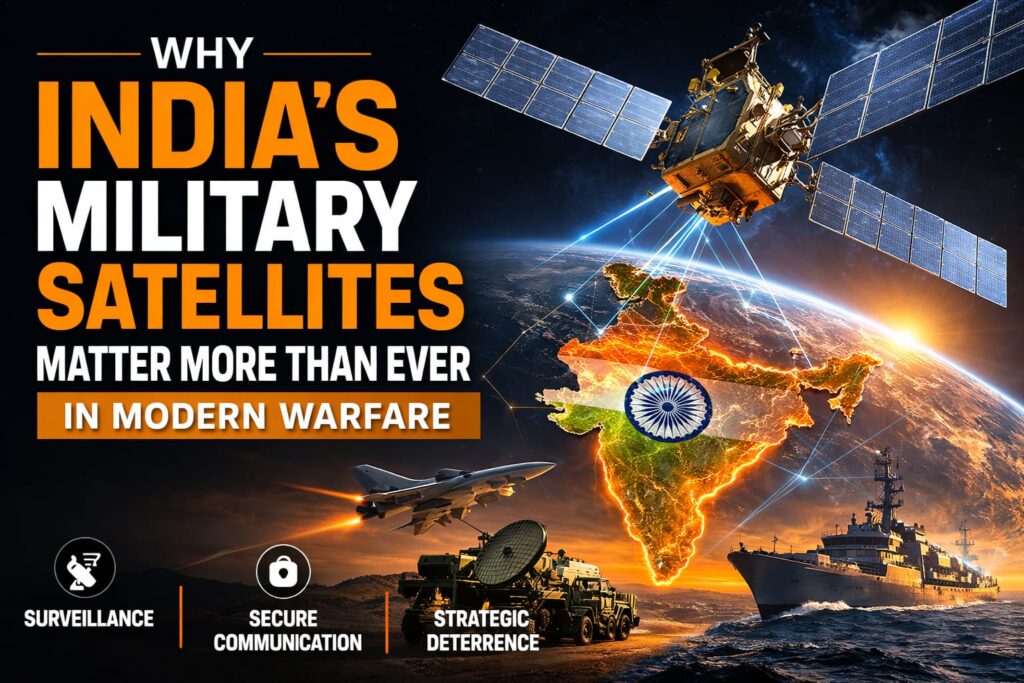
Modern warfare is no longer shaped only by soldiers, aircraft, warships and missiles. Increasingly, the systems that determine military advantage operate far above the battlefield, in orbit around Earth. Satellites now influence surveillance, targeting, navigation, communication and early warning, making space a critical layer of military power.
For India, military satellites have become an increasingly important strategic asset. As security challenges expand across land borders, maritime zones and regional airspace, space-based capabilities are now deeply linked to national defence planning. Whether monitoring naval movement, supporting border surveillance or maintaining secure communication during military deployments, satellites are becoming essential to modern strategic readiness.
Why Military Satellites Matter in Modern Warfare
Military satellites serve several strategic purposes simultaneously.
They provide surveillance over large distances that aircraft cannot continuously maintain. Satellite imaging helps monitor troop movements, naval deployments and infrastructure activity across sensitive regions.
They also strengthen secure communication, especially during military deployments in remote or difficult terrain.
Navigation support has become equally critical because modern military systems increasingly depend on precise positioning.
In modern conflict, the side that sees earlier, communicates better and coordinates faster often gains an important advantage before direct combat begins.
India’s Expanding Defence Space Capability
The Indian Space Research Organisation has steadily built satellite systems that support strategic observation and communication.
At the same time, the Defence Research and Development Organisation has increased focus on integrating space capability into defence requirements.
This gives India growing strategic depth across multiple theatres.
India’s defence planning increasingly depends on satellite support not only for observation but also for secure command systems, operational coordination and long-distance strategic monitoring.
Maritime Surveillance and Strategic Awareness
The Indian Ocean remains central to India’s long-term strategic calculations.
Satellites improve awareness across key maritime zones including:
- Bay of Bengal
- Strait of Hormuz
- Andaman and Nicobar Islands
Continuous maritime observation has become difficult without orbital support.
Naval movements across major sea lanes often require persistent tracking, and satellites make this possible over large distances that conventional systems alone cannot fully cover.
Border Monitoring and High-Altitude Security
Satellite observation is equally important across high-altitude frontier regions where weather and terrain limit conventional surveillance.
Space systems help detect changes in infrastructure, movement patterns and military preparation.
This improves decision-making before situations escalate.
In difficult terrain, even small changes in activity can carry strategic significance. Satellite monitoring therefore supports long-term situational awareness.
Secure Communication During Conflict
Communication reliability is often decisive in military operations.
Satellites help maintain secure links between air, naval and ground units even when conventional systems face disruption.
This reduces operational vulnerability.
For remote deployments and maritime operations, secure satellite communication often becomes one of the most reliable systems available.
Navigation and Precision Capability
Military precision increasingly depends on reliable navigation.
Satellite support improves:
- missile guidance
- aircraft routing
- naval coordination
- operational timing
This directly affects strategic effectiveness.
As military systems become more advanced, even small navigation errors can reduce operational efficiency.
Why Space Security Will Matter More for India
Future conflicts will increasingly involve electronic disruption, communication resilience and satellite protection.
As warfare becomes faster and more technology-driven, orbital capability will become more important for deterrence and preparedness.
Protecting satellites will therefore become almost as important as deploying them.
Strategic Conclusion
Military satellites are no longer secondary tools. They are becoming central to modern military capability.
For India, they strengthen surveillance, communication, precision and strategic awareness across land, sea and air.
The future battlefield will still exist on Earth, but increasingly, critical systems shaping outcomes will begin in space.
Also read : India’s National Security Doctrine in the 21st Century