
Introduction
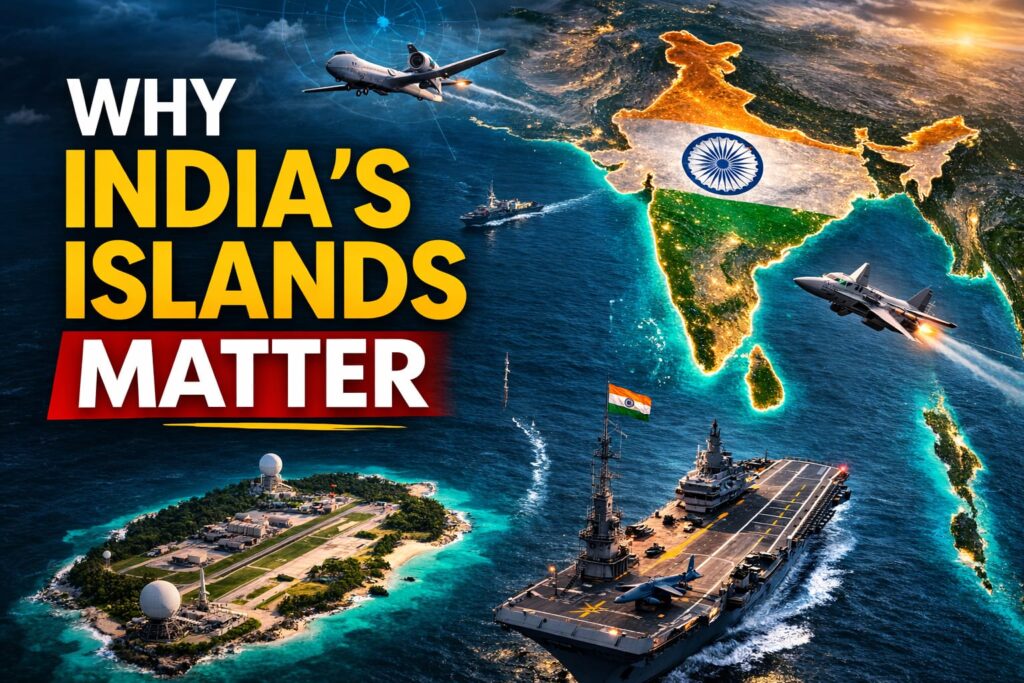
In modern strategic planning, geography often determines long-term military advantage before a crisis even begins. For India, this principle is especially important because some of its most valuable strategic assets are not located on the mainland but far into the surrounding ocean.
India’s island territories are often discussed in administrative or tourism terms, yet their strategic value has grown significantly in recent years. As maritime competition expands across the Indian Ocean, these islands are becoming increasingly important for surveillance, deterrence, logistics, and operational reach.
In the coming decades, India’s island territories may play a far greater role in national security than many conventional land positions.
Andaman and Nicobar Islands: India’s Eastern Strategic Advantage
The Andaman and Nicobar Islands occupy one of the most strategically important positions available to India.
Located near the Strait of Malacca, these islands sit close to one of the world’s busiest maritime corridors. A large share of global trade and energy movement passes through this route every day.
This gives India an important strategic advantage because activity near this maritime chokepoint can be observed and monitored from a forward position.
The islands also extend India’s military presence deep into the eastern Indian Ocean.
Why the Strait of Malacca Matters
The Strait of Malacca remains one of the most sensitive maritime chokepoints in Asia.
A major share of commercial shipping moving between the Indian Ocean and the Pacific passes through this narrow corridor.
For any major Asian power, visibility near this route carries long-term strategic value.
Because the Andaman and Nicobar chain lies nearby, India possesses natural geographic leverage that few countries can replicate.
Lakshadweep and the Western Maritime Front
On the western side, Lakshadweep also carries growing strategic relevance.
Located in the Arabian Sea, these islands help extend India’s observation capacity across western maritime routes linked to West Asia.
This matters because India’s western maritime front remains directly connected to energy imports, tanker movement, and naval activity linked to the wider Arabian Sea.
As strategic attention increasingly turns toward maritime security, Lakshadweep becomes more important than its size may suggest.
Islands Strengthen Surveillance and Early Warning
One of the greatest military advantages of island territories is persistent surveillance.
Forward island positions improve:
- Radar coverage
- Maritime patrol operations
- Naval observation
- Air surveillance
- Early warning capability
This is especially important in an era where maritime activity can shift quickly during regional tension.
Why Islands Matter for Future Military Logistics
Island territories are not only observation points.
They also support:
- Forward logistics
- Aircraft operations
- Naval replenishment
- Rapid deployment capability
In future maritime scenarios, logistics may decide endurance more than raw firepower.
This makes island infrastructure strategically valuable.
India’s naval posture also depends on long-term force development visible through official naval planning.
Maritime Competition Is Increasing Their Importance
As naval competition intensifies across the Indian Ocean, island territories become more important because they shape presence without requiring constant mainland deployment.
A country with island depth can maintain wider operational flexibility.
For India, this geographic advantage already exists naturally.
The long-term challenge is converting geography into fully developed strategic capability.
Conclusion
India’s island territories are no longer peripheral assets.
They are becoming central to modern strategic thinking.
The Andaman and Nicobar Islands strengthen India’s eastern maritime reach, while Lakshadweep supports western maritime awareness.
As maritime competition increasingly shapes regional power, these islands may become some of India’s most valuable strategic positions.
India’s maritime thinking has become more important as the Indian Ocean increasingly shapes regional strategic competition.