
Introduction
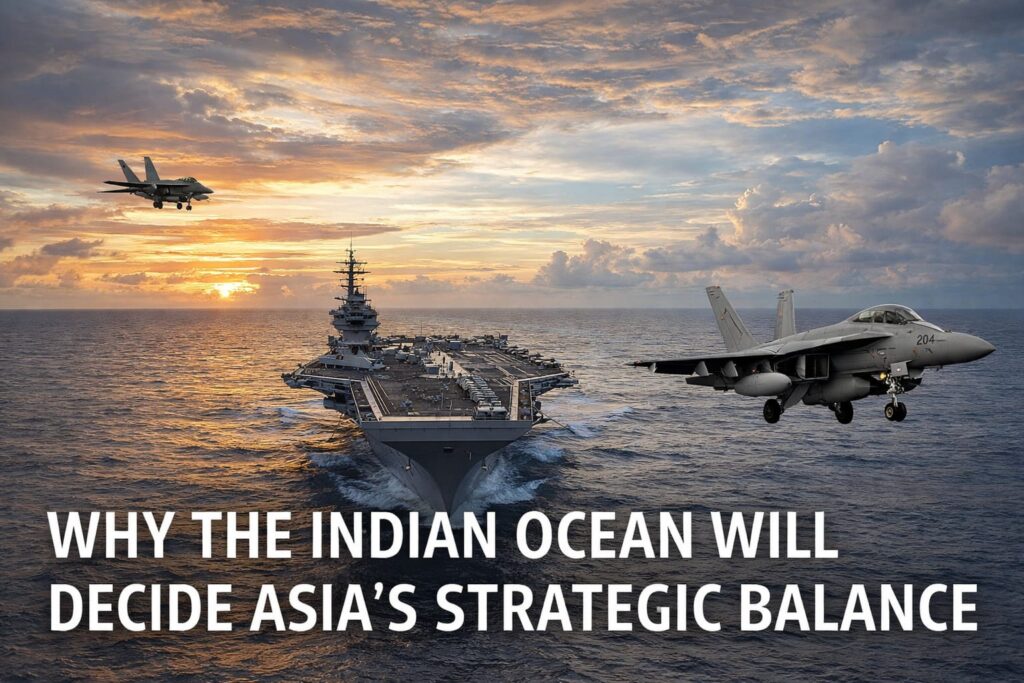
For much of modern history, Asia’s strategic debates focused heavily on land borders, mountain frontiers, and continental rivalries. In the 21st century, maritime geography is returning to the centre of power. The Indian Ocean is increasingly emerging as one of the most decisive strategic theatres in the world.
For India, this is not simply a maritime question. It directly affects national security, energy continuity, trade routes, and long-term strategic influence.
The future balance of power in Asia may depend less on territorial disputes and more on who shapes the maritime environment across the Indian Ocean.
Why the Indian Ocean Has Become Strategically Critical
The Indian Ocean carries some of the world’s most important sea lanes of communication. A large share of global oil shipments, container traffic, and energy trade moves through this maritime space every day.
Critical chokepoints connected to this region include:
- Strait of Hormuz
- Bab-el-Mandeb
- Strait of Malacca
Any disruption in these narrow passages immediately affects fuel prices, shipping costs, insurance rates, and strategic calculations across Asia.
India’s maritime doctrine increasingly depends on long-term naval readiness, as reflected in official naval planning and force development priorities.
Why India Occupies a Natural Strategic Position
India’s geography gives it a unique strategic advantage.
Its peninsular shape places the country naturally close to major shipping lanes moving between West Asia, Africa, and East Asia.
India’s island territories further strengthen this position:
- Andaman and Nicobar Islands
- Lakshadweep
These locations allow India to maintain strategic visibility across some of the busiest maritime corridors in the world.
China’s Expanding Presence Across the Indian Ocean
China’s strategic focus has increasingly moved into the Indian Ocean through infrastructure, port access, and naval presence.
Important locations often discussed include:
- Gwadar Port
- Hambantota Port
- Djibouti Naval Base
These developments create long-term strategic pressure across the wider region.
Chokepoints Will Define Future Strategic Pressure
Modern maritime power often concentrates around narrow passages rather than open waters.
A country does not need to dominate an entire ocean to shape strategic outcomes. It only needs awareness and capability around critical chokepoints.
This is why events in the Strait of Hormuz immediately affect India’s strategic calculations.
India’s Naval Future Will Matter More Than Ever
The role of the Indian Navy will become increasingly central.
Future maritime strength depends on:
- Carrier battle groups
- Submarine expansion
- Long-range surveillance
- Island infrastructure
- Maritime domain awareness
The strategic objective is sustained presence and deterrence.
Conclusion
The Indian Ocean is no longer simply a geographic space between continents. It is becoming one of the decisive strategic theatres of this century.
India’s geography gives it a natural advantage, but geography alone is never enough. Strategic advantage must be converted into capability, infrastructure, and long-term doctrine.
As Asia’s power balance evolves, the Indian Ocean may ultimately decide which nations shape the future regional order.