
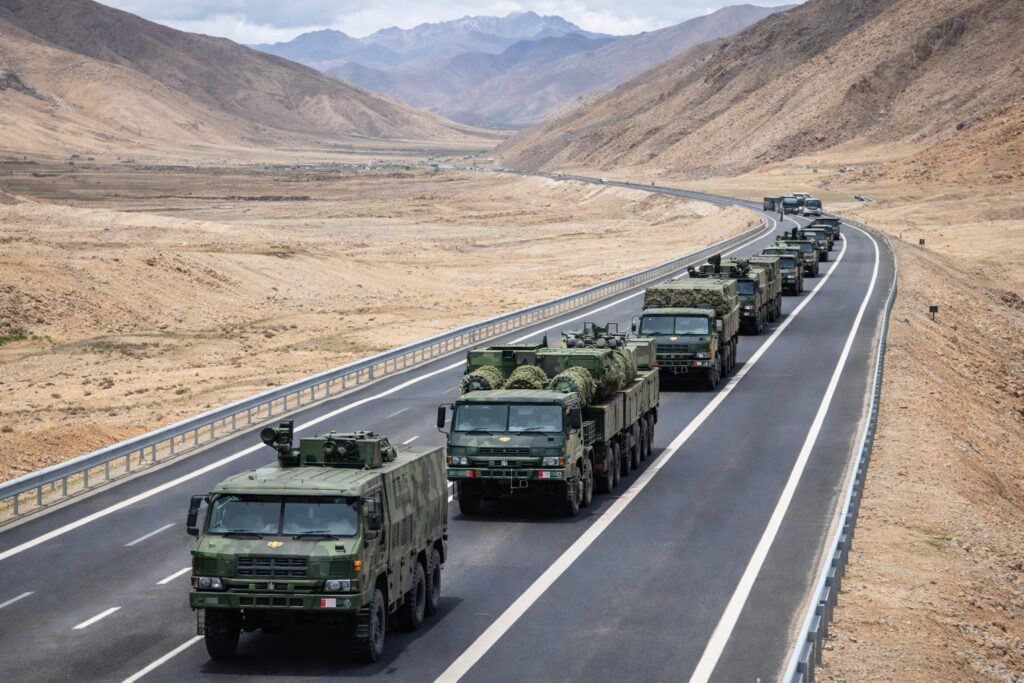
Introduction: Power Is No Longer Built Only Through Armies
Modern strategic competition is no longer shaped only by armies, missiles, and military deployments. Increasingly, power is built through the ability of a state to convert civilian strength into military advantage.
No major power has pursued this model more systematically than China.
Through what Beijing calls Military-Civil Fusion (MCF), China has integrated civilian infrastructure, technology, industrial production, logistics systems, research institutions, and transportation networks into a broader national security framework.
For India, this matters because China’s strategic rise is not visible only at the border. It is embedded in railways, ports, supply chains, digital systems, and dual-use infrastructure that can serve both civilian and military purposes.
Understanding this strategy is essential for understanding how China builds long-term strategic leverage.
What Is Military-Civil Fusion?
Military-Civil Fusion is a national doctrine under which civilian and military sectors are designed to support one another.
The objective is clear:
- civilian innovation strengthens defence capability
- industrial growth supports military production
- transport systems improve military mobility
- technology ecosystems serve strategic goals
This means many Chinese civilian projects cannot be viewed only through an economic lens.
A commercial port, a logistics corridor, a satellite company, or a transport hub may also contribute to military preparedness.
China has deliberately reduced the traditional boundary between civilian development and military planning.
Why China Chose This Model
China understands that future power depends not only on military size but on national strategic efficiency.
Instead of treating defence and development separately, Beijing treats both as parts of one long-term state project.
This gives China several advantages:
- faster military modernisation
- lower strategic costs
- deeper industrial resilience
- stronger wartime adaptability
It also allows China to prepare for strategic competition without appearing to militarise every sector openly.
This makes military-civil fusion one of the most important foundations of China’s rise.
Global strategic institutions such as CSIS have also studied China’s military-civil fusion model in detail.
Border Infrastructure and Strategic Mobility
One of the clearest examples of military-civil fusion is border infrastructure.
Across western China, especially near Tibet, transport projects have strategic value beyond civilian connectivity.
Roads, tunnels, rail links, and airfields improve:
- troop movement
- logistics supply
- rapid reinforcement capability
This directly affects India because Chinese deployment flexibility near the Line of Actual Control improves when infrastructure expands.
Military movement that once took longer can now happen far more rapidly.
This is one reason India has accelerated its own border infrastructure development.
Technology as Strategic Force
China’s technological rise is deeply linked to military-civil fusion.
Sectors such as:
- artificial intelligence
- drones
- cyber systems
- satellite navigation
- quantum research
- advanced electronics
are not isolated from national security planning.
Chinese firms operating in advanced technology sectors often contribute to strategic capacity indirectly or directly.
For India, this means strategic competition increasingly includes industrial capability and technological independence.
Maritime Expansion and Dual-Use Ports
Military-civil fusion also shapes maritime strategy.
Chinese port investments across multiple regions are watched carefully because civilian access can create long-term strategic options.
Commercial ports can provide:
- logistical familiarity
- maintenance access
- supply flexibility
- future naval utility
For India, this matters most in the Indian Ocean.
As maritime competition expands, dual-use infrastructure becomes strategically significant.
Maritime competition also shapes India’s long-term planning, especially in Why the Indian Ocean Will Shape Global Power in the 21st Century.
Why India Must Read This Correctly
China’s challenge is not simply military pressure at the border.
It is the ability to convert national development into strategic depth.
India’s response therefore cannot remain limited to troop deployment alone.
It must also include:
- infrastructure acceleration
- supply chain resilience
- port strength
- technology investment
- logistics security
Strategic Lessons for India
Military-civil fusion demonstrates that strategic power is built long before conflict begins.
It is built through roads, industrial systems, ports, digital networks, and technological ecosystems.
China has understood this clearly.
India’s long-term strategic success will depend on how effectively it aligns development with national security priorities.
India has already adjusted its strategic posture in response to changing regional realities, as discussed in How India Rewrote Deterrence After 2016.
Conclusion
China’s military-civil fusion strategy is one of the most important drivers of Asian strategic competition.
It explains how economic growth, infrastructure expansion, and technological development can also become instruments of long-term military advantage.
For India, understanding this model is essential because future strategic competition will not be decided only at borders.
It will be shaped by which state can build deeper strategic capacity across the entire national system.