
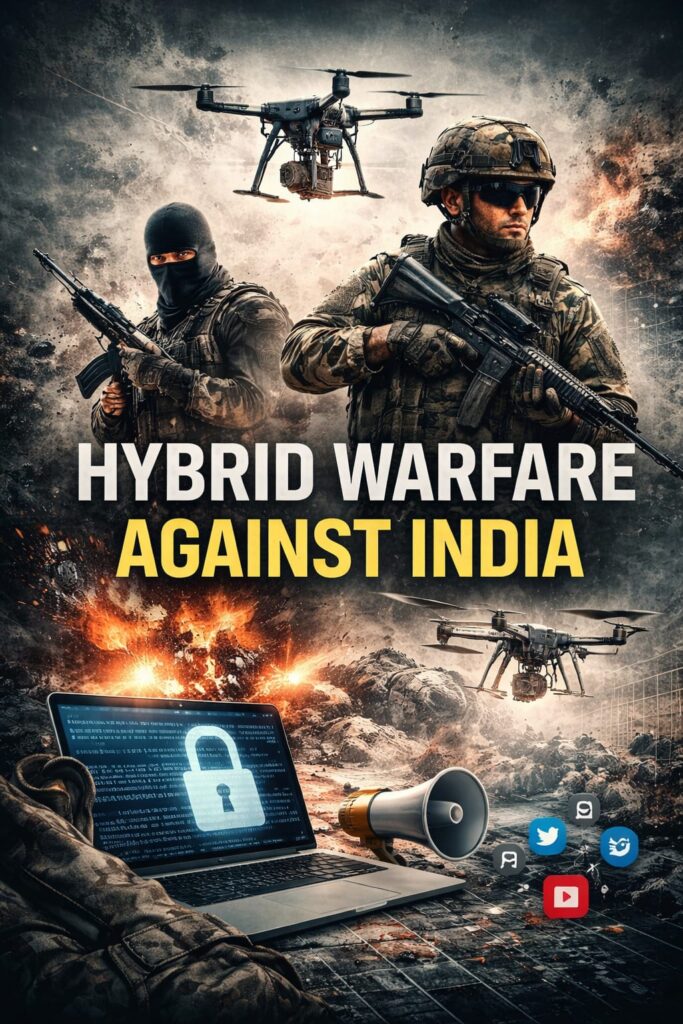
Introduction: War Without a Declaration
Wars are no longer fought only by armies crossing borders.
In the 21st century, states weaken rivals without firing a formal first shot. They use terrorists instead of soldiers, drones instead of jets, misinformation instead of missiles, and internal fault lines instead of frontlines.
This is hybrid warfare — a strategy that blends military, economic, technological, informational, and psychological tools into a single, continuous campaign.
This evolving threat environment fits squarely within India’s national security doctrine, which increasingly recognises non-kinetic and sub-threshold conflict as central to modern warfare.
India is not preparing for hybrid warfare.
India is already fighting one.
What Is Hybrid Warfare?
Hybrid warfare is the simultaneous use of multiple instruments of power to destabilise a target state while staying below the threshold of full-scale war.
It combines:
- Irregular forces and terrorism
- Cyber attacks and economic pressure
- Drones and low-cost technologies
- Disinformation, propaganda, and narrative manipulation
- Legal, diplomatic, and political warfare
The objective is not battlefield victory.
The objective is strategic exhaustion.
Hybrid warfare as a concept has been extensively studied in Western military doctrine, including formal assessments of its use below the threshold of conventional war.
Terrorism as a Strategic Tool, Not a Tactic
Cross-border terrorism against India is often treated as a law-and-order problem or a military issue. In reality, it functions as a core instrument of hybrid warfare.
Terrorism is used to:
- Tie down security forces internally
- Create fear and uncertainty among civilians
- Internationalise internal security challenges
- Provoke political instability or overreaction
Groups operating against India do not function independently. They operate as state-enabled proxies, allowing their sponsors to maintain plausible deniability while inflicting sustained damage at minimal cost.
Drones: Cheap Technology, Disruptive Power
The rise of commercial drones has dramatically altered the hybrid warfare landscape.
Drones are effective because they are:
- Inexpensive and widely accessible
- Difficult to detect with traditional air-defence systems
- Suitable for surveillance, smuggling, and targeted delivery
Along India’s borders, drones have been used to:
- Drop weapons, explosives, and narcotics
- Reconnoitre sensitive military installations
- Probe gaps in counter-UAS and air-defence coverage
Hybrid warfare thrives on asymmetry — and drones offer disproportionate impact for negligible investment.
Narrative Warfare: The Invisible Front
Narrative warfare is the most underestimated component of hybrid conflict.
By shaping perception rather than reality, hostile actors attempt to:
- Portray India as unstable or oppressive
- Amplify internal divisions and grievances
- Undermine trust in institutions and governance
- Influence international opinion against Indian interests
Social media platforms, coordinated disinformation networks, selective outrage campaigns, and algorithmic amplification are all tools of this invisible battlefield.
Narrative warfare does not need universal belief.
It only needs confusion, polarisation, and doubt.
Cyber and Economic Pressure
Hybrid warfare increasingly targets the nervous system of the state.
Cyber intrusions are used to:
- Map critical vulnerabilities
- Signal coercive capability
- Prepare the ground for future escalation
At the same time, economic pressure — through trade leverage, supply-chain manipulation, and technology denial — is employed to shape strategic behaviour without open confrontation.
These methods operate continuously, quietly, and below the threshold of public alarm.
Hybrid warfare increasingly targets trade, technology access, and logistics networks, making India’s supply chain strategy a critical pillar of national security.
The China Factor in Hybrid Warfare
On India’s eastern front, hybrid warfare takes a more comprehensive form.
Pressure is applied through:
- Military coercion along disputed borders
- Economic leverage and market dependencies
- Cyber capabilities and data access
- Information control and narrative shaping
This approach deliberately blurs the line between peace and conflict, ensuring sustained strategic pressure even in the absence of open hostilities.
Why Hybrid Warfare Is So Difficult to Counter
Hybrid warfare exploits the structural vulnerabilities of modern democracies:
- Legal and ethical constraints
- Open information environments
- Political pluralism and media fragmentation
Traditional military power alone is insufficient.
Fighter aircraft cannot neutralise hostile narratives.
Armoured divisions cannot secure social cohesion.
Missile systems cannot restore institutional trust.
Hybrid warfare forces states to defend every domain, continuously.
India’s Response: Adaptation Underway
India’s response to hybrid warfare is evolving.
Areas of progress include:
- Improved intelligence coordination and counter-terror operations
- Enhanced border surveillance and drone countermeasures
- Growing recognition of information warfare as a security domain
However, gaps remain:
- Fragmented narrative response mechanisms
- Limited civil–military coordination in non-kinetic domains
- Slow institutional adaptation to cognitive and information warfare
Winning hybrid conflicts requires whole-of-nation alignment, not just military readiness.
Hybrid Warfare Is the New Normal
Hybrid warfare is no longer an exception.
It is the default mode of conflict in the 21st century.
For India, this means:
- National security begins far beyond physical borders
- Internal resilience is as critical as external deterrence
- Information, infrastructure, and institutions are strategic assets
Wars may still be fought with weapons.
But they are increasingly decided long before the first shot is fired.
Geographic vulnerabilities such as strategic chokepoints amplify the impact of hybrid pressure by combining military, economic, and psychological stress in confined regions.