
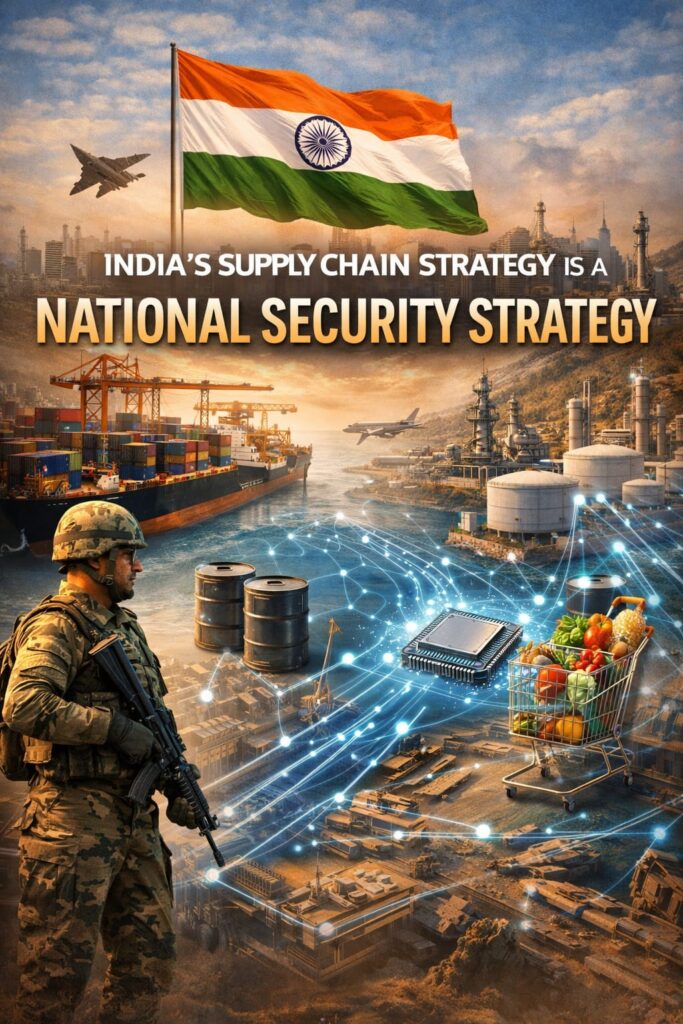
Supply Chains Are the New Battle Lines
National security is no longer decided only on borders or battlefields.
In the 21st century, power is increasingly shaped by who controls supply chains—of energy, food, technology, medicine, and critical minerals.
Disrupt a country’s supply chains, and you weaken its economy, military readiness, and political stability—without firing a single shot.
For India, this reality has transformed supply chain planning into a core security priority.
Why Supply Chains Matter More Than Ever
Globalisation once promised efficiency. It also created strategic dependence.
Recent global shocks—pandemics, wars, sanctions, and trade coercion—have shown that nations dependent on external suppliers for critical goods are vulnerable under pressure.
Supply chains today affect:
- Defence production timelines
- Energy security
- Food availability
- Healthcare readiness
- Industrial continuity during crises
Security is no longer just about strength—it is about resilience.
Strategic vulnerabilities such as the Siliguri Corridor show why supply chain resilience matters beyond geography.
Defence Readiness Begins in Factories, Not Frontlines
Modern militaries depend on complex industrial ecosystems.
Weapons, ammunition, vehicles, electronics, fuel, and spare parts all rely on uninterrupted supply chains. Even short disruptions can reduce operational readiness.
A country that cannot sustain production during crises risks strategic paralysis.
This is why defence preparedness now begins far from borders—in manufacturing zones, logistics hubs, ports, and transport corridors.
According to India’s National Logistics Policy, major supply chain reforms have improved integration, infrastructure planning, and resilience across the country’s logistics networks.
Technology and Semiconductor Dependence
Technology has become the most sensitive supply chain of all.
Semiconductors, rare earths, batteries, and electronics power everything from missiles to satellites to civilian infrastructure.
Global concentration of these supply chains has created strategic choke points. Countries that control them wield disproportionate influence.
India’s push to build domestic capacity and diversify sourcing is not economic protectionism—it is risk mitigation.
Energy and Fuel: The Lifeblood of Security
No military, economy, or government functions without energy.
Fuel supply disruptions affect:
- Armed forces mobility
- Power generation
- Transportation and logistics
- Civilian life
Energy supply chains—oil imports, gas routes, power grids—are therefore national security assets.
Diversification, storage capacity, and infrastructure resilience determine how long a country can withstand external shocks.
Food Security Is Strategic Stability
Food shortages destabilise societies faster than military threats.
Agricultural supply chains—fertilisers, irrigation, storage, transport—are critical for internal security and social stability.
Ensuring uninterrupted food flow during crises protects not just civilians, but governance itself.
This is why food supply resilience is increasingly treated as a strategic imperative.
Supply Chains and Strategic Autonomy
Dependence limits decision-making.
Countries heavily reliant on external suppliers face pressure during diplomatic disputes or conflicts. Economic coercion has become a common geopolitical tool.
By strengthening domestic supply chains and trusted partnerships, India increases its ability to make sovereign choices—free from external leverage.
Strategic autonomy today is built through logistics, not slogans.
Infrastructure Is the Enabler
Supply chains do not exist in isolation.
They depend on:
- Roads and railways
- Ports and airports
- Power grids
- Digital networks
Infrastructure connects production to consumption, factories to frontlines.
Without strong infrastructure, even domestic supply chains remain fragile.
India’s approach mirrors how infrastructure has become a core pillar of national security, not just economic development.
The Strategic Shift Underway
India’s approach reflects a broader global shift.
Security planning now integrates:
- Industry
- Logistics
- Trade routes
- Technology ecosystems
This is not militarisation of the economy—it is securitisation of resilience.
Prepared nations absorb shocks. Unprepared ones react too late.
Conclusion: Security Runs Through Supply Chains
In the modern world, wars are often decided before they begin.
They are decided by:
- Stockpiles
- Production capacity
- Logistics depth
- Redundancy and resilience
India’s future security will depend not only on soldiers and weapons, but on the strength and reliability of its supply chains.
In the age of economic warfare and strategic coercion, supply chains are national security.