
What Is the Siliguri Corridor?
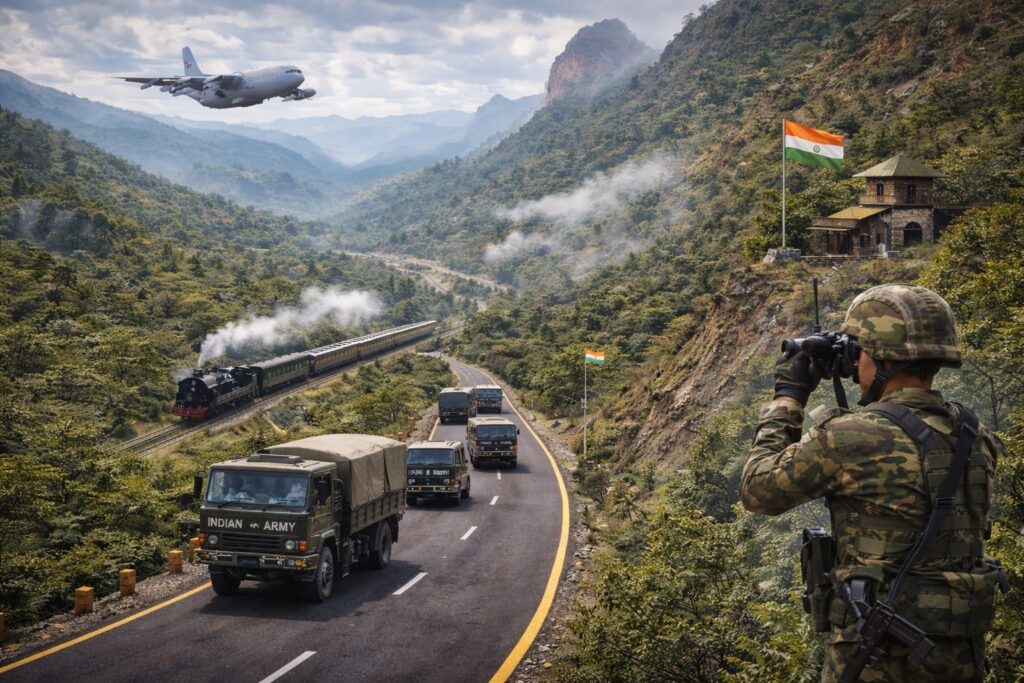
The Siliguri Corridor, often called the Chicken’s Neck, is a narrow stretch of land in West Bengal that connects mainland India to its eight northeastern states.
At its narrowest point, the corridor is barely 20–22 kilometres wide.
Despite its small size, this strip of land carries enormous strategic weight for India’s national security, territorial integrity, and internal connectivity.
Why the Siliguri Corridor Matters to India
The Siliguri Corridor is the only land link between:
- Mainland India
- Arunachal Pradesh, Assam, Meghalaya, Manipur, Mizoram, Nagaland, Tripura, and Sikkim
Any disruption here would effectively cut off the Northeast from the rest of the country.
This makes the corridor not just a geographic feature, but a strategic vulnerability.
Official defence assessments have repeatedly highlighted the strategic importance of connectivity and logistics in India’s Northeast region.
Geography That Creates Vulnerability
The Siliguri Corridor is surrounded by three countries:
- Nepal to the west
- Bhutan to the north
- Bangladesh to the south
Just beyond lies China, across the Doklam plateau.
This clustering of borders creates a complex security environment, where even limited instability can have outsized consequences.
Military Significance of the Siliguri Corridor
From a defence perspective, the corridor is crucial for:
- Movement of troops to the Northeast
- Transport of fuel, ammunition, and supplies
- Reinforcement during border crises
In any conflict scenario, logistics would determine outcomes faster than firepower.
If the corridor were compromised:
- Army mobilisation would slow dramatically
- Air supply would face capacity limits
- Civilian life in the Northeast would be disrupted
This is why the corridor is considered a strategic chokepoint.
China Factor and the Doklam Lesson
The 2017 Doklam standoff highlighted how close strategic pressure points are to the Siliguri Corridor.
China’s infrastructure buildup in Tibet — including roads, railways, and airbases — allows rapid mobilisation near India’s vulnerable areas.
Even without direct action, proximity itself becomes pressure.
This makes deterrence, surveillance, and preparedness around the corridor non-negotiable.
Infrastructure as the First Line of Defence
India’s response has increasingly focused on infrastructure-led security:
- Expanded road networks
- Improved rail connectivity
- Upgraded bridges for heavy military loads
- Airfield capacity expansion in the Northeast
These steps reduce dependency on a single route and improve response time.
This directly ties into the broader reality that infrastructure is now a core component of national security, not just development.
Can the Siliguri Corridor Be Bypassed?
India has explored alternatives, including:
- Enhanced rail and road links within the Northeast
- Inland waterways through Bangladesh
- Increased airlift capacity
While these reduce risk, no alternative fully replaces the corridor.
The Siliguri Corridor will remain strategically critical for the foreseeable future.
Why the Corridor Is a Deterrence Test
The real danger is not invasion, but miscalculation.
When adversaries know that:
- India can defend the corridor
- Logistics can be sustained
- Rapid reinforcements are possible
they are less likely to test red lines.
In this sense, the Siliguri Corridor is not just a vulnerability — it is also a measure of India’s deterrence credibility.
Conclusion: A Narrow Strip With National Consequences
The Siliguri Corridor may be small on the map, but its importance is immense.
It is:
- A lifeline for the Northeast
- A logistical artery for the military
- A strategic pressure point in India’s neighbourhood
Protecting and strengthening this corridor is not optional — it is essential for India’s long-term security and stability.
In modern geopolitics, control over movement decides power, and the Siliguri Corridor sits at the heart of that reality.