
Northeast India: From Periphery to Frontline
For decades, Northeast India was viewed as India’s remote edge — geographically distant and strategically underestimated. That perception has changed dramatically. Today, the region stands at the very centre of India’s national security calculus.
Bordering China, Myanmar, Bangladesh, and Bhutan, Northeast India is not India’s backyard — it is its eastern shield. Any conflict, pressure, or instability in the region directly impacts India’s sovereignty and strategic depth.
Geopolitical Location That Shapes Strategy
Northeast India is connected to mainland India through the narrow Siliguri Corridor, often called the “Chicken’s Neck.” This slender land link makes the region uniquely sensitive during military contingencies.
At the same time, the region sits close to critical Asian theatres:
- China’s Tibet Autonomous Region
- Southeast Asia through Myanmar
- Bay of Bengal access routes via Bangladesh
This geography alone ensures that Northeast India will always remain a strategic priority.
The China Factor and the Arunachal Pradesh Question
China’s repeated claims over Arunachal Pradesh highlight why the region matters so deeply. The Line of Actual Control (LAC) in the eastern sector is long, mountainous, and operationally challenging.
Control over high-altitude terrain here offers:
- Observation advantages
- Early warning capability
- Air and missile deployment potential
India’s military posture in Arunachal Pradesh is therefore not defensive symbolism — it is strategic necessity.
Terrain: India’s Natural Advantage
The mountains, dense forests, and river systems of Northeast India create difficult conditions for any invading force. While such terrain complicates logistics, it also acts as a force multiplier for defenders who understand it well.
History shows that terrain often decides wars more than troop numbers. In the Northeast, geography strongly favours prepared defenders with local dominance.
Air Power, Infrastructure, and Rapid Mobility
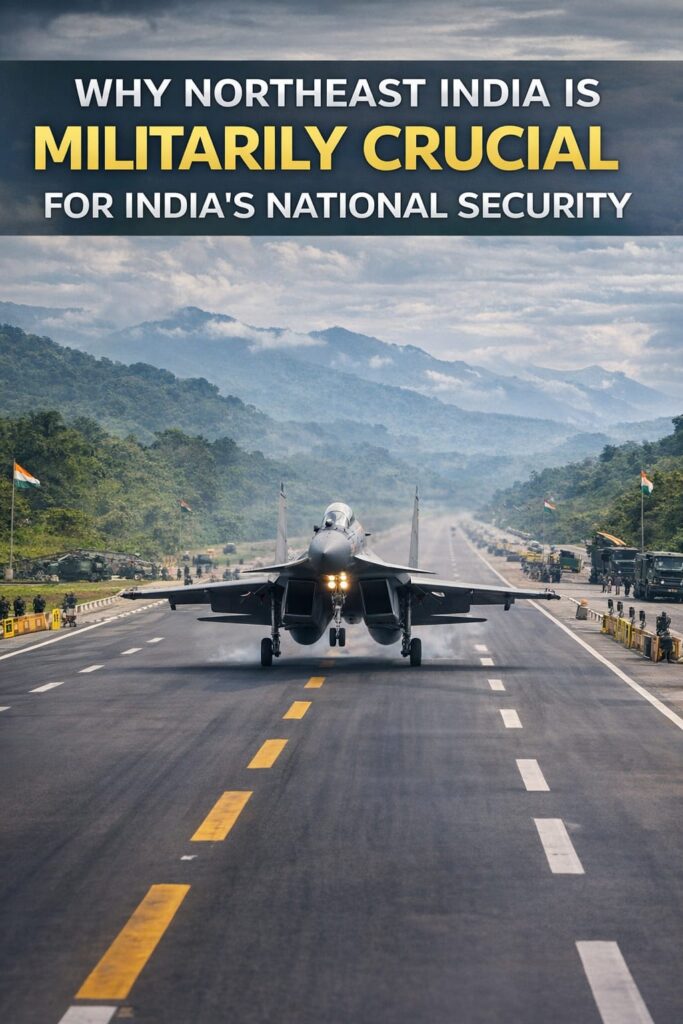
Modern warfare demands flexibility. Northeast India now hosts upgraded airbases, advanced radar coverage, and improved road networks. Highway emergency landing facilities and advanced airfields allow rapid force deployment during crises.
These developments enable:
- Faster troop movement
- Dispersed air operations
- Reduced vulnerability to enemy strikes
Infrastructure is no longer just economic development — it is military preparedness.
India’s growing focus on defence infrastructure, including highway emergency landing facilities, highlights the strategic importance of the region.
Gateway to Southeast Asia
Beyond defence, Northeast India is India’s bridge to Southeast Asia. Stability in the region strengthens India’s Act East Policy and counters external influence in neighbouring countries.
Security, diplomacy, and development intersect here. Neglecting one weakens the others.
Lessons from the Past
India’s earlier underinvestment in Northeast infrastructure limited operational flexibility. That lesson has been learned. Today’s emphasis on connectivity, surveillance, and preparedness reflects a long-overdue strategic correction.
Nations that ignore geography pay the price. Nations that master it secure their future.
Why Northeast India Will Define India’s Strategic Future
As global power competition intensifies, border regions gain importance. Northeast India is no exception. It will continue to influence India’s military planning, foreign policy, and regional balance of power.
The region is no longer a distant frontier — it is a decisive factor in India’s national security architecture.
According to India’s Ministry of Defence, infrastructure development in the Northeast has been prioritised to improve military mobility and preparedness.